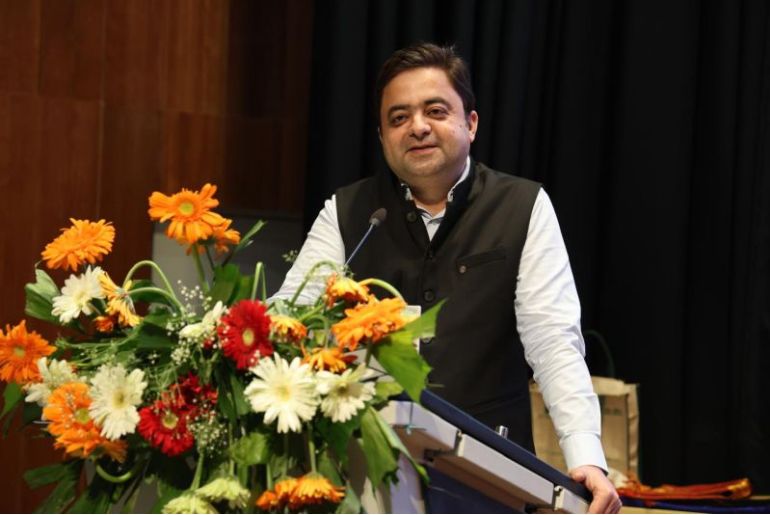
Director General of the National Institute of Solar Energy (NISE), Prof. Mohammad Rihan delivered a keynote on “𝐓𝐫𝐚𝐧𝐬𝐢𝐭𝐢𝐨𝐧𝐢𝐧𝐠 𝐭𝐨 𝐚 𝐋𝐨𝐰 𝐂𝐚𝐫𝐛𝐨𝐧 𝐒𝐨𝐥𝐚𝐫 𝐃𝐨𝐦𝐢𝐧𝐚𝐭𝐞𝐝 𝐈𝐧𝐝𝐢𝐚𝐧 𝐏𝐨𝐰𝐞𝐫 𝐆𝐫𝐢𝐝” at IIT Hyderabad during ICPS 2025, showcasing NISE’s pivotal role in India’s solar energy transformation.
During his address, Prof. Rihan outlined India’s pathway toward a low-carbon, resilient, and self-reliant power sector, emphasizing alignment with the country’s Panchamrit commitments and Nationally Determined Contributions (NDCs). He highlighted national initiatives designed to enhance climate resilience, promote energy independence, and ensure universal energy access across the country.
Prof. Rihan stressed the importance of tackling critical research challenges and leveraging emerging opportunities in the renewable energy sector.
“There is a need to focus on improving the performance of solar PV components and systems, advancing renewable energy forecasting, and developing efficient energy storage technologies,” he said.
He also emphasized the role of advanced grid management solutions in enabling high levels of renewable energy penetration in India’s power grid, highlighting their importance for a stable and sustainable energy future.
A significant point raised in the keynote was the evolving role of education in the energy sector. Prof. Rihan highlighted, “There is an urgent need to review and reorient Electrical Engineering education to align with the evolving requirements of the green energy transition and future power systems.” He noted that adapting educational curricula is essential for preparing the next generation of engineers, researchers, and policymakers to meet the challenges of a rapidly transforming energy landscape.
The keynote received strong engagement from researchers, policymakers, and industry professionals attending ICPS 2025, with many noting the depth of insights shared on India’s clean energy trajectory. Prof. Rihan’s address underscored the critical need for innovation, research, and policy alignment to accelerate India’s transition to a solar-dominated, low-carbon power sector.
His presentation provided a comprehensive roadmap for stakeholders, emphasizing that coordinated efforts across technology development, grid integration, and skill development are vital to realizing India’s ambitious renewable energy targets and ensuring a sustainable, self-reliant energy future.
 Electrify your feed! Click here to join our Whatsapp group and to get the latest updates, expert insights, and innovations driving India’s energy storage revolution.