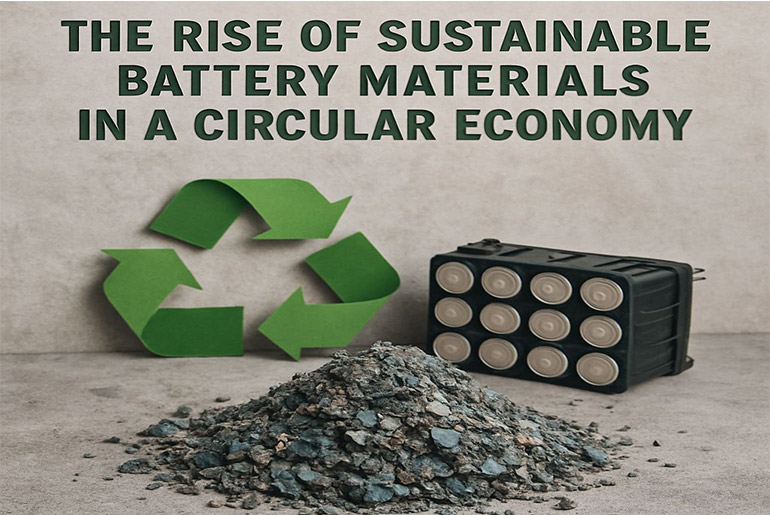
The global shift toward electrification is undeniable. From the rise of electric vehicles (EVs) to the large-scale adoption of renewable energy systems, we are witnessing an energy revolution. At the heart of this transition lies one powerful but limited component—batteries. For the past two decades, lithium-ion batteries have been the dominant technology powering our smartphones, laptops, electric cars, and increasingly, our homes and industries. Their efficiency, energy density, and relatively long life cycles have made them the battery of choice across the globe. However, as our appetite for electrification grows, so does the concern around sourcing raw materials, environmental impact, and battery waste. It’s time to look beyond lithium—not just in terms of alternative battery chemistries, but also in how we reuse and recycle the materials that have already been extracted. This shift is being fueled by the principles of the circular economy, where products are designed not just for performance but for end-of-life value as well.
Let’s take a deeper look into why recycling beyond lithium and embracing sustainable battery innovation is the next big thing in clean energy.
Lithium-Ion’s Dominance and the Growing Demand
Lithium-ion batteries currently power more than 90% of global EVs and dominate energy storage solutions worldwide. According to the International Energy Agency (IEA), global sales of electric vehicles reached a record 14 million in 2023 and were projected to hit 17 million in 2024. This growth directly translates to increased demand for lithium and other critical battery materials like nickel, cobalt, and manganese.
The World Bank has projected that the demand for lithium could increase more than fourfold by 2030 under a scenario aligned with limiting global warming to below 2°C. But lithium is not infinite—and its mining brings environmental challenges such as groundwater depletion, land degradation, and carbon emissions.
In India alone, the Central Pollution Control Board (CPCB) reported over 1.6 million tons of e-waste generated in 2021–22, with batteries contributing significantly to that figure. As energy storage scales, so will the waste—unless we make proactive changes.
The Circular Economy: Designing Waste Out of the Equation
The circular economy is a transformative approach that emphasizes keeping materials in use for as long as possible through reuse, refurbishment, remanufacturing, and recycling. It presents a strong alternative to the traditional linear economy of “take, make, dispose.”
In the battery sector, this means:
- Designing batteries with recycling in mind
- Recovering valuable materials efficiently
- Reducing dependence on virgin materials
- Building systems to support closed-loop manufacturing
This shift isn’t just good for the environment—it’s good business. The recycled battery materials market is forecasted to grow to USD 19.4 billion by 2030, driven by both industry innovation and regulatory pressure.
Governments around the world are waking up to this reality. In India, the Battery Waste Management Rules (2022) now require Extended Producer Responsibility (EPR), mandating battery manufacturers to collect and recycle used batteries. Similarly, the European Union’s Battery Regulation (2023) enforces minimum recovery rates, pushing battery producers to recycle at least 70% of lithium-ion battery weight by 2030.
Beyond Lithium: Alternative Materials Gaining Ground
While recycling lithium efficiently is crucial, forward-looking companies and researchers are also exploring alternative materials that are cheaper, safer, and more sustainable.
1. Sodium-Ion Batteries
- Sodium is far more abundant than lithium, making it cheaper and widely available.
- CATL, a global leader in battery manufacturing, has already launched sodium-ion battery prototypes aimed at electric vehicles and energy storage.
- UK-based Faradion, recently acquired by Reliance Industries, is developing sodium-ion tech suited for the Indian market, offering a promising low-cost solution.
2. Zinc-Air and Aluminum-Ion Batteries
- These alternatives also have safety, recyclability, and less toxicity.
- Zinc is stable, has no fire hazard and is generally abundant enough for grid storage.
- Aluminum-ion batteries are already being researched for their fast charging and sustainable processing.
3. Bio-Based Batteries
- Researchers are in the early stages of experimenting with wood-derived cellulose, silk proteins, and other natural materials to make disposable battery parts.
These replacements won’t challenge lithium-ion batteries in the next few months, but will serve as a great supplement and help lessen the burden on overall lithium demand.
Battery Recycling: Closing the Loop
One of the best potential solutions to the battery waste problem, is high efficiency recycling. A few companies across the globe are developing new business models and technologies to be able to recover materials from used batteries and reintegrate them into manufacturing.
Redwood Materials (USA)
- Founded by Tesla co-founder JB Straubel, Redwood Materials is a leader in sustainable battery recycling.
- They assert they can recover approximately 95% lithium, cobalt, nickel, and copper from used batteries.
- They have partnered with large auto manufacturers and are developing a closed loop supply chain.
Li-Cycle (Canada)
- with a unique spoke and hub model, Li-Cycle separates batteries at regional centers before processing materials centrally.
- They claim to have recovery rates between 80% and 100% for key battery metals.
Ace Green Recycling (India–USA)
- Ace Green has developed a non-smelting, fully electric recycling process, significantly reducing carbon emissions compared to traditional recycling methods.
- In partnership with ACME Metal Enterprise in Taiwan, Ace is now scaling its lead and lithium battery recycling operations.
- Their Grid Metallics Processing System (GMPS) is expected to process over 65 million pounds of lead batteries annually, enabling the creation of over 1 million new car batteries with recycled materials.
These companies not only have the solution for waste, but they’re also tackling environmental footprint and minimizing costs in battery manufacturing processes.
Industrial and Policy Trend
Governments and markets are moving quickly to join forces for a sustainable battery transition.
- In India, the FAME II scheme and PLI for ACC Battery Storage are incentivizing local battery manufacturing and recycling.
- Also, the EU Battery Passport releases to track the material and environmental footprint of each battery sold, which is expected by 2026.
- Global automakers, including but not limited to, Volkswagen, Tesla, and Hyundai, are investing in internal recycling functions and focusing on sustainable supply chain sourcing.
Increasing demand for more life cycle assessments, material traceability, and carbon footprint tracking olas are pushing to embed sustainability into every phase of the development cycle.
A Future Fueled by Regeneration
The battery of the future won’t just be powerful—it will regenerate. It will be designed for reuse, made from non-toxic or upcyclable materials, and made to join a circular economy that transforms yesterday’s waste into tomorrow’s energy.
Companies across the world—like Redwood Materials and Ace Green Recycling, as well as CATL, Faradion, and Li-Cycle—are showing us the shape of that future. They are demonstrating that innovation is not about extraction, but restoration.
As we prepare to live in a world run by batteries, let’s be sure that future is made from batteries that not only store energy, but also store conscience.
A Final Thought
The clean energy transition is no longer a technology challenge—it has become an ethical challenge. The materials we choose, the waste we create, and the resources we consume all carry weight.
Recycling beyond lithium is not a trend—it is a requirement for a sustainable planet. By embracing a circular economy and supporting companies leading the way in innovation and responsibility, we are moving closer to a future where batteries power us—rather than battle with the Earth.
 Electrify your feed! Click here to join our Whatsapp group and to get the latest updates, expert insights, and innovations driving India’s energy storage revolution.