

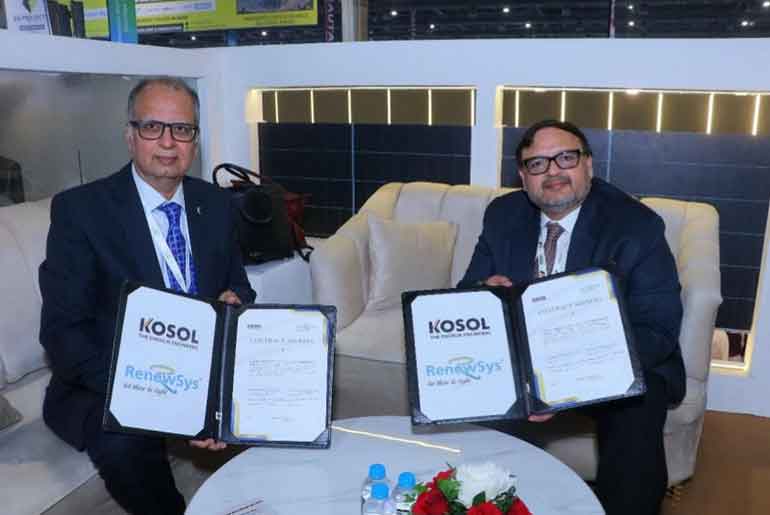
RenewSys India Pvt. Ltd. has signed a 1.2 GW supply agreement with Gujarat-based solar module manufacturer Kosol Energie Pvt. Ltd. for photovoltaic (PV) encapsulants and backsheets. Under the agreement, RenewSys will supply its CONSERV POE encapsulants and PRESERV backsheets to Kosol Energie over a 12-month period from October 2026 to September 2027.
The agreement expands the partnership between the two companies following the successful completion of a previous 1.1 GW POE encapsulant supply contract, which ran from December 2025 to September 2026. With the latest arrangement, Kosol Energie has expanded its sourcing from RenewSys to include two critical components used in solar module manufacturing.
The materials will support Kosol Energie’s production of high-efficiency n-type TOPCon solar modules, including its glass-to-backsheet product range, at its fully automated manufacturing facility in Gujarat.
RenewSys’ CONSERV POE encapsulants are UL-certified and designed for TOPCon solar cells. The products offer high volume resistivity, low water absorption and resistance to potential-induced degradation (PID), supporting module performance and durability.
The company’s PRESERV backsheets are engineered to provide moisture protection and electrical insulation, helping extend module life under demanding environmental conditions in India.
Avinash Hiranandani, Vice Chairman and Managing Director of RenewSys India Pvt. Ltd., said Kosol Energie’s decision to place a larger order and include backsheets reflects confidence in the company’s product quality and supply capabilities.
He added that India’s solar module manufacturers are transitioning towards TOPCon technology and expanding production capacities, increasing the need for component suppliers capable of meeting evolving technical and commercial requirements. The partnership also supports the development of a domestic solar manufacturing supply chain.
Kalpesh Kalthia, Chairman and Managing Director of Kosol Energie Pvt. Ltd., said RenewSys’ CONSERV POE encapsulants had delivered consistent quality and dependable supply across its production lines over the previous year.
He noted that adding PRESERV backsheets would enable Kosol Energie to source two essential module components from a single domestic supplier as it expands TOPCon manufacturing capacity. He also highlighted the importance of domestic partnerships in strengthening India’s solar manufacturing ecosystem.
The supply agreement comes amid India’s expanding solar module manufacturing capacity, supported by the Approved List of Models and Manufacturers (ALMM), the Production Linked Incentive (PLI) scheme and increasing demand across utility-scale, commercial and industrial (C&I), and rooftop solar segments.
Domestic sourcing of encapsulants and backsheets is becoming increasingly important for module manufacturers seeking to reduce import dependence, improve supply-chain reliability, shorten procurement lead times and maintain consistent product quality.
RenewSys is India’s integrated manufacturer of solar PV modules and key components, including encapsulants and backsheets. The company has a module manufacturing capacity of 5.6 GW, encapsulant capacity of 17 GW and backsheet capacity of 4 GW. Its 2.7 GW high-efficiency solar cell manufacturing line is under installation.
Headquartered in Mumbai, RenewSys is the renewable energy business of the ENPEE Group, which has a manufacturing legacy dating back to 1961.
Kosol Energie is an Indian solar PV module manufacturer, EPC contractor and solar solutions provider with operations across utility-scale and C&I projects. The company has executed 1 GW of projects across these segments and more than 10,000 rooftop installations nationwide. Its capabilities include PV module and component manufacturing, solar park development, battery energy storage systems, floating solar, ground-mounted projects and rooftop solutions.
The expanded agreement strengthens the relationship between the two companies while supporting India’s efforts to build a more self-reliant solar manufacturing ecosystem through domestic production and sourcing of critical module components.
 Electrify your feed! Click here to join our Whatsapp group and to get the latest updates, expert insights, and innovations driving India’s energy storage revolution.