In the rapidly evolving world of clean energy, one company has managed to turn a simple molecule—CO₂—into the backbone of a global storage revolution. Milan-headquartered Energy Dome, founded in 2020, has swiftly emerged as one of the most disruptive forces in long-duration energy storage. With its patented CO₂ Battery, the company has redefined what’s possible beyond lithium—offering a sustainable, scalable, and low-cost pathway to 24/7 renewable power.
At the heart of this transformation lies a leadership vision driven by Claudio Spadacini, Founder and CEO, and a team that has turned concept into commercialization in record time. From Europe to India, Energy Dome’s momentum is undeniable—marked by its strategic partnership with Google, and a landmark collaboration with NTPC for a 160 MWh CO₂ Battery project at Kudgi.
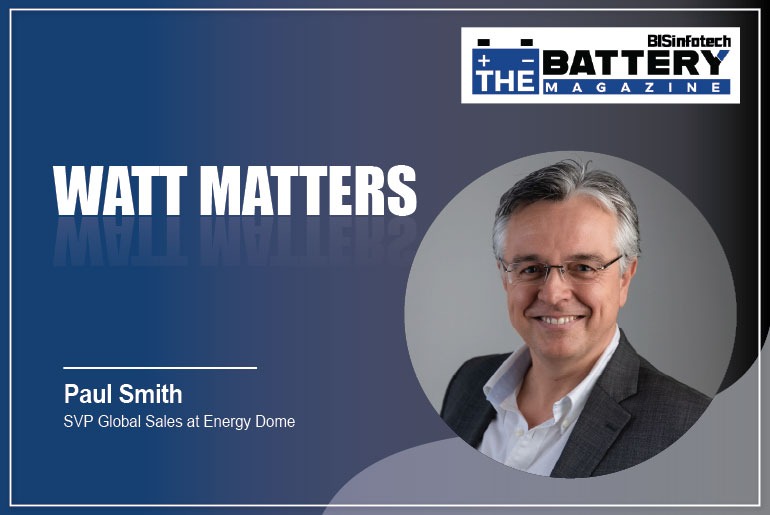
Shweta, Sub Editor at The Battery Magazine, had the opportunity to speak with Paul Smith, SVP Global Sales at Energy Dome, who highlighted how the company’s modular design, sustainable supply chain, and “Made-in-India” ambitions are redefining the very future of energy storage. Let’s delve into this exclusive conversation to explore how Energy Dome is engineering a cleaner, longer-lasting tomorrow.
To begin with, could you share Energy Dome’s journey from inception to where you stand today — and how your CEO and leadership have shaped the mission to revolutionize long-duration energy storage?
Energy Dome was founded in Milan, Italy in 2020 with the vision of solving one of the key challenges for the energy transition: large-scale long-duration energy storage to enable 24/7 clean power from intermittent renewables.
Under the leadership of our founder and CEO, Claudio Spadacini, the whole team is dedicated to bringing the benefits of our CO2 Battery technology to the global market. Even by the standards of the quickly developing renewables and energy storage industries, we have moved incredibly fast from concept to large-scale global deployment in just five years.
It’s a good question you ask about how the mission has been shaped: we have focused very strongly on developing a standardised, modular product design based entirely on well-proven industrial components. The standardisation allows us to replicate the same design, which enables rapid scale-up so that we can bring the technology to more customers quickly. The use of standard components means we can rely on an extremely diverse, established industrial supply chain so that we can deliver projects competitively, on time, anywhere in the world.
With NTPC’s 160 MWh CO₂ Battery deployment at the Kudgi plant now under way, what have been the primary technical and commercial lessons from initiating your first major project in India?
We’ve been very impressed with NTPC’s openness to innovation and commitment to actually doing things, not just talking. NTPC have great technical capabilities and organisational resources, which make them an ideal partner for our first project here in India.
Something else we already suspected, but now know from experience, is that there is tremendous depth of expertise and production capacity in the Indian industrial sector. We are now deeply engaged with many local manufacturers who are supplying components for the NTPC project, and we are confident that we will be able to leverage these and new supply chain relationships to deliver multiple large-scale projects.
Taking the Government’s “Make in India” policy a step further, we also look forward to building on India as a production base not only for domestic projects but also for the global market. We already see the first examples, for instance the electrical generator for our first commercial project was made in Bangalore!
Energy Dome has recently entered a strategic commercial partnership and investment agreement with Google, aiming to develop CO₂ Battery projects across Europe, the U.S., and Asia-Pacific. What makes this collaboration significant for your global scale-up ambitions?
Our partnership with Google is indeed a tremendous milestone: Google wants to run its operations on 24/7 carbon-free energy by 2030 and we’re thrilled to be working with them to achieve this goal.
Googe selected Energy Dome’s proven and market-ready CO2 Battery technology because it’s competitive and can be quickly deployed at the right scale. Google joining us as an investor is in itself a big vote of confidence, but perhaps more importantly, we are moving quickly on the commercial partnership with a pipeline of sites and projects in development and contracting stages.
Your technology contrasts strongly with lithium-ion systems in design and supply chain, using only steel, water and CO₂, and avoiding critical materials. How do you think this positions Energy Dome in terms of sustainability, resilience, and geopolitical risk?
These are all really key points. As you say, our CO2 Battery relies on common materials such as steel, water, and CO2 which can be easily sourced anywhere. There is no question of supply chain concentration to worry about, as there is for critical materials used in lithium-based batteries.
The CO2 Battery also leads the way on sustainability. The steel grades we use are already produced in India and many other countries, as well as being 100% recyclable at end-of-life. Although we have water in the plant, we don’t consume but simply use it in a closed loop system. So again, even in a very dry environment, the sustainability is there.
Another thing to think about is the life-time aspect and how this adds resilience to the energy system. As we all know, conventional batteries degrade while the CO2 Battery is much more like a pumped hydro energy storage plant – with 30, 40 years or longer life-time. With long-term energy system resilience in mind, it definitely makes sense to be investing in solutions which will operate reliably for several decades, versus something that will need to be replaced in a few years.
Taking these three issues of sustainability, resilience and geopolitical risk you can genuinely say that the CO2 Battery is a really effective, strategic enabler of energy security and industrial independence.
Grid forms and inertia are key stability services as renewable penetration increases. How does the mechanical turbomachinery architecture of your CO₂ Battery solution support grid reliability compared to inverter-based systems?
We have seen just a few months ago in Spain how the absence of the natural inertia provided by conventional power generators can lead to grid collapse with high renewables penetration. Unlike inverter-based BESS technology, the CO2 Battery uses standard synchronous electrical machines providing the same system benefits as a thermal power plant such as inertia and reactive power.
You recently received state approval for a 20 MW/200 MWh (10 hour) CO₂ Battery project in Wisconsin with Alliant Energy — the first in the U.S. What does this signify in terms of replicability of your Sardinia and Indian projects in new regions, and how do you envision the project pipeline evolving?
The project with Alliant Energy really does demonstrate the scale-up model through replication of a standard plant design. With just some minor adaptation for the 60Hz market, the fully engineered standard design enabled us to support Alliant through the project design and permitting stage – with great results and stakeholder support across the board.
We’ve already been awarded another (confidential) project in the United States and we are actively offering several GW of capacity following this rapid scale-up model.
From a policy and regulatory standpoint, what enabling frameworks or market signals do you think governments — particularly in India and Europe — need to provide to accelerate adoption of long duration storage like CO₂ Batteries?
Although electricity markets in Europe and India are very different, there are similar needs for enabling progressively higher levels of intermittent renewables on the grid.
Unfortunately, energy markets on their own do not currently provide strong enough price signals to encourage investment in long-duration (8+ hours) energy storage (LDES), so policymakers need to carefully consider how to encourage deployment, for example, through long-term contracts providing revenues to justify investment.
At the same time, Governments also need to consider how to remove obstacles and encourage the adoption of the most promising innovations, helping to level the playing field with incumbent technologies. By supporting innovation, we will be able to deliver together on the competitive, resilient and sustainable electricity sector which we owe to future generations.
Finally, looking ahead to 2030, what’s Energy Dome’s ‘moonshot’ ambition — be it technological breakthroughs, global deployment targets, or ecosystem impact — that you’d like to share with our readers?
Very simply, we aim to make the CO2 Battery the global market reference point for competitive, large-scale, long-duration energy storage applications.
By 2030 – based on projects under execution and in development – we already know that we will have a large fleet of projects in successful operation, and similarly, based on the huge interest we know that the market demand is there.
Particularly for India, we are making the country central to our growth story. We embrace the fact that India is a price-sensitive market since we know that this will drive our competitiveness globally.
For our next projects in India, we will be working closely with Indian partners and suppliers to deliver a fully local CO2 Battery product. By 2030 these first “made in India” projects will be operational, becoming a template for executing on the GW’s of energy storage we know that the market needs.
 Electrify your feed! Click here to join our Whatsapp group and to get the latest updates, expert insights, and innovations driving India’s energy storage revolution.