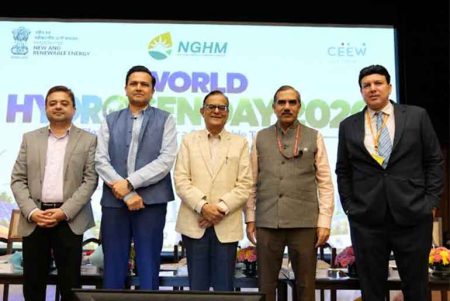
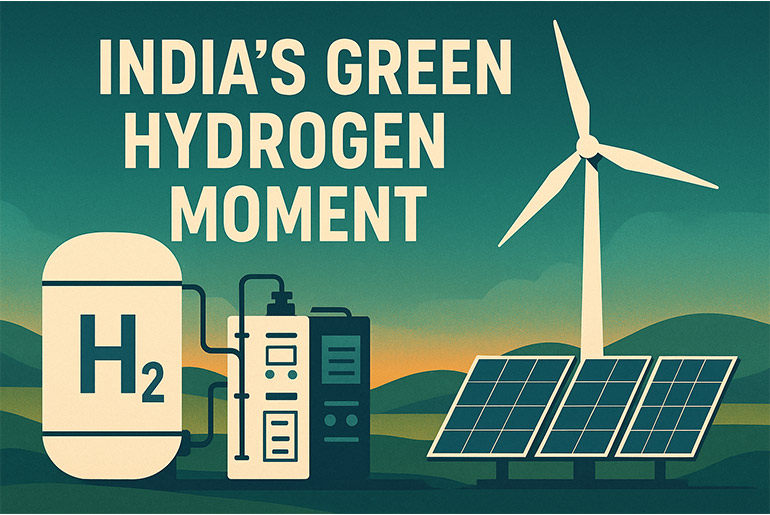
India’s Green Hydrogen Mission has the country poised on a transformative cusp. The government’s plan – branded the National Green Hydrogen Mission (NGHM) – aims to make India a “global hub” for clean hydrogen production, usage and export. Formally launched in January 2023, it targets around 5 million tonnes (Mt) of green H₂ per year by 2030 (scalable to 10 Mt as export markets develop). This bold push is backed by roughly ₹19,744 crore (~US$2.4 billion) in public funding through 2030. If it succeeds, India could decarbonise deep-pocket industries – from steel and fertilizers to refining and shipping – and cut huge fossil fuel imports. But getting there means slashing current green-H₂ costs and building whole new supply chains. Below we unpack the NGHM’s incentives, the industries set to benefit, and the remaining gaps for scale-up.
Mission Objectives and Incentive Framework
The heart of India’s Green Hydrogen Mission is the Strategic Interventions for Green Hydrogen Transition (SIGHT) programme – a PLI-style scheme with ~₹17,490 crore (US$2.3 b) outlay. Under SIGHT, ~₹4,440 crore is earmarked to subsidise domestic manufacturing of electrolyzers, and ~₹13,050 crore to incentivise green-H₂ production. In practice this means competitive bids where approved projects get viability-gap support for each kg of green H₂ (and preferential treatment for home-made equipment). According to official sources, the aim is to “reduce the cost of Green Hydrogen, enabling its uptake in emerging sectors and [to] establish a domestic manufacturing ecosystem” by de-risking first movers. Beyond cash subsidies, the mission creates a favourable policy framework. All renewable power used for green H₂ up to 2030 will skip interstate transmission charges for 25 year – a huge saving, since fees can otherwise more than double power costs in some states. Renewable energy banking will be enabled, and projects get fast-tracked open access and grid-connection permissions. Other incentives include simplified procedures (single-window clearances), tax breaks and SEZ support for hydrogen plants. Notably, green H₂ and green ammonia facilities are exempt from environmental clearance, shaving months off project timelines. All these steps – plus plans for hydrogen pipelines and export corridors – are meant to build investor confidence.
In total, the mission anticipates allocating US$2.4 billion by 2030: roughly $2.1 b for SIGHT (electrolyzers + production), plus $176 m for pilot/demo projects and about $48 m for R&D (For context, India’s initial green-H₂ target is 5 Mt/yr by 2030– almost double today’s total hydrogen demand – implying that roughly half of India’s H₂ would be “green” within a decade.) The government also plans to mandate a growing share of green H₂ use by heavy industries, and will procure hydrogen via auctions to jump-start demand. An empowered task force of top officials and industry experts is overseeing this rollout.
Industry Winners and Emerging Markets
The mission is a clear signal to certain sectors: Electrolyzer and equipment makers, renewable power developers, and hydrogen end-users all stand to gain. Companies that build electrolysers (especially PEM and alkaline types) should see a surge in demand. The ₹4,440 Cr electrolyzer subsidy pool – effectively a Production-Linked Incentive – is designed to attract global and domestic manufacturers. Analysts expect India’s electrolyzer market to be ~$5 b by 2030 (growing to ~$31 b by 2050). With that promise, international players (and local conglomerates) are lining up joint ventures and factory investments.
For renewable energy companies, the mission creates a powerful buyer for solar and wind power. India’s abundant sun and wind (especially in Rajasthan, Gujarat, Tamil Nadu and coastal areas) can be tapped for dedicated renewable farms. Indeed, RMI finds that on-site solar costs in green-hydrogen projects can be as low as ₹2.1/kWh today (dropping to ₹1.5 by 2030). By waiving grid charges, states like Odisha are making off-site solar even cheaper – one study notes Odisha’s extra ₹3/kWh waiver could cut landed power costs by up to 90%. Such incentives mean power generators can sell electricity to electrolyzer projects at rock-bottom prices. Overall, stand-alone green-H₂ projects already achieve costs of ~$4.4–4.8/kg, and subsidies (both national and state) can trim another 20–30%.
Heavy industries form the core demand sector. Ammonia and fertilizer producers will use green H₂ to decarbonize. The Mission explicitly mentions “green ammonia” for fertilizers and chemical feedstock as target sub-sectors. For example, IFFCO and other fertilizer majors plan green ammonia plants powered by renewables. In steelmaking, green hydrogen can replace coking coal via direct reduced iron (DRI) furnaces. India’s largest steelmakers (Tata Steel, JSW, etc.) are exploring pilot DRI plants with hydrogen. The government has already set aside ₹455 Cr for low-carbon steel demos and ₹115 Cr for hydrogen storage R&D.
Oil & gas refiners and utilities are also on notice. Refining is the single largest hydrogen consumer, and green H₂ can clean up fuel production. State refiners like BPCL and HPCL have announced electrolyzer projects at refineries (e.g. 5 MW projects in Madhya Pradesh and Chennai). City gas distributors are planning hydrogen blending into CNG pipelines and gas grids. Even Indian Railways and fleet operators are trialing hydrogen buses and trucks (the NGHM has a ₹496 Cr allocation for mobility pilots).
Beyond domestic needs, export-oriented hubs will emerge. India aims to be a major exporter of green ammonia and synthetic fuels. Several “hydrogen hubs” are planned near ports (e.g. in Gujarat and Andhra) to produce hydrogen and ammonia for export to Europe and East Asia. The Mission identifies at least two such hubs initially, and €3 billion export markets loom. For investors and manufacturers, this means opportunities in port infrastructure, electrolyzer logistics, and ship/rail refueling stations.
In short, “who wins” under India’s Green Hydrogen Mission includes:
- Electrolyzer makers and component suppliers (earning PLI subsidies and guaranteed market).
- Renewable energy developers (with new captive power off-take and waived grid fees).
- Fertilizer and chemical companies (shifting to green ammonia feedstock).
- Steel producers (using hydrogen for DRI).
- Oil refiners and CNG operators (adopting hydrogen blending in fuels).
- Transport and mobility firms (fuel cells for trucks, buses, ships benefitting from pilot support).
- Infrastructure players (pipeline builders, storage tank makers, fueling station companies).
- Research institutions and innovators, who can tap the new ₹48 Cr R&D fund and public–private SHIP (Strategic Hydrogen Innovation Partnership) program.
Indeed, private sector interest is surging. RMI notes that Indian industry has already announced projects totaling ~12 Mt per year of end-use capacity (ammonia, methanol, exports, etc.), roughly 20 GW of electrolyzer capacity. Approved projects so far top $2 billion in investments, with another ~$12 billion on the way. Major conglomerates (Adani, Reliance, Tata, JSW, ACME, etc.) are racing to stake claims. In parallel, over 15 states have issued their own green-H₂ policies and waivers, making India’s policy landscape a patchwork – but one that largely favors green hydrogen development.
Major Incentives at a Glance
- SIGHT Fund (₹17,490 Cr): ₹4,440 Cr for electrolyser manufacturing + ₹13,050 Cr for green-H₂ production.
- Transmission Charge Waiver: 25-year waiver of interstate transmission charges for RE powering green H₂/ammonia projects (projects commissioned by 2030).
- Renewable Energy Banking & Open Access: Free banking of RE and priority open-access approvals to ensure stable power supply.
- Regulatory Relief: Exemption from environmental clearance for H₂/ammonia plants, simplified permitting and a single-window interface.
- Fiscal & Tax Incentives: Potential tax breaks, SEZ benefits and duties relief (details to be announced) to lower project costs.
- Pilot and Hub Funding: Dedicated funds for green steel (₹455 Cr), hydrogen transport (₹496 Cr for mobility, ₹115 Cr for shipping) and development of special Hydrogen Economic Zones.
Together, these measures can dramatically improve economics. For example, one study shows that transmission waivers and state subsidies can cut renewable power costs for green H₂ by over 90% in places like Odisha, making on-site hydrogen cost-competitive. In Gujarat and Maharashtra, on-site solar is already ~₹2.1/kWh ($0.026) and projected to fall to ₹1.5 by 2030 – levels at which green H₂ ($4–5/kg) approaches grey hydrogen prices. The policy push in India mirrors global moves: world governments plan trillions for hydrogen. The Hydrogen Council estimates $300+ billion will be invested worldwide in green hydrogen by 2030 (with countries like the US and EU launching multi-billion-dollar incentives). India’s ₹2.3 billion (US$) mission is a fraction of this, but it could spark a domestic boom if well-implemented.
Gaps and Challenges Ahead
Despite the fanfare, challenges remain before India’s green hydrogen moment can truly arrive. The biggest is cost competitiveness. Even with subsidies, green hydrogen today costs roughly $4–6/kg, whereas conventional (grey) hydrogen is ~$1–3/kg. Analysts say off-site (grid-connected) green-H₂ costs must fall ~50% to compete. This will require both scale (manufacturing electrolyzers by the gigawatt) and cheaper renewables. While India’s solar/wind costs are low, especially in Rajasthan or Gujarat, other states face high grid charges. RMI found that without waivers, transmission fees could more than double power costs. If states withdraw their incentives, long-term prices could rebound.
Infrastructure is nascent. There are virtually no hydrogen pipelines in India yet – transport relies on compressed liquid tankers. Building a dedicated hydrogen grid (or repurposing natural gas pipelines) will take years. Similarly, large-scale storage (for seasonal surplus power) is unproven. The Mission mentions hydrogen hubs and pilot storage technologies, but substantial private capital is needed. Investors in distribution (tankers, fueling stations) will watch policy signals closely.
- Technology limits: Electrolyzer manufacturing still relies on imported components and catalysts (like platinum). India has little domestic supply chain for high-end electrolysers, so the ₹4,440 Cr push is partly to build this ecosystem. But local R&D must accelerate – the Mission’s SHIP program (with industry co-funding) is a step. Likewise, fuel-cell technology and hydrogen-compatible equipment (turbines, burners, engines) are at early stages. Research on catalysts, membranes and storage materials will be crucial.
- Water and land constraints: Producing 5 Mt of H₂/year demands ~2.9 billion cubic meters of water (assuming 18 L/kg H₂). This could stress water supplies unless seawater desalination is used, adding cost. Also, gigawatts of solar or wind plus electrolysers require land and high capital outlay. Strategic site selection (next to coasts, rivers, or deserts) can help, but environmental and social clearances (beyond the plant itself) could pose hurdles.
- Demand uncertainty: For hydrogen to roll out, buyers must materialize. The Mission’s plan to set consumption quotas for industry (e.g. “designated consumers” using a rising fraction of green H₂) is not yet detailed. Without firm offtake commitments, many projects may stall. (Investors worry: will utilities or fertilizer co-ops buy hydrogen at a premium, or will global markets develop quickly enough?) Certification schemes and tracking (like India’s planned “certification framework”) may help reassure consumers about purity.
The Road Ahead: Global Context and Future Outlook
India’s green hydrogen push is part of a global race. Presently the world consumes ~97 Mt of hydrogen annually (mostly grey), with low-carbon production under 1 Mt. But demand for clean hydrogen is projected to explode under net-zero scenarios. In the next five years, global electrolyzer capacity with investment approvals has surged to 20 GW (from ~1 GW in 2023). Countries like China are racing ahead in electrolyzer manufacturing (9 GW in late-stage development), while the US and EU pour funds into hydrogen credit programs and auctions. India’s £2.3b (~₹19,744 Cr) plan is modest by comparison, but it may catalyze domestic industry similarly to India’s past solar boom (where subsidies spurred 50 GW of capacity).
Critically, India’s mission acknowledges that hydrogen is not just fuel but a feedstock. The focus on green ammonia (for fertilizers) and green steel (for heavy industry) mirrors global strategies: the OECD notes the NGHM aims at decarbonising “ammonia production, petroleum refining, steel production, and the mobility sector”. India also hopes to become a price-setter. As one Ministry statement puts it, the mission will help India “assume technology and market leadership in Green Hydrogen”.
On the R&D front, the government has created a Strategic Hydrogen Innovation Partnership (SHIP) fund. This will pool industry and government funding for targeted research – for example, advanced electrolyzer designs (like solid oxide) or hydrogen storage materials. Leading labs (IITs, CSIR, national labs) are gearing up hydrogen programs, often partnering with foreign researchers. International collaborations (with Australia, Japan, EU, etc.) are also in motion to transfer best practices and technologies.
For investors and manufacturers, the takeaway is that capital-intensive ventures now have a clearer tailwind. Manufacturing electrolyzer stacks, building gigawatt-scale PV/wind projects paired with electrolysis, or developing hydrogen-fueled steel plants all move from speculation to viable business under NGHM’s umbrella. However, prudent investors will track policy details – e.g. how fast subsidies are disbursed, how “designated consumers” quotas are set, and whether state governments maintain power waivers. The Mission’s success depends on coherent follow-through: shrinking the 2–3x price gap with grey hydrogen, building pipelines and refueling networks, and creating real demand sinks. If done, India could not only meet a large portion of its own hydrogen needs domestically, but also export green fuels to industrial economies.
In summary, India’s Green Hydrogen Mission signals a golden opportunity – a bold bet that the country can harness its renewable riches to drive an industrial leap. The incentives laid out are substantial and multi-faceted, and the early response from industry is enthusiastic. Yet turning the vision into reality will require navigating high costs and nascent infrastructure. In the words of MNRE, the mission will “lead to significant decarbonisation of the economy, reduced dependence on fossil fuel imports” – if India can make every kilogram of green hydrogen count.
 Electrify your feed! Click here to join our Whatsapp group and to get the latest updates, expert insights, and innovations driving India’s energy storage revolution.