Researchers at Tokyo University of Science (TUS) have identified two scandium-based approaches that could significantly improve the durability and performance of sodium-ion batteries (SIBs), offering new design strategies for developing longer-lasting energy-storage technologies. The study examined how scandium (Sc³⁺) doping and surface coating affect the structure and electrochemical properties of a promising sodium-ion battery cathode material.
Sodium-ion batteries are gaining attention as an alternative to lithium-ion batteries because sodium is considerably more abundant than lithium. The technology can also offer advantages in cost, safety and low-temperature performance, with sodium-ion batteries already being commercialised for applications including portable electronics and electric vehicles.
The research team, led by Professor Shinichi Komaba and Associate Professor Shinichi Kumakura of TUS, investigated the O3 polytype of Na[Ni₁/₂Mn₁/₂]O₂ (NNMO), a promising cathode material that offers relatively high reversible capacity but suffers from severe capacity fading caused by large structural volume changes during charging and discharging.
Scandium Improves Capacity Retention
The researchers prepared scandium-doped NNMO samples, referred to as NNMSOx, and also developed scandium-coated NNMO particles through a wet-processing method followed by annealing.
Electrochemical testing showed a substantial improvement in cycling durability. After 100 cycles, capacity retention increased from just 18.6% for undoped NNMO to 67.8% for NNMSO8 and 75.4% for NNMO-SC800. The researchers attributed the improvement to reduced side reactions and greater structural stability.
The two approaches, however, work through different mechanisms.
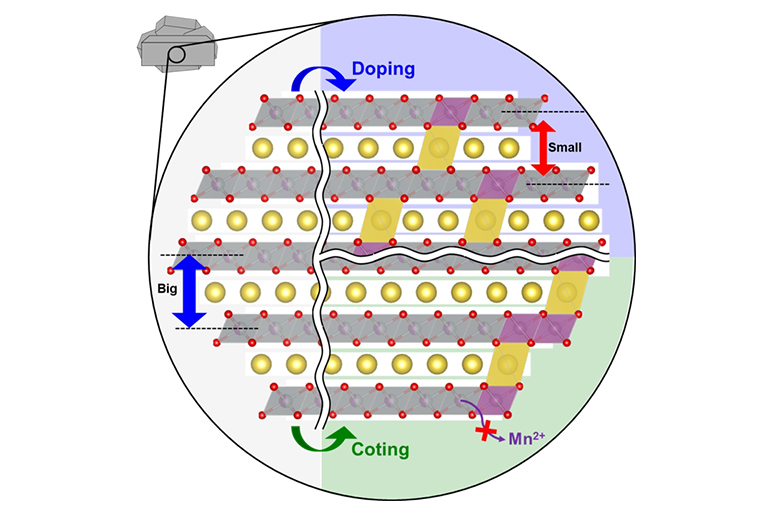
With Sc³⁺ doping, scandium becomes incorporated into the crystal structure and helps stabilise the bulk phase. The researchers found that the doped material also showed a smoother charging and discharging profile because scandium substitution suppresses Na⁺/vacancy ordering.
In contrast, scandium coating primarily acts at the particle surface. The coating forms an O3-NaScO₂-like phase, creating a protective layer that suppresses interfacial side reactions without substantially changing the bulk structure.
Full-Cell Testing Shows Stronger Long-Term Performance
The researchers also tested sodium-ion full cells using the modified cathodes with hard carbon anodes.
After 300 cycles, the full cell using NNMSO8 retained 71.4% of its initial capacity, while the cell using NNMO-SC800 retained 91.2%. Both modified materials also demonstrated improved rate capability.
The study found that neither approach completely eliminates degradation. Coating improves cycling stability but does not prevent loss of crystallinity during long-term cycling, while doping suppresses bulk degradation but does not fully prevent capacity fading.
Combination Could Offer a Stronger Strategy
The researchers believe that combining the two approaches could provide a more comprehensive solution by addressing degradation both inside the electrode structure and at its surface.
“Our findings show that a synergistic combination of bulk doping and surface coating is a promising strategy to improve performance of SIBs,” notes Prof. Komaba. “This will help extend the lifespan of SIBs and consequently widen their practical application.”
However, the researchers noted that scandium’s cost and availability could limit its direct commercial use. The next step will therefore be to apply the underlying insights to more abundant and cost-effective elements that could be suitable for commercial-scale sodium-ion battery production.
The research was published in the journal Small under the title “Scandium doping and coating for improving O3-NaNi1/2Mn1/2O2 electrode in sodium battery.”
The findings provide new material-design principles for improving sodium-ion battery lifespan, cycling stability and performance, potentially supporting wider adoption of sodium-ion technology in future energy-storage applications.
The study points towards a promising pathway for longer-lasting sodium-ion batteries, with the researchers now looking beyond scandium towards more abundant and commercially viable elements that could translate these material-level findings into scalable battery technologies.
 Electrify your feed! Click here to join our Whatsapp group and to get the latest updates, expert insights, and innovations driving India’s energy storage revolution.