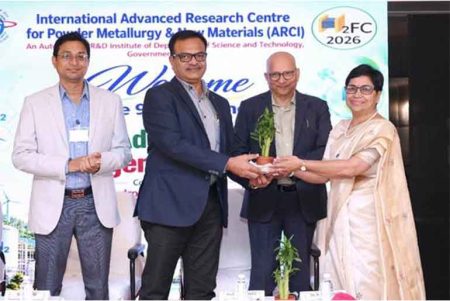
NITI Aayog’s Frontier Tech Hub released the Data Centre Evaluation Framework on 14 October 2026 to help states plan the sustainable growth of data centres. The launch was attended by Prof. Abhay Karandikar, Member, NITI Aayog; Anurag Jain, CEO, NITI Aayog; Debjani Ghosh, Distinguished Fellow, NITI Aayog; representatives from the Ministry of Power, MeitY and DPIIT, along with industry and media representatives.
The Framework, developed with inputs from industry, MeitY, Ministry of Power and DPIIT, provides State governments with a practical approach to planning, evaluating and facilitating data-centre investments. It helps them assess infrastructure readiness, safeguard critical resources and maximise long-term economic and strategic value.
India’s data-centre capacity has grown from about 375 MW in 2020 to approximately 1.5 GW currently, driven by the growing demand for Artificial Intelligence (AI), cloud computing, high-performance computing and data-intensive digital applications.
As India accelerates its AI and digital transformation, data centres are emerging as critical infrastructure underpinning the country’s technological and economic ambitions. While this presents a significant opportunity, data centres at increasing scale also place substantial demands on electricity, water, land, connectivity and local infrastructure. The focus therefore needs to move beyond attracting investment to ensuring that projects are developed in locations where the necessary infrastructure and resources can support them over the long term.
The Government of India has taken important steps to create an enabling environment for data-centre investments, including a tax holiday until 2047 for eligible foreign cloud service providers leveraging India-based data-centre infrastructure. As investments grow in scale, effective State-level planning and investment readiness will be critical to ensuring sustainable growth of the sector.
Speaking on the occasion, Prof. Abhay Karandikar, Member, NITI Aayog, highlighted the opportunity to leverage data-centre investments to build India’s technological capabilities. He emphasised the need to strengthen domestic R&D, industry–academia collaboration and Indian participation across the data-centre technology value chain. He also underscored the potential for India to develop innovative solutions in advanced cooling, energy efficiency and resource-efficient computing, converting infrastructure investments into long-term economic and technological value.
Anurag Jain, CEO, NITI Aayog, highlighted the need to move beyond investment attraction towards investment readiness. He emphasised that States need to assess infrastructure availability, resource requirements and economic benefits before committing support to data-centre projects. The Framework provides a structured approach to help States make informed decisions, anticipate constraints and facilitate faster, more predictable project execution without creating an additional layer of regulation.
Debjani Ghosh, Distinguished Fellow, NITI Aayog, highlighted, “As AI reshapes the global economy, data centres are becoming critical strategic infrastructure. For India, the opportunity is not simply to attract investment, but to build sustainable capacity that strengthens our competitiveness and delivers lasting economic value. This framework will help states make smarter decisions – identifying the right locations, planning infrastructure ahead of demand and ensuring that every investment creates measurable public value.”
A Framework for Investment-Ready and Sustainable Data Centre Growth
The Framework is structured around five pillars: Power and Energy; Water and Cooling; Siting and Environmental Sustainability; Economic and Strategic Value; and Policy, Governance and Implementation.
To ensure resource sustainability, key recommendations include assessing grid readiness and net grid draw, promoting renewable energy and storage-backed power, and evaluating basin-level water stress and public-supply impacts. The Framework also calls for rainwater harvesting, on-site water treatment and storage, and lifecycle plans for e-waste, batteries and other hazardous waste.
To maximise economic value, the Framework recommends identifying suitable data-centre zones, distinguishing colocation from active compute services, linking State incentives to measurable outcomes, and promoting Make in India across IT and non-IT infrastructure. These measures are supported by time-bound approvals, clear accountability and monitoring of project commitments.
The Framework is intended to serve as a decision-support tool for State governments, enabling them to evaluate investment proposals against infrastructure availability, environmental sustainability, economic value and implementation readiness. By identifying potential constraints early and providing greater clarity on project requirements, it seeks to improve investment decisions, reduce implementation risks and facilitate sustainable growth of India’s data-centre ecosystem.
The Framework seeks to help States plan better, move faster and convert the next wave of data-centre investment into sustainable capacity and lasting economic value.
 Electrify your feed! Click here to join our Whatsapp group and to get the latest updates, expert insights, and innovations driving India’s energy storage revolution.