
As India progresses toward an electrified and sustainable future, Smart Home Energy Storage Management is emerging as a critical tool for energy efficiency and grid resilience. Intelligent battery systems are changing how homes individually and collectively consume, store, and share energy – from the home to the neighborhood. With solar rooftops, smart meters, and IoT-enabled devices becoming more common, the next frontier is not just storing energy—but managing it intelligently.
The Progression of Smart Energy Storage
Historically, home batteries were considered backup equipment for outage resiliency. Now, Smart Home Energy Storage Management completely reinvents their role. These systems bring together AI, IoT, and data analytics to seamlessly manage generation, consumption, and grid interaction educationally. The outcome is a dynamic energy landscape where energy flows a lot more intelligently, optimized for cost and carbon emissions.
In 2025, with India’s renewable energy generation capacity exceeding 180 GW, the residential sector has emerged as a key player in grid stability. Residential energy storage systems (ESSs) provide the means for homes to take power off the grid during off hours, store it and sell it back when the time is right, all under net metering policies.
The Function of Smart Home Energy Storage Management
At its core, Smart Home Energy Storage Management consists of three prisms: storage technology, data intelligence and grid connection.
- Storage Technology: Lithium-ion is continuing to surge ahead in the race for renewable energy storage technologies, despite new technologies such as solid-state and hybrid chemistries coming into play. The energy storage is made to be light, safe, and long-lasting, which is why it is great for smart home energy storage management.
- Data Intelligence: Algorithms built in ‘AI algorithms’, analyze consumption at homes, weather conditions and prices of electricity from the grid to propose an ideal charge-discharge cycle.
- Connectivity: Via IoT-based energy management systems (HEMS), smart batteries communicate with solar panels, EV chargers, and devices to seamlessly exchange and flow energy data.
This ultimately means households can optimize their self-consumption and minimize reliance on the central grid.
Technologies That Enable Smart Home Energy Storage Management
A number of next-generation technologies are key to Smart Home Energy Storage Management:
- AI and Predictive Analytics: Predictive models enable energy generation (from rooftop solar) and energy consumption forecasting to add energy resilience.
- Intelligent Inverters: Intelligent inverters provide bidirectional energy flow, allowing homes to function, in part, as microgrids that both consume or receive energy and provide energy.
- Internet of Things (IoT) and Cloud Platforms: Connected Sensors can monitor real-time performance, battery health, and temperature, to support preventative maintenance and remote optimization.
- Vehicle-to-Grid (V2G) Technology: With increased demand for EV adoption, vehicles can now use their reserve energy as mobile energy units that can interface with the home and the grid to balance loads.
Taken together, these technologies help make the ideas of Smart Home Energy Storage Management more efficient and effective.
Market Growth of Residential Energy Storage in India (2023-2033)
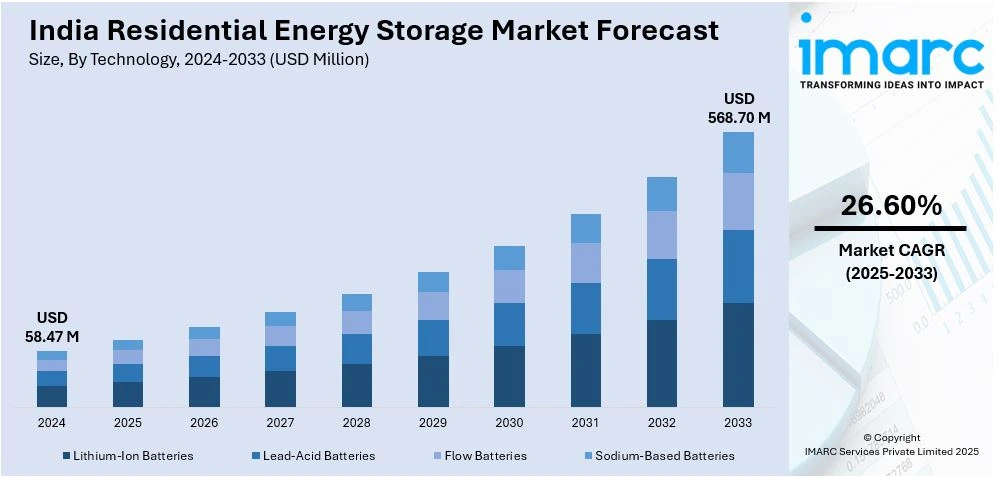
As stated by IMARC Group (2024), the value of the residential energy storage market in India was USD 58.47 million in 2024 and will grow at a projected CAGR of nearly 28% (2024-2033) for a total market size of USD 568.70 million in 2033. This trend reflects a faster pace of adoption of Smart Home Energy Storage Management systems in India due to the proliferation of rooftop solar systems, the integration of smart meters, and declining costs of lithium-ion based batteries.
India’s Market Landscape: Growth and Progress
India is rapidly advancing toward smart energy ecosystems. Industry estimates show the Indian smart home energy storage (ESS) market is anticipated to rise from USD 0.4 billion in 2023 to USD 4.7 billion by 2030, with A CAGR of almost 40%.
Multiple factors are contributing to this growth:
- Government initiatives: The National Energy Storage Mission and Solar Roooftop Programme Phase-II are examples of policies and incentives that have encouraged adoption.
- Decreasing battery prices: Lithium-ion battery prices have fallen by more than 85% in the last ten years, allowing consumer energy storage systems to be more feasible.
- Rollouts of smart metering: As DISCOMs roll out advanced metering infrastructure (AMI), users will consistently be able to see energy flow in real-time.
- Rising demand for backup: With frequent power fluctuations in Tier-2 and Tier-3 cities, consumers seek reliable, smart alternatives.
Case Studies: Global to Indian Examples
Tesla Powerwall (Global Benchmark):
Powerwall 3 from Tesla includes AI-driven management to assist homeowners with maximizing their usage of solar energy and independence from the grid. Users in California reported they achieved a reduction of as much as 60% in their reliance on the grid.
Tata Power Solar + Storage (India):
Tata Power has launched pilot design projects in various locations in Maharashtra and Delhi NCR where rooftop solar is combined with lithium-ion batteries. These battery storage systems utilize Smart Home Energy Storage Management to monitor their load patterns and have reported households reductions of energy costs between 20-30%.
SunSource Energy Community Projects:
In Uttar Pradesh and Rajasthan, solar and storage microgrids are being tested for 24/7 clean energy for residential communities. The Smart management integrates power, offering the ability to share power from one home to the other, to create decentralized power in communities.
The advantages of Smart Home Energy Storage Management:
Energy Independence: Homes are independent in generating, storing, and managing their power.
- Peak Load Management: Systems can discharge batteries during extreme load, reducing strain on the national grid.
- Cost Savings: AI scheduling ensures power is stored when rates are low and consumed when high.
- Sustainability: Maximizes solar utilization, reducing carbon emissions.
- Grid Resilience: Distributed storage systems support grid stability during outages.
These benefits make Smart Home Energy Storage Management a cornerstone of India’s clean energy vision.
Challenges to Overcome
While there is potential for growth, there are a number of challenges:
- High upfront costs: The costs for residential ESS installations are high, even with subsidies.
- Battery disposal: The end-of-life management and recycling infrastructure is evolving.
- Integration challenges: There are currently no interoperability standards among devices.
- Consumer awareness: Many customers don’t know about any smart functionality beyond backup.
Industry experts feel that if these challenges are addressed with a combination policy incentives, research and development funding, and standardization, adoption niches will improve.
Insights and Future Directions for Research
Recent research suggests that residential storage systems in India could reach up to 15 GW of flexible capacity by 2030, according to NITI Aayog and the IESA. This could increase even further with the use of Smart Home Energy Storage Management that is AI-driven—potentially providing a 25-30% increase in efficiency.
Future directions include:
- AI-based Predictive Maintenance: A system that forecasts the degradation of its components for improved battery life.
- Blockchain-based Energy Trading: Allowing residences to engage in peer-to-peer trading of electricity.
- Integration with Smart Grids: Prosumer-DISCOM dynamic interactions for load balancing.
- Second-life EV batteries: Enable used EV batteries to aid in the home energy storage system—reducing cost of the storage system and decreasing waste.
The combination of renewable generation, AI, and digital energy management can help establish the next phase of innovation in the energy sector in India.
Final Thoughts
Smart Home Energy Storage Management is more than a technological advancement. It is a new attitude towards energy consumption in India. Through the evolution of policies and decreasing costs, solar, AI, and sophisticated storage will offer the opportunity for Indian households to control their energy future.
The homes of tomorrow will not be just consumers of energy, they will generate, store and optimize energy use, providing India with a decentralized, sustainable, self-reliant energy future.
 Electrify your feed! Click here to join our Whatsapp group and to get the latest updates, expert insights, and innovations driving India’s energy storage revolution.