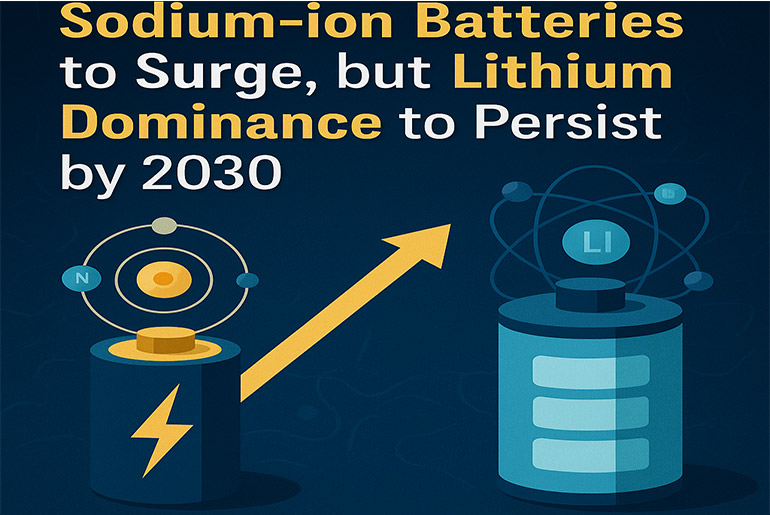
The global battery industry is standing at the edge of a quiet transformation — not a revolution led by lithium, but an uprising driven by sodium. A new report from International Renewable Energy Agency sends a clear message to the energy world: sodium-ion batteries are no longer just a laboratory curiosity. They are entering real markets, powering vehicles, stabilizing grids, and attracting investor attention. And yet, for all the excitement, the verdict is firm — sodium will not dethrone lithium by 2030. It will walk beside it.
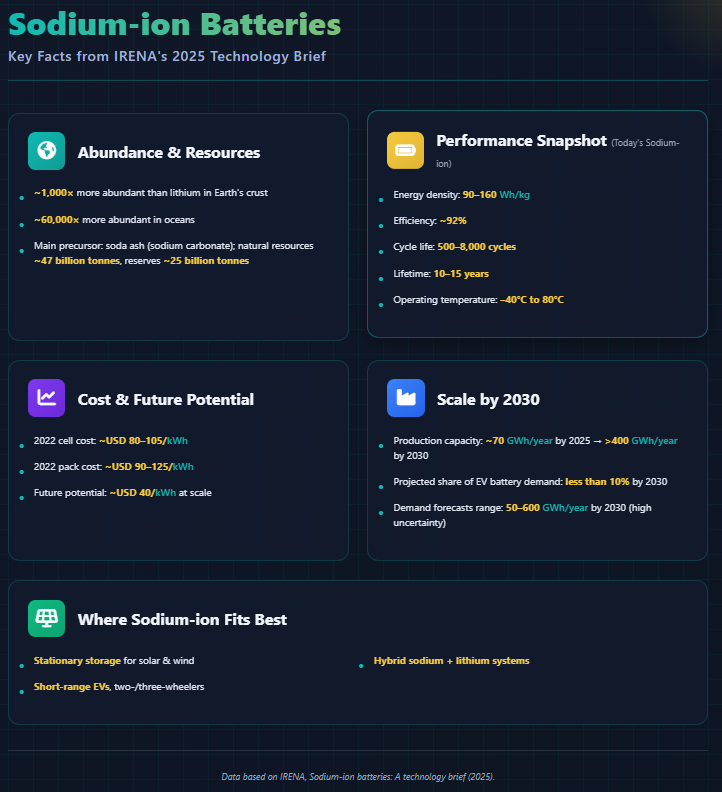
According to IRENA’s latest technology brief, global sodium-ion battery manufacturing capacity could grow from just 70 gigawatt-hours (GWh) in 2025 to nearly 400 GWh by 2030, driven by industrial-scale deployment and aggressive investments, primarily in China
Still, even with this expansion, sodium-ion batteries are expected to represent less than 10% of global electric vehicle battery demand by the end of the decade. Lithium-ion technology — with its manufacturing scale, performance maturity, and entrenched ecosystem — will remain the industry’s backbone.
Why the World Is Suddenly Looking at Sodium
Batteries weren’t always strategic weapons — but today, they are as essential as oil once was.
Over the past few years, lithium prices surged dramatically, exposing the fragile supply chains behind electric vehicles and renewable power systems. Geopolitical tensions, mining challenges, and concentrated mineral supply raised a dangerous question: what happens if lithium becomes the new rare earth?
This is where sodium entered the conversation.
Sodium is everywhere. While lithium is mined from limited geological pockets, sodium exists in abundance — dissolved in oceans, embedded in minerals, and widely extractable through soda ash production. IRENA highlights that sodium is about 1,000 times more abundant than lithium in Earth’s crust and almost 60,000 times more abundant in seawater.
This abundance is not just chemistry trivia — it is industrial power. It means sodium-ion batteries could bring price stability, diversified sourcing, and insulation from geopolitical shocks. It also means battery production may someday become more geographically distributed instead of being dominated by a handful of mineral-rich countries.
What Sodium-ion Still Lacks
For all its promise, sodium-ion batteries remain a work in progress.
Lithium-ion batteries continue to outperform sodium-ion on one crucial metric: energy density. Modern lithium batteries pack more power into smaller spaces, making them indispensable for long-range electric vehicles and performance-grade applications.
Current sodium-ion cells typically reach 90–160 Wh/kg, while premium lithium-ion variants go far higher. Yet the gap is narrowing. Manufacturers are already developing next-generation sodium cells with a target energy density of 190–200 Wh/kg — pushing the technology closer to practical EV suitability.
However, until sodium reaches those levels at scale, lithium remains immovable in markets where size, weight, and range matter most.
The Safety Advantage No One Talks Enough About
Here is where sodium-ion quietly becomes dangerous — in a good way.
Sodium-ion batteries exhibit better thermal stability, improved behaviour in extreme temperatures, and safer electrolyte profiles compared with lithium-ion systems. They can also be transported fully discharged without the same safety risks.
In hot climates. In cold regions. In unstable grids. In remote storage farms.
That’s where sodium begins to shine.
IRENA notes that sodium-ion batteries retain performance at sub-zero temperatures, charge rapidly (80% in under 15 minutes in some chemistries), and deliver strong cycle life — often matching lithium-ion products in durability.
For grid infrastructure planners, safety is not optional. It is everything.
Where Sodium-ion Will Win First
The report is clear: sodium-ion will not fight lithium on the highway first. It will conquer the grid.
Stationary Energy Storage
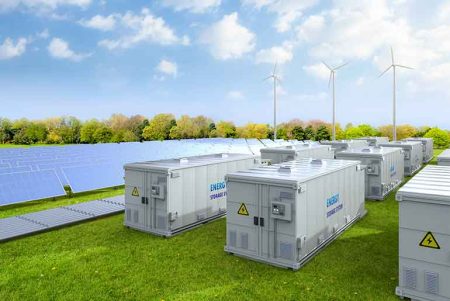
Solar and wind are exploding worldwide — but renewables are useless without storage. Sodium-ion’s stability, lower fire risk, and tolerance to environmental extremes make it ideal for large-scale grid batteries.
Weight does not matter inside concrete enclosures. Safety does.
Electric Mobility (Short-Range)
Sodium-ion vehicles are already on roads in China. Compact EVs and scooters using sodium packs deliver a range of around 250 km, suitable for city driving and delivery systems.
India and Southeast Asia may soon follow — especially in price-sensitive two- and three-wheeler markets where cost outweighs speed.
Hybrid Batteries
Manufacturers are now designing batteries that combine sodium and lithium inside the same systems — extracting power from lithium where density is needed and safety from sodium where stability matters.
The future does not seem to belong to one chemistry. It belongs to intelligent combinations.
Can Sodium Ever Become Cheaper Than Lithium?
Not yet.
Today, sodium-ion cell prices range between USD 80–105/kWh, while lithium-ion has already dropped to USD 52–81/kWh in many markets.
But the curve is bending.
Several manufacturers expect sodium-ion cells to reach as low as USD 40/kWh once economies of scale kick in. This would open a new era of low-cost energy storage — especially for emerging economies where battery prices dictate adoption.
Again, sodium is not beating lithium today — but it is playing the long game.
The Hard Truth IRENA Tells
The report ends all speculation with one grounded conclusion:
- Sodium-ion batteries should not be seen as lithium’s replacement. They are lithium’s companion.
- Lithium will lead high-performance EVs. Sodium will support grid expansion. Together, they create resilience.
- For a world attempting to electrify transport, decarbonize power, and stabilize energy supply — battery diversity is no longer optional.
It is necessary.
Final Word: The Future Belongs to More Than One Element
Energy transitions never follow single roads.
Coal did not vanish because oil arrived. Oil did not die because renewables appeared.
Sodium will not erase lithium.
But it will change conversations.
It will reshape strategy.
It will democratize battery supply.
And in doing so, it may become one of the quiet heroes of the clean energy era.
 Electrify your feed! Click here to join our Whatsapp group and to get the latest updates, expert insights, and innovations driving India’s energy storage revolution.