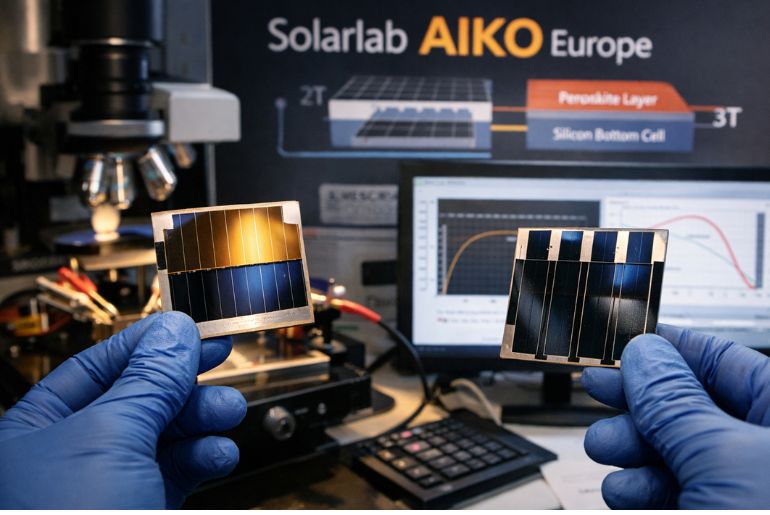
At a recent photovoltaic (PV) conference, Solarlab Aiko Europe, the Germany-based research division of Chinese back-contact (BC) module manufacturer Aiko, shared significant updates on its perovskite-silicon tandem solar cell research, highlighting advancements in both two-terminal (2T) and three-terminal (3T) tandem configurations. The company emphasized its ongoing efforts to develop next-generation solar technologies that combine high efficiency, manufacturability, and stability.
According to the research team, the latest 2T perovskite-silicon tandem lab-scale cell achieved a power conversion efficiency of 34.76%. The tandem configuration utilized a heterojunction (HJT) silicon bottom cell and was developed collaboratively with researchers at Aiko headquarters and the company’s state-of-the-art Yiwu R&D line. To enhance performance, interface engineering and material passivation methods were applied, reducing efficiency losses and improving long-term stability, a critical factor for commercial viability.
While 2T tandem cells are widely recognized for their simplicity and ease of manufacturing, 3T tandem cells are gaining attention due to their flexibility and potential yield enhancement. One of the key challenges with 2T designs is current matching between the sub-cells, which can limit performance under varying spectral conditions. In contrast, 3T designs enable independent current extraction, making them less sensitive to sunlight spectrum changes and particularly well-suited for bifacial applications. Furthermore, 3T tandems offer greater module design flexibility, facilitating optimized material usage and potential reductions in overall production costs.
Preliminary results from a proof-of-concept 3T perovskite-silicon tandem technology, based on Aiko’s All Back Contact (ABC) cell, indicate higher energy yields and a lower levelized cost of electricity, demonstrating the technology’s potential for commercial scalability.
Aiko continues to advance its research at facilities in Freiburg, Yiwu, and Zhuhai, focusing on both material optimization and tandem cell architecture. Notably, Solarlab Aiko Europe has previously participated in a collaborative research project with the Dutch consortium Solliance, combining PERC cells with perovskite layers to achieve a 27.7% efficient device in 2021, laying the foundation for current advancements.
The company highlighted that the combination of perovskite’s high absorption efficiency with silicon’s stability and maturity provides a compelling route toward high-performance, cost-effective solar energy solutions. By exploring both 2T and 3T tandem architectures, Aiko is positioning itself at the forefront of next-generation photovoltaic innovation, aiming to deliver solutions that enhance energy yield, durability, and affordability for industrial and residential applications.
A spokesperson from Solarlab Aiko Europe stated, “Our research into perovskite-silicon tandem cells, including both 2T and 3T configurations, demonstrates our commitment to pushing the boundaries of solar efficiency while addressing manufacturability and cost challenges. These developments bring us closer to scalable, high-performance solutions for the solar industry worldwide.”
This ongoing research reinforces Aiko’s mission to accelerate the deployment of high-efficiency, sustainable solar technologies, supporting global efforts toward renewable energy adoption and net-zero carbon targets. By combining state-of-the-art materials, innovative cell architectures, and international collaboration, Solarlab Aiko Europe continues to make significant contributions to the future of photovoltaic technology.
 Electrify your feed! Click here to join our Whatsapp group and to get the latest updates, expert insights, and innovations driving India’s energy storage revolution.