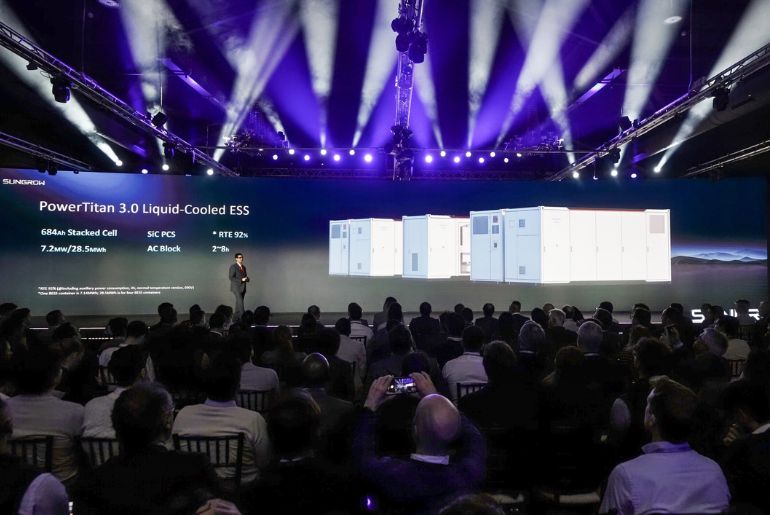
Sungrow has launched its next-generation PowerTitan 3.0 energy storage system (ESS) along with a Single-Platform Design for DC-coupled PV-ESS solutions during the Sungrow PV & ESS Summit held in Spain. The announcements highlight the company’s focus on utility-scale storage, efficient solar-storage integration, and grid stability as renewable energy penetration rises across Europe.
PowerTitan 3.0 Built for Utility-Scale Energy Storage
The newly introduced PowerTitan 3.0 is designed to meet the needs of large, utility-scale energy storage projects. The system uses 600Ah-plus stacked battery cells combined with silicon carbide (SiC) power conversion systems (PCS) and supports discharge durations ranging from two to eight hours.
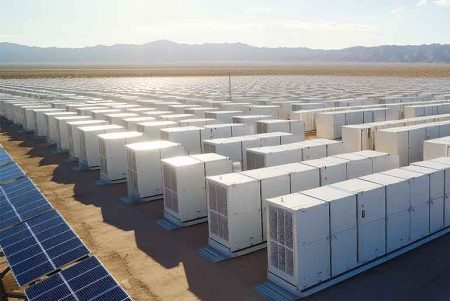
Each 20-foot container integrates a 1.78 MW PCS and 7.14 MWh of battery capacity. In a four-hour configuration, a single block can deliver up to 7.2 MW / 28.5 MWh, making it suitable for large deployments across Europe.
The SiC PCS provides 450 kVA per unit and achieves a maximum efficiency of 99.3 percent, while the stacked battery design delivers a system-level round-trip efficiency of 92 percent.
PowerTitan 3.0 is factory pre-installed and pre-commissioned using an AC block design. Sungrow stated that the system can complete self-configuration and self-checks within one hour, allowing a 1 GWh project to be deployed in around 12 days.
Designed for Europe’s varied climates, the system can operate without derating at temperatures as low as minus 40 degrees Celsius, making it suitable for Nordic, Alpine, coastal, and high-humidity environments.
Single-Platform DC-Coupled PV-ESS Architecture Introduced
Alongside PowerTitan 3.0, Sungrow also unveiled a Single-Platform Design for DC-coupled PV-ESS solutions. The platform integrates the company’s 1+X modular inverter series, a dedicated energy storage interface, PowerTitan 3.0 with a built-in DC/DC module, and a self-developed PV-ESS Synergy Management System.
The integrated design supports discharge durations of up to eight hours, a DC/AC ratio of up to 2.0, and an ESS power ratio of up to 100 percent. According to Sungrow, the platform improves system-level cost optimisation and increases energy conversion efficiency by around 3–5 percent.
The solution is designed to meet European market needs such as energy arbitrage using peak and valley tariffs, continuous green power supply, better grid compatibility, and reduced renewable integration pressure. Sungrow said its DC-coupled PV-ESS solution has been deployed in more than 90 projects globally.
Grid-Forming Technology Takes Center Stage
Grid-forming technology was another major focus at the summit, reflecting Europe’s growing share of renewable energy. Henry Liu, Director of Sungrow’s Grid Solution Department, highlighted how grid-forming systems support stable and resilient power networks while aligning with evolving European Union standards.
Sungrow showcased capabilities including voltage and frequency support, oscillation damping, system strength support, and gigawatt-scale black start functionality. The company noted that these features have been proven in several projects, including a 7.8 GWh energy storage installation in Saudi Arabia, described as the world’s largest grid-forming storage project.
Sungrow Reinforces Long-Term Commitment to Europe
“In 2026, Sungrow continues to prioritise Europe as a pivotal market, reinforcing its commitment through a robust localised service infrastructure,” said James Li, Vice President of Sungrow Europe.
“Today, Sungrow’s European operations are built on a widespread and specialised service network supported by more than 280 engineers, five repair workshops, 14 service warehouses, and over 220 service partners. Our two major service centres in Pamplona (9,000 m²) and Munich (5,000 m² including outdoor facilities) serve as hubs for technical training, service innovation, and regional support. Looking ahead, Sungrow will be continuously advancing our European presence through strategic partnerships and next-generation technologies focused on supporting the continent’s green energy transition,” he added.
 Electrify your feed! Click here to join our Whatsapp group and to get the latest updates, expert insights, and innovations driving India’s energy storage revolution.