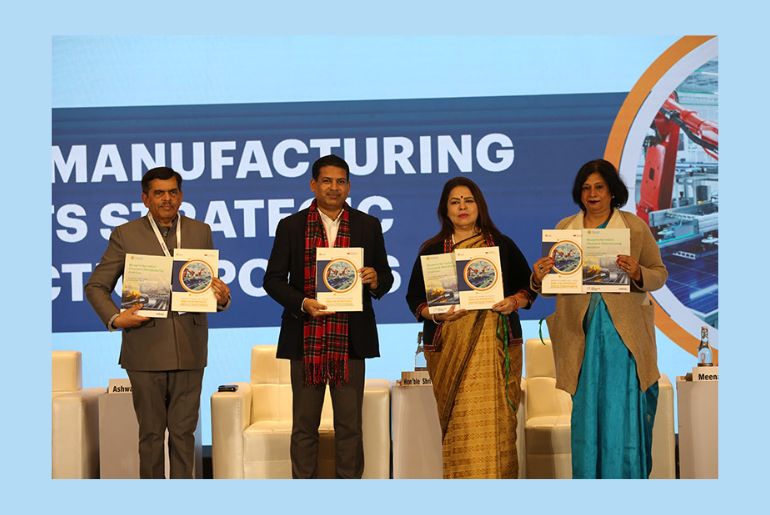
The Energy and Resources Institute (TERI) unveiled its landmark report, “India’s PV Manufacturing & Its Strategic Inflection Points”, at the Bharat Climate Forum (BCF) 2026 held at ITC Maurya, New Delhi. The report launch coincided with the formal introduction of India’s National Cleantech Manufacturing Implementation Plan, attended by senior government officials, global institutions, industry leaders, and financial stakeholders.
Dr Vibha Dhawan, Director General of TERI, highlighted the report’s strategic assessment of India’s solar photovoltaic (PV) manufacturing ecosystem.
Dr Vibha Dhawan, Director General of TERI stated, “TERI’s macro-level study, Reassessment of Solar Potential in India, points to a horizon of unparalleled abundance: an aggregate solar potential exceeding 10,800 GW across ground-mounted, rooftop, and emerging deployment pathways. The question is no longer whether India can deploy enough solar, but whether we capture sufficient domestic value through manufacturing, technology, skills, and resilient supply chains, while keeping electricity affordable.”
Shri Santosh Sarangi, Secretary of the Ministry of New and Renewable Energy, emphasized the nation’s clean energy progress. “India’s renewable energy journey over the last decade has been spectacular, scaling solar capacity from 2.63 GW in 2014 to over 134 GW today. Our focus has been on accelerating deployment, achieving Atmanirbharta in manufacturing, and driving citizen adoption, building a resilient ecosystem that serves as a global blueprint,”.
The report notes that while India has strengthened module manufacturing, upstream vulnerabilities remain, as the country imports nearly all polysilicon and most wafers. Dependencies on imported manufacturing equipment pose risks of supply-chain disruptions, foreign exchange volatility, and geopolitical exposure. TERI recommends domestic equipment incentives, accelerated R&D, affordable finance via sovereign Green-PV bonds, concessional debt, co-equity by national investment institutions, and risk-mitigation instruments to enhance upstream capacity.
Further, the study suggests developing Solar–Semicon Technology Parks, shared pilot fabs for next-generation tech, and a dedicated PV–Semicon Skill Council to boost innovation, workforce readiness, and women’s participation in manufacturing.
The BCF 2026, featuring addresses by Shri C P Radhakrishnan, Vice-President of India, Union Ministers, and global leaders, focused on clean energy transitions, climate-resilient growth, cleantech manufacturing, and sustainable finance.
Shri Manohar Lal Khattar, Union Minister for Power, Housing and Urban Affairs, highlighted, “Non-fossil fuel sources now account for over 51.5% of India’s installed capacity, achieved five years ahead of 2030 targets. Since 2014, we added 178 GW of renewable energy, making India the world’s third-largest solar producer.”
The Forum reinforced India’s commitment to aligning national ambition with international collaboration for a green, resilient, and developed Bharat.
 Electrify your feed! Click here to join our Whatsapp group and to get the latest updates, expert insights, and innovations driving India’s energy storage revolution.