Close Menu
The Battery MagazineThe Battery Magazine
  • Just In
  • Batteries
    • Battery Manufacturing (BESS)
    • Battery Materials & Chemistries
    • Battery Recycling
    • C&I Storage
  • Solar
  • Renewable energy
    • Wind Energy
    • Hydropower
    • Green Hydrogen
    • Bioenergy
  • Tenders
    • Energy Storage
    • Solar Energy
    • Wind Energy
  • Policy
    • Storage
    • Solar
    • Wind
    • EV
    • Transmission
  • EV
    • EV Batteries
    • EV Charging Infrastructure
    • Electric Mobility Trends
  • Grid
    • Transmission & Distribution
    • Grid Infrastructure
    • Power Generation
    • Power Equipments
  • Exclusive
    • Cover Story
    • Watt Matters
    • Perspective
    • Articles
  • More
    • E-Mag
    • Events
    • Contact Us
Facebook LinkedIn WhatsApp
The Battery MagazineThe Battery Magazine
  • Just In
  • Batteries
    • Battery Manufacturing (BESS)
    • Battery Materials & Chemistries
    • Battery Recycling
    • C&I Storage
  • Solar
  • Renewable energy
    • Wind Energy
    • Hydropower
    • Green Hydrogen
    • Bioenergy
  • Tenders
    • Energy Storage
    • Solar Energy
    • Wind Energy
  • Policy
    • Storage
    • Solar
    • Wind
    • EV
    • Transmission
  • EV
    • EV Batteries
    • EV Charging Infrastructure
    • Electric Mobility Trends
  • Grid
    • Transmission & Distribution
    • Grid Infrastructure
    • Power Generation
    • Power Equipments
  • Exclusive
    • Cover Story
    • Watt Matters
    • Perspective
    • Articles
  • More
    • E-Mag
    • Events
    • Contact Us
LinkedIn Facebook WhatsApp YouTube
The Battery MagazineThe Battery Magazine
Home » BLOG » Top 5 Manufacturing Companies for Lithium-Ion Batteries in India
BLOG

Top 5 Manufacturing Companies for Lithium-Ion Batteries in India

Shweta KumariBy Shweta KumariMay 30, 20253 Mins Read
Facebook Twitter LinkedIn WhatsApp
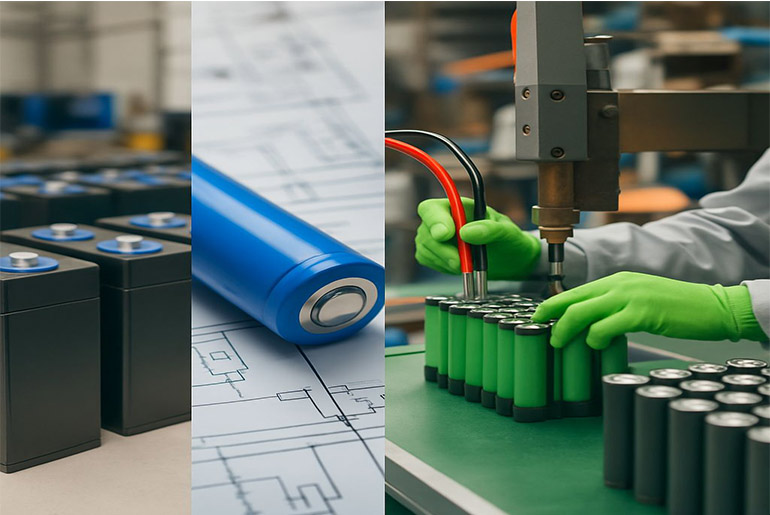
Top 5 Manufacturing Companies for Lithium-Ion Batteries in India

As India is speeding up its transition towards electric mobility and renewable energy, the lithium-ion battery industry has become a critical driver to enable this green revolution. Driven by the growing requirement for electric vehicles (EVs), energy storage systems, and consumer electronics, several indigenous firms have stepped forward to establish robust lithium-ion battery production capacity.

Let’s look at these top 5 Indian companies in lithium-ion batteries that are leading the way in innovation and making an effort towards a sustainable world:

1. Amara Raja Energy & Mobility Ltd.
Formerly known as Amara Raja Batteries, the company has emerged as a player to watch in India’s energy storage industry. It started construction on a gigafactory in Telangana in 2023 for lithium cell and battery pack manufacturing. The plant is expected to have a cell capacity of 16 GWh and a battery pack capacity of 5 GWh when complete.

Key Highlights:

  • Backward integration into cell manufacturing. 
  • Emphasis on energy storage systems and electric mobility 
  • Collaboration with international technology suppliers for high-end chemistry cells.

2. Exide Energy Solutions Ltd. (EESL)

Exide Energy Solutions Ltd. (EESL), a part of Exide Industries, is making important progress in producing lithium-ion batteries locally. They’re building a large-scale lithium-ion battery plant in Bengaluru, Karnataka, with an investment of over ₹6,000 crore. The company has also formed a strategic partnership with SVOLT Energy from China, focusing on batteries for cars and large-scale energy storage. EESL is dedicated to supporting India’s Atmanirbhar Bharat mission, aiming for self-reliance in energy solutions and manufacturing.

3. The Tata Group, which includes Tata Agratas Energy Storage Solutions Pvt. Ltd.
Agratas Energy, a joint venture of the Tata Group, has announced the establishment of a 20 GWh battery cell gigafactory in Sanand, Gujarat, marking the company’s entry into the lithium-ion battery market. It is anticipated that the facility will serve both Tata Motors’ EVs and other outside clients.

Important Points to Remember:

  • supported by Tata Motors and Tata Sons.
  • Pay attention to lithium iron phosphate (LFP) and other cutting-edge chemicals.
  • potential for exports in addition to domestic consumption.

4. Ola Electric Mobility Pvt. Ltd.
Ola is not just a mobility platform; it’s rapidly transforming into a technology-driven EV manufacturer, including battery cell production. The company is building a cell gigafactory in Krishnagiri, Tamil Nadu, under India’s PLI (Production Linked Incentive) scheme.

Key Highlights:

Targeting integrated battery production for its electric scooters and cars.

Focus on high energy-density NMC (Nickel Manganese Cobalt) chemistry.

Indigenous R&D through its Battery Innovation Center (BIC).

5. Lohum Cleantech

Lohum is India’s first integrated lithium-ion battery manufacturer and recycler. The company offers lithium-ion battery packs and modules for 2W, 3W, and stationary storage and is a pioneer in battery recycling and second-life technologies.

Key Highlights:

  • comprehensive solutions that include reuse and recycling. 
  • supplies to leading EV OEMs and energy storage developers.


India’s lithium-ion battery ecosystem is expanding swiftly thanks to government initiatives like the PLI scheme, FAME incentives, and Make in India campaigns. In addition to setting up large production facilities, these top five manufacturers are investing heavily in R&D, localization, and sustainable technologies. As the demand for EVs and clean energy increases, these companies are expected to play a significant role in building India’s energy future.

whatsapp icon Electrify your feed! Click here to join our Whatsapp group and to get the latest updates, expert insights, and innovations driving India’s energy storage revolution.
battery manufacturing battery recycling EV battery green mobility India energy storage lithium-ion batteries Sustainable Technology
Shweta Kumari
  • Website
  • LinkedIn

Sub-editor by profession. Love for words and storytelling, where every word narrates a story. Shaping stories in a world powered by electrons—where lithium meets logic, and every spark tells a tale of innovation, sustainability, and our electrified future.

Keep Reading

From Silent Component to Strategic Enabler: The Rising Importance of Battery Separators in the Global Energy Transition

DOE Awards Coreshell 50 Million Dollars for Silicon-Anode Batteries

DOE Awards Coreshell Technologies $50 Million for U.S. Silicon-Anode Battery Manufacturing

The BESS Value Chain: Knowing Critical Skills Battery Energy Storage Systems (BESS) have moved to the center of the power sector, stabilizing grids and enabling new business models. As governments and industries across the world invest in BESS, a quieter constraint is emerging – the availability of people with right skills, at the right stage and in the right geography. This article walks through the BESS value chain, maps the critical skilling needs, and uses real-world examples to highlight workforce readiness. The value-chain approach helps with effective skilling and workforce planning. Cell manufacturing is the most capital-intensive and technically demanding segment of the battery value chain. Domestic cell manufacturing plays a critical role in strengthening energy storage ecosystems and reducing import dependence. It includes: - Materials and chemistry R&D (cathode, anode, electrolyte, separator) - Electrode production (mixing, coating, calendaring) - Cell assembly (stacking/winding, electrolyte filling, formation, ageing) Skills required here include electrochemistry, process engineering, advanced automation, quality control, safety engineering, and clean-room operations. Leading cell manufacturers have built large in-house training ecosystems to continuously upgrade workforce capabilities as battery chemistries evolve. Module and pack assembly: Cells are combined into modules and packs with mechanical structures, thermal management and electrical interconnections. This stage is often closer to end markets and can be co-located with EV plants or BESS integrators. Key skills include: - Precision welding (laser, ultrasonic) - Busbar design and electrical interconnection design - Thermal design and validation - Battery Management System (BMS) integration - Robotics and automation programming - Line maintenance and troubleshooting Compared with cell manufacturing, module and pack assembly can create more technician roles, however, automation is rapidly changing the nature of these jobs towards robotics and mechatronics (India Manufacturing Workforce, 2025). System integration and project delivery is one of the fastest growing and most important stages of the BESS ecosystem. System integrators turn packs into complete BESS solutions by adding: - Power Conversion Systems (PCS) - Energy Management Systems (EMS) and SCADA - Protection, safety & fire detection and suppression systems - Civil, electrical and grid-connection infrastructure This stage demands inter-disciplinary skill sets: power systems engineering, software and controls, cybersecurity, grid codes, project management and HSE (health, safety and environment). Finding engineers who bridge power electronics and software is one of the biggest hiring challenges (Cleantech, 2026). Operation, maintenance and end-of-life: Once commissioned, BESS assets require: - Monitoring and predictive maintenance - Performance analytics and warranty management - Safety inspections and incident response - Second-life assessment and recycling logistics Here, skills blend field service, data analytics, remote asset monitoring, safety management and regulatory compliance (for example, extended producer responsibility and hazardous waste rules). As more systems reach mid-life, demand is rising for specialists in diagnostics, repowering and recycling. (NITI Aayog, Deloitte, GIZ) To summarize, three patterns stand out for BESS workforce landscape: 1. Geographic concentration: Cell manufacturing jobs are concentrated in China, Europe and North America with other regions racing to catch up through policy and gigafactory initiatives. (European Commission, JRC, 2026) 2. Skill polarization: Demand is growing fastest for high-skill roles (electrochemists, automation engineers, power electronics specialists, data scientists, grid integration experts), while low-skill assembly roles are increasingly automated. (India Manufacturing Workforce, 2025 and ACC PLI impact report, 2026) 3. Timing mismatch: Gigafactories and BESS projects are being announced and built faster than local training systems can produce qualified workers. 4. Talent competition: EV manufacturing, semiconductor production, renewable-energy integration, and advanced manufacturing industries are often competing for the same engineering and automation talent pools. While policies are expected to create tens of thousands of jobs over the coming decade, industry surveys consistently highlight a shortage of: - Experienced cell and pack manufacturing engineers - BMS and power electronics specialists - Safety and certification experts - Skilled technicians for automated lines and field O&M A significant challenge is gap between academic training and industry requirements. Many engineering programs still lack - battery specific curriculum, hands on laboratory exposure, industry-linked certification pathways and interdisciplinary learning modules. This is where the value chain lens becomes particularly useful: different stages require different skilling strategies. Skilling needs across BESS value chain: The rise of hybrid roles One of the most striking trends is the rise of the hybrid roles that cut across traditional disciplinary boundaries, e.g. electrochemistry + data science for cell performance analytics, electrical engineering + cybersecurity for grid-connected storage systems etc. Industry interviews and surveys repeatedly note that these hybrid profiles are the hardest to hire and retain, especially outside established clusters. (Worldmetrics, 2026, and Cleantech 2025) What industry and policy makers need to do Reports by IEA, European Commission, World Metrics, India’s ACC PLI impact study and industry experiences summarize key aspects: 1. Integrate skills planning into project planning: Workforce planning, training partnerships and curriculum development should be a part of the early project design for gigafactories and large BESS programs, not an afterthought. 2. Invest in hybrid profiles: Programs that deliberately blend power systems, software, data and safety will pay the highest dividends, because these are the roles that unlock system-level performance and reliability. 3. Use automation as a skilling lever (not a substitute): Automation and AI should be paired with structured upskilling for operators and technicians, turning them into higher-value problem solvers rather than displacing them without a pathway. 4. Build regional centers of excellence: Shared training centers, test beds, certification labs can reduce duplication and raise standards, especially in markets where individual firms may not have the scale to do everything alone. 5. Embed diversity and inclusion from the start: Where companies have proactively recruited and supported women and under-represented groups into technical roles, they have expanded their talent pool and improved retention. Making this a design principle, not a side project, will be critical as competition for skills intensifies. 6. Strengthen Industry-Academia collaboration: Battery-focused curriculum, apprenticeships, certification programs, hands-on labs should be developed jointly by educational institutions and industry stakeholders. Conclusion: The real storage constraint is human. The BESS industry is often described in terms of gigawatt, gigawatt-hours and gigafactories. But behind every line of capacity is a line of people: technicians, engineers, project managers, safety officers, data analysts and many others. If industry and policymakers treat skilling with the same urgency as they treat financing and permitting, then nothing can stop the BESS sector from growing into a resilient, high-quality backbone of the clean energy system. We just need to realize that skills are as strategic as materials and capital. - Aditi Pathak, Senior Manager IESA Academy, Customized Energy Solutions (CES) India - Sweta Jha, Assistant Manager L&D, Replus Engitech Pvt Ltd

The BESS Value Chain: Knowing Critical Skills

Comments are closed.

Renewable energy
TATA power Rajasthan solar project

Tata Power Renewables Supports Tata Steel’s Decarbonization with 72.5 MW Solar Project in Rajasthan

August 27, 2026
Canadian Solar Posts 1.2 Billion Q2 Revenue

Canadian Solar Posts $1.2 Billion Q2 Revenue as Record Energy Storage Shipments Boost Results

August 27, 2026
JAKSON Appoints Ivan Saha as Managing Director

JAKSON Appoints Ivan Saha as Managing Director to Drive Solar Manufacturing Growth

August 27, 2026
VSL PowerHive Makes BESS Debut

VSL PowerHive Makes BESS Debut with Launch of 261 kWh Energy Storage System

August 27, 2026
Batteries
Ukraine Ranks as Europe’s Fourth-Largest Battery Storage Market

Ukraine Ranks as Europe’s Fourth-Largest Battery Storage Market with 3 GWh Installed

August 27, 2026
ACME Solar Secures rs1,571 Crore Funding from IIFCL

ACME Solar Secures ₹1,571 Crore Funding from IIFCL for 300 MW Rajasthan Project

August 27, 2026
Sungrow Energy Storage Project

Sungrow Accelerates 200 MW/400 MWh Energy Storage Project Deployment

August 26, 2026
Tamil Nadu to Achieve 50% Renewable Energy

Tamil Nadu to Achieve 50% Renewable Energy Share by 2031

August 26, 2026

Subscribe for Updates

Get the latest news about energy storage in your inbox.

    © 2026 Thebatterymagazine.com.
    • Home
    • About Us
    • Contact Us
    • Privacy Policy
    • Terms of Service

    Type above and press Enter to search. Press Esc to cancel.