India’s battery-storage market has reached a point where the question is no longer whether Battery Energy Storage Systems (BESS) are needed. The harder question is whether projects can be made commercially viable, financed at scale and brought into operation before the grid needs them. That is the gap Viability Gap Funding for Battery Storage is designed to address.
When the Union Cabinet approved the first Viability Gap Funding (VGF) scheme for Battery Energy Storage Systems in September 2023, India was still trying to establish the economics of grid-scale battery storage. The government approved ₹3,760 crore of budgetary support within a total scheme outlay of ₹9,400 crore to support 4,000 MWh of BESS by 2030–31. The VGF could cover up to 40% of project capital cost, with the scheme targeting a Levelised Cost of Storage (LCoS) of ₹5.50–6.60/kWh.
Three years later, the programme looks very different.
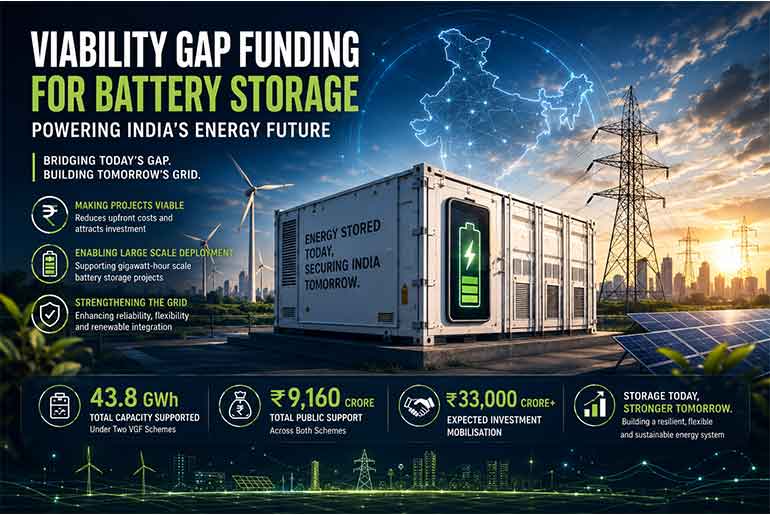
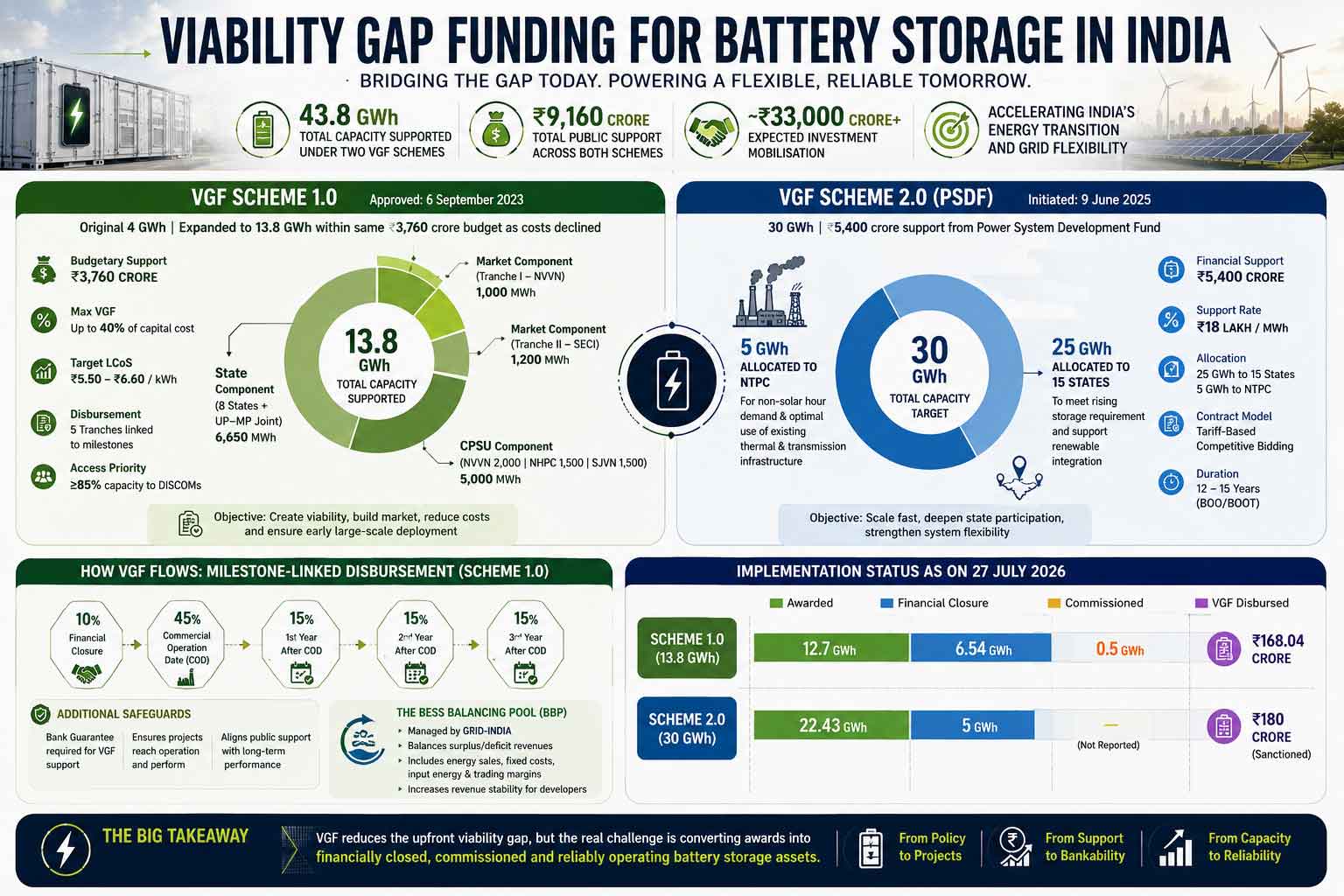
The capacity supported under the first scheme has expanded to 13.8 GWh without an increase in the approved ₹3,760-crore budget, while a second VGF scheme launched in June 2025 adds another 30 GWh, backed by ₹5,400 crore from the Power System Development Fund (PSDF).
Together, the two schemes now cover 43.8 GWh of BESS capacity.
But there is an important distinction between supporting storage capacity and commissioning storage capacity.
As of the government’s latest status update of July 27, 2026, the first VGF scheme had issued Lett ers of Award for 12.7 GWh, achieved financial closure for 6.54 GWh and commissioned only 0.5 GWh. Under the second scheme, 22.43 GWh had received Letters of Award, 19.65 GWh had executed Battery Energy Storage Purchase Agreements (BESPAs), and 5 GWh had achieved financial closure.
That gap between policy support, award, financial closure and commercial operation is where the real story of Viability Gap Funding for Battery Storage begins.
Why does India need Viability Gap Funding for Battery Storage?
A BESS does not generate electricity in the conventional sense. Its value comes from when and how it uses electricity.
A battery can charge when electricity is inexpensive or renewable generation is abundant and discharge when demand is high. It can help shift energy into peak periods, support renewable integration, manage congestion and provide flexibility to the power system.
But the economics of such a project are more complicated than simply calculating the cost of a battery.
A developer has to account for the battery system, power-conversion equipment, balance-of-system costs, land, connectivity, financing, operations and maintenance, degradation, augmentation and eventually replacement. The revenue side can also depend on how the project is contracted and which services it provides.
That creates the viability gap.
The project may be technically useful to the grid, but the tariff or revenue that a buyer is willing to pay may initially be insufficient to support the required investment.
This is why Viability Gap Funding for Battery Storage was introduced as a market-creation mechanism rather than simply a consumer subsidy.
The government’s original scheme was intended to lower the cost of storage and make BESS commercially viable, particularly for managing peak electricity demand and integrating renewable energy. At least 85% of the capacity from VGF-supported BESS projects was to be made available to distribution companies, helping connect the public support to actual electricity demand.
The logic was straightforward: support the early projects, establish procurement and financing experience, bring down costs and create the conditions for larger-scale deployment.
That logic is now being tested.
Viability Gap Funding for Battery Storage began with 4 GWh
The first Viability Gap Funding for Battery Storage scheme was approved by the Union Cabinet on September 6, 2023.
Its original architecture was:
- Parameter Original VGF scheme
- BESS capacity 4,000 MWh
- Budgetary support ₹3,760 crore
- Total initial outlay ₹9,400 crore
- Maximum VGF Up to 40% of capital cost
- Target LCoS ₹5.50–6.60/kWh
- Approval period 2023–24 to 2025–26
- Fund disbursement Five tranches
- Priority access At least 85% to DISCOMs
The government estimated that BESS systems during the initial period could cost roughly ₹2.40–2.20 crore/MWh, translating into a ₹9,400-crore capital requirement for 4,000 MWh.
The scheme was also deliberately structured around competitive procurement. Public and private entities could participate, with developers selected through bidding by the implementing agencies.
This matters because the government was not attempting to prescribe one technology or one developer model.
Instead, it was trying to use public support to make a competitive BESS market possible.
The VGF was never meant to be paid upfront
One of the most misunderstood aspects of Viability Gap Funding for Battery Storage is the assumption that the government simply pays a fixed percentage of project cost at the beginning.
It does not work that way.
Under the first scheme, VGF is released in five tranches linked to project milestones:
- 10% upon financial closure;
- 45% upon achieving Commercial Operation Date (COD);
- 15% after the first year from COD;
- 15% after the second year from COD;
- 15% after the third year from COD.
The structure makes the support increasingly dependent on actual project progress and operation.
This is an important design feature.
A project that has merely won a tender cannot claim the entire VGF allocation. The developer has to reach financial closure, construct the system, achieve COD and continue operating it.
For lenders and developers, however, this also means that VGF does not eliminate the need for upfront financing.
That is one reason why the distinction between a tender award and a financially closed project matters so much.
Falling BESS costs changed the first VGF scheme
The most interesting development in the first Viability Gap Funding for Battery Storage programme was not a new budget allocation. It was the expansion of capacity within the existing budget.
As BESS prices declined, the government increased the supported capacity from the original 4,000 MWh to 13.2 GWh, and subsequently to 13.8 GWh, while retaining the ₹3,760-crore approved budget. The government’s April 2025 explanation shows how sharply the economics had changed. For an initial 1,000-MWh component, the VGF estimate fell from ₹96 lakh/MWh to ₹46 lakh/MWh or 30% of capital cost, whichever was lower. The reason given was the decline in BESS costs.
This is a useful demonstration of how public support can change as technology costs evolve.
The same fiscal allocation can support more storage if the underlying cost of storage falls.
But there is also a lesson here for policymakers: battery economics are not permanently fixed.
In 2025, the direction was strongly downward. By 2026, the market had become more complicated.
From ₹10.18/kWh to much lower BESS tariffs
India’s early BESS procurement showed just how large the economic barrier initially was. The Ministry of Power reported that the cost of BESS discovered through tariff-based competitive bidding during 2022–23 was around ₹10.18/kWh when the storage system was assumed to operate for two cycles a day.
By December 2025, the government said recent bids had brought the storage cost down to about ₹2.1/kWh without VGF for two cycles a day, with around ₹2.8/kWh corresponding to an assumed 1.5-cycle-per-day utilisation.
That is an extraordinary change in only a few years. It explains why the government could expand the capacity under the first VGF scheme without expanding its budget. But a low bid is not automatically the same thing as a sustainable project.
By July 2026, Reuters reported that rising prices for lithium, copper and aluminium, along with other supply-chain pressures, were putting pressure on India’s previously low-priced BESS projects. Some developers and suppliers were reportedly finding earlier tariffs difficult to sustain.
This creates a new question for Viability Gap Funding for Battery Storage:
If the viability gap changes with battery prices, how should public support respond when costs rise again after tariffs have already been discovered?
That question is becoming increasingly important for lenders as well as developers.
What happened to the first 13.8 GWh?
The latest government data gives a much clearer picture than the headline capacity figure.
As of July 27, 2026, the first VGF scheme had:
13.8 GWh
supported capacity
12.7 GWh
Letters of Award issued
12.7 GWh
BESPAs executed
6.54 GWh
financial closure achieved
0.5 GWh
commissioned
₹168.04 crore
VGF disbursed.
These numbers deserve to be read carefully.
The first 13.8 GWh is the supported programme capacity.
The 12.7 GWh is the capacity for which the procurement process has progressed to Letters of Award and BESPAs.
The 6.54 GWh represents projects that have crossed the financial-closure milestone.
The 0.5 GWh is the capacity that had actually reached commissioning.
This is why saying “India has deployed 13.8 GWh through VGF” would be incorrect.
The government has supported the development of 13.8 GWh. It has not commissioned 13.8 GWh under that scheme.
That distinction is fundamental to understanding the effectiveness of Viability Gap Funding for Battery Storage.
The second VGF scheme takes storage support to 30 GWh
The government did not wait for the first programme to finish before scaling up.
On June 9, 2025, the Ministry of Power initiated a second VGF scheme for 30 GWh of BESS, with ₹5,400 crore of financial support from the Power System Development Fund.
This second programme was designed differently.
Of the 30 GWh:
- 25 GWh was allocated across 15 states to meet their storage requirements;
- 5 GWh was allocated to NTPC.
The NTPC component is particularly significant because the government said it is intended to support electricity demand during non-solar hours and optimise the use of existing thermal-generation and transmission infrastructure.
This widens the role of BESS.
Storage is no longer being framed only as a way of absorbing excess solar power.
It can also become a power-system flexibility asset, shifting energy into periods when the system needs it most.
VGF 2.0: ₹18 lakh per MWh
The second VGF programme provides financial support of ₹18 lakh/MWh. At 30 GWh, the total support amounts to ₹5,400 crore. The government has said the programme is expected to attract around ₹33,000 crore in investment, making the public funding a catalyst for a significantly larger pool of private and institutional capital. That is precisely what a viability-gap mechanism is supposed to achieve. The government does not need to fund the entire BESS asset. Instead, it reduces part of the project’s financial burden so that the remaining investment can be mobilised commercially.
The second scheme therefore represents an evolution in India’s approach:
Public support → lower project cost → competitive procurement → private investment → operational storage.
But the last step remains the most important.
Where does VGF 2.0 stand?
The latest official status, dated July 27, 2026, shows:
- Milestone VGF 2.0
- Total supported capacity 30 GWh
- Letters of Award 22.43 GWh
- BESPAs executed 19.65 GWh
- Financial closure 5 GWh
- VGF sanctioned following financial closure ₹180 crore
The government has not reported commissioned capacity for this second scheme in that July update. Again, the numbers tell a more useful story than the headline. The programme is moving. But 22.43 GWh awarded does not mean 22.43 GWh operating. And 5 GWh financially closed does not mean 5 GWh commissioned.
For the industry, the next milestones will therefore be more important than the announcement of additional capacity.
The hidden financial architecture: the BESS Balancing Pool
One of the more important—and less discussed—elements of India’s Viability Gap Funding for Battery Storage framework is the BESS Balancing Pool (BBP).
The mechanism is designed to manage surplus and deficit revenues from BESS projects supported under the scheme. Grid-India has been identified as the BESS Nodal Agency overseeing the balancing pool, while NVVN and SECI have been identified as BESS Implementing Agencies responsible for securing BESS discharge during pre-declared high-demand and stress hours.
The pool effectively recognises a fundamental characteristic of storage economics:
BESS revenue may not be uniform every month.
A battery may earn revenue through the sale of discharged electricity, while its project costs include fixed charges payable to the developer, input-energy costs and implementing-agency margins.
Under the balancing-pool structure, surpluses can be deposited into the pool and deficits can be compensated from it. The objective is to smooth revenue fluctuations and create a more stable commercial framework for supported BESS projects.
This is significant because it addresses a problem beyond capital cost.
VGF reduces part of the investment gap. The balancing pool addresses part of the operating-revenue uncertainty.
Together, they make the policy intervention more sophisticated than a simple capital subsidy.
VGF is not India’s only battery-storage support mechanism
It would be misleading to present Viability Gap Funding for Battery Storage as the entire foundation of India’s BESS market. The government has been building several layers of support and market rules around storage.
The Ministry of Power notified guidelines in March 2022 for the procurement and utilisation of BESS as part of generation, transmission and distribution assets, including ancillary services. Tariff-Based Competitive Bidding guidelines have also been notified for ESS procurement by distribution licensees. In September 2023, the government issued the National Framework for Promotion of Energy Storage Systems.
There are also transmission-cost interventions.
The government has extended a 100% waiver of Inter-State Transmission System (ISTS) charges for eligible co-located BESS projects commissioned by June 30, 2028, subject to the applicable conditions.
The CEA has also advised on co-locating ESS with solar projects. In February 2025, it recommended storage equivalent to at least 10% of installed solar capacity for a minimum two-hour duration in such configurations to improve dispatchability.
And in September 2025, amendments to the Electricity Rules enabled consumers to develop, own, lease or operate energy-storage systems, expanding potential ownership and business models beyond utility-owned assets.
This broader architecture matters because VGF can only solve one part of the equation.
India already has an Energy Storage Obligation
Another important policy layer is the Energy Storage Obligation (ESO). India’s ESO trajectory rises from 1% in FY2023–24 to 4% by FY2029–30, with compliance linked to the procurement of stored energy and a requirement that at least 85% of the energy stored annually come from renewable sources.
That creates a demand-side signal. VGF, by contrast, is primarily a financial intervention. The two therefore work differently:
- ESO creates a requirement to use or procure storage.
- VGF helps make some storage projects economically viable.
- Competitive bidding discovers the price.
- Transmission-charge relief can lower delivered project costs.
- Resource-adequacy planning identifies the system requirement.
- The strength of India’s storage policy will ultimately depend on how these mechanisms work together.
The scale of India’s storage requirement is much larger than VGF
This is perhaps the most important context for understanding the size of the VGF schemes. The National Electricity Plan 2023 estimated that India would need around 236 GWh of BESS by 2031–32. The April 2025 Ministry of Power response used this figure while explaining the need for the VGF programme.
But newer resource-adequacy planning has also provided a different trajectory.
The latest planning documents point to increasing BESS requirements as renewable penetration and peak-demand requirements grow.
This means the 43.8 GWh covered by the two VGF schemes is not India’s total future storage requirement.
It is a targeted intervention within a much larger market.
That distinction is important for manufacturers, developers and investors.
VGF can catalyse early and strategic projects, but India will ultimately need a market capable of supporting storage beyond government-funded programmes.
Can Viability Gap Funding for Battery Storage actually make BESS bankable?
This is the central question.
The answer is: it can improve bankability, but it cannot guarantee it.
A BESS project can receive VGF and still struggle to achieve financial closure.
Why?
Because project bankability depends on more than capital cost.
A lender will want to understand:
- who is buying the storage service;
- how long the contract lasts;
- what the tariff is;
- whether the counterparty can pay;
- what happens if battery performance degrades;
- who pays for augmentation;
- what availability is guaranteed;
- what happens at the end of the battery’s contracted life;
- how input electricity costs are treated;
- whether the project has secure grid connectivity;
- what warranties are available;
- and how technology and supply-chain risks are allocated.
This is why the government’s July 2026 numbers are so revealing.
Under the first VGF scheme, 12.7 GWh had received awards, but only 6.54 GWh had reached financial closure. Under the second scheme, 22.43 GWh had received awards, but only 5 GWh had reached financial closure.
The gap is not necessarily evidence of failure.
Projects take time to complete.
But it shows that winning the tender is not the same as making the project bankable.
The 2026 cost shock adds another layer
India’s BESS market has also entered a more complicated cost environment.
After years of falling battery prices, rising prices for critical materials and changing global supply conditions have put pressure on some low-priced projects. Reuters reported in July 2026 that tariffs for Indian battery storage were expected to rise as higher input costs squeezed previously low-priced projects. Some projects were reportedly facing difficulty as suppliers reconsidered earlier commercial commitments.
This is particularly relevant for projects awarded at aggressively low tariffs.
A BESS project may look viable when the bid is submitted.
But the economics can change between:
bid → award → financing → equipment procurement → construction → commissioning.
That time gap can be particularly dangerous for storage because battery cells and other system components represent a major portion of project cost.
The implication for Viability Gap Funding for Battery Storage is important.
A VGF scheme designed around one cost environment cannot automatically protect a project against every future change in battery prices.
This makes contract design, price-discovery mechanisms and risk allocation just as important as the size of the government grant.
The real viability gap may now be bigger than capital cost
India’s early BESS problem was largely a cost problem.
Storage was expensive.
The government therefore intervened to reduce the cost of projects.
But India’s next BESS challenge may be a broader bankability problem.
The industry now needs to demonstrate that projects can:
- win competitively,
- secure contracts,
- raise debt,
- procure batteries,
- reach COD,
- and
- operate reliably for the contracted period.
That is a different challenge from simply reducing the capital cost.
The government’s own milestone-based VGF structure recognises this to some extent. A large portion of the VGF is released only at COD and during subsequent years of operation.
The policy therefore places value not just on building the asset, but on keeping it operational.
From tender award to commercial operation: the metric that matters
For India’s battery-storage industry, the next few years should therefore be judged through a more rigorous set of indicators.
Instead of asking only:
- How many GWh has India tendered?
the industry should also ask:
- How much has reached financial closure?
- How much is under construction?
- How much has achieved COD?
- How much is actually dispatching?
- What availability is being achieved?
- Are developers earning sustainable returns?
- Are buyers receiving the contracted storage services?
These questions are particularly important because India’s BESS market has already experienced very low bids.
Reuters reported in late 2025 that record-low Indian BESS bids had raised concerns about project viability, with some industry participants questioning whether extremely low tariffs could support sustainable projects.
For Viability Gap Funding for Battery Storage, that makes the next stage of implementation more important than the headline allocation.
What does VGF mean for BESS manufacturers?
The effects extend beyond developers.
A larger BESS project pipeline creates demand for:
- battery cells;
- modules;
- battery management systems;
- power conversion systems;
- energy management systems;
- thermal management;
- fire detection and suppression;
- transformers and switchgear;
- containers;
- EMS software;
- monitoring systems;
- testing and certification.
This makes VGF an indirect industrial-policy instrument as well.
The June 2025 VGF programme is particularly important because the government expects it to attract around ₹33,000 crore of investment against ₹5,400 crore of public support.
If those projects move from procurement to construction, they can create a much larger domestic market for BESS equipment and services.
But demand visibility must be sustained.
A manufacturer cannot build capacity based only on a tender announcement. It needs confidence that projects will actually reach financial closure and construction.
That brings us back to the central issue:
bankable deployment creates durable manufacturing demand; awarded capacity alone does not.
The VGF story is therefore bigger than a subsidy
It is tempting to describe India’s battery-storage VGF programme as a subsidy that makes batteries cheaper.
That description is incomplete.
The programme is doing several things simultaneously.
It is:
- reducing the initial viability gap;
- creating demand through competitive procurement;
- bringing utilities into storage contracting;
- supporting large-scale BESS deployment;
- building operating experience;
- creating a framework for revenue balancing;
- and potentially helping India develop a deeper storage financing market.
But none of these outcomes is automatic.
The first VGF programme demonstrates that public support can move a project pipeline forward. The second programme demonstrates that the government is willing to scale that intervention. The next phase has to demonstrate that projects can move all the way through the pipeline.
So, is Viability Gap Funding enough for India’s BESS market?
No. But it may be necessary for the market’s early scale-up.
The two VGF programmes now cover 43.8 GWh of BESS capacity, backed by ₹9,160 crore of public financial support. The first programme has expanded from 4 GWh to 13.8 GWh within its original ₹3,760-crore budget, while the second adds 30 GWh with ₹5,400 crore from PSDF.
That is a significant intervention.
But the July 2026 implementation numbers provide the necessary reality check.
Only 0.5 GWh under the first programme had been commissioned, despite 12.7 GWh receiving awards. The second programme had 22.43 GWh awarded and 5 GWh financially closed, with no commissioned capacity reported in that update.
That does not diminish the importance of the schemes.
It tells us what the next test is.
India no longer needs to prove that the government can announce BESS support.
It needs to prove that support can consistently produce financially viable, financed, constructed and operational storage assets.
That is ultimately what the phrase Viability Gap Funding for Battery Storage should mean.
Not merely closing the gap between the cost of a battery and the price a buyer is willing to pay.
But closing the gap between policy ambition and working storage capacity.
The next phase of India’s BESS market
India’s storage market is entering a more demanding phase. The first phase was about demonstrating that batteries could provide grid services. The second was about creating procurement mechanisms and reducing costs. VGF became one of the government’s most important tools in that transition. The third phase is about execution and bankability.
For developers, this means building projects that can survive real-world cost and performance conditions. For lenders, it means understanding battery degradation, augmentation, warranties and contracted revenues. For utilities, it means designing procurement around the services the grid actually needs. For manufacturers, it means building reliable supply chains rather than simply chasing tender volumes. And for policymakers, it means ensuring that financial support is accompanied by rules that make projects investable over their full life.
The government’s VGF experience already offers an important lesson.
When battery prices fell, the same public allocation supported more capacity. When project economics became more challenging, the market exposed the limitations of extremely low bids. And when the government measured implementation, the difference between awarded, financially closed and commissioned capacity became visible.
That is why the future of Viability Gap Funding for Battery Storage should not be judged by the ₹9,160 crore headline alone.
The stronger measure is whether those public funds help create a BESS market that eventually needs less public support, attracts private capital more confidently and delivers dependable flexibility to India’s electricity system.
VGF can bridge the first economic gap. The real test is whether India can use that bridge to reach a self-sustaining storage market.
 Electrify your feed! Click here to join our Whatsapp group and to get the latest updates, expert insights, and innovations driving India’s energy storage revolution.