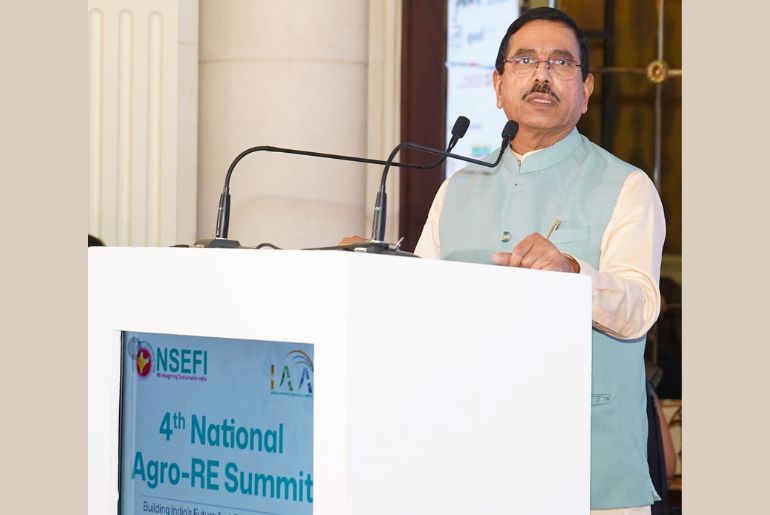
Union Minister of New & Renewable Energy Pralhad Joshi highlighted the growing impact of renewable energy in strengthening India’s rural economy and improving farmers’ incomes while addressing the 4th National Agro-RE Summit in New Delhi.
Speaking at the event, the minister emphasised that renewable energy is increasingly reaching farms and rural households, enabling farmers to access reliable electricity while lowering irrigation costs and boosting agricultural productivity. He noted that solar technologies are transforming how rural communities generate and consume power.
“A farmer irrigating his field today may be doing so using solar power, and a household that once worried about electricity bills may now be producing its own electricity through rooftop solar. This is not just an energy transition, it is also a transformation of the rural economy,” Union Minister of New & Renewable Energy Pralhad Joshi said.
Solar Pumps Reducing Irrigation Costs
The minister highlighted the expanding use of solar irrigation pumps in agriculture, which reduce farmers’ reliance on diesel while ensuring reliable daytime irrigation.
Diesel-powered irrigation can cost nearly ₹6,790 per acre for wheat and over ₹8,000 per acre for crops such as cotton. Solar pumps, however, can help farmers save ₹5,000 to ₹6,500 per acre annually, while also cutting emissions.
Under the PM‑KUSUM Scheme:
• More than 10 lakh standalone solar agricultural pumps have been installed
• Over 13 lakh grid-connected pumps have been solarised
The minister noted that these initiatives are helping farmers become “Urjadaata” (energy providers) in addition to “Annadata” (food providers).
PM-KUSUM 2.0 to Promote Agri-PV
Joshi also announced that the government is preparing PM-KUSUM 2.0, which will feature a dedicated 10 GW Agri-PV component. The initiative aims to enable farmers to install solar panels while continuing agricultural activities on the same land.
This co-location model will allow farmers to generate electricity while cultivating crops, supporting decentralised renewable energy generation in rural areas.
Agrivoltaics Unlocking New Income Opportunities
The minister talked a lot about how agrivoltaic systems could be used to grow crops and make solar energy at the same time. Some estimates say that India’s agrivoltaic potential could be anywhere from 3,000 GW to almost 14,000 GW.
Studies indicate that such systems could significantly enhance farm income. In some cases, annual earnings could rise from about ₹60,000 per acre to more than ₹1 lakh per acre when electricity generation income is combined with crop cultivation.
Rooftop Solar Expanding Household Energy Access
Joshi also highlighted the progress of the PM Surya Ghar: Muft Bijli Yojana.
Key achievements include:
• Over 31 lakh households have installed rooftop solar systems
• Families are generating their own electricity and reducing power bills
India’s Renewable Energy Growth
The minister noted that India’s non-fossil fuel capacity has grown from about 81 GW in 2014 to nearly 275 GW today, with more than half of the country’s installed electricity capacity now coming from non-fossil sources.
Capacity expansion includes:
• Solar: from 2.8 GW in 2014 to nearly 143 GW
• Wind: from around 21 GW to about 55 GW
• Biopower: from 8.1 GW to about 12 GW
Joshi reiterated that India aims to reach 500 GW of non-fossil fuel capacity through millions of decentralised renewable installations across farms, rooftops and rural enterprises.
Call for Collaboration in Agrivoltaics
Speaking at the summit, Shripad Yesso Naik highlighted agrivoltaics as a key solution for balancing energy generation with agricultural land use.
He stressed that agrivoltaic systems allow simultaneous crop cultivation and clean electricity generation, improving land-use efficiency while supporting renewable expansion.
Naik called for stronger collaboration among government, industry, research institutions and financial organisations to accelerate the deployment of affordable agrivoltaic technologies for farmers.
About the Summit
The 4th National Agro-RE Summit was organised by the National Solar Energy Federation of India in collaboration with the India Agrivoltaics Alliance.
The event brought together policymakers, industry leaders, farmer representatives and renewable energy stakeholders to discuss strategies for integrating renewable energy with agriculture.
 Electrify your feed! Click here to join our Whatsapp group and to get the latest updates, expert insights, and innovations driving India’s energy storage revolution.