
A massive surge in artificial intelligence and hyperscale data-centre development is set to spark one of the biggest energy-storage investment cycles of the decade, according to a new analysis released by UBS Securities. The report predicts that the global energy-storage market—already one of the fastest-growing segments of the power sector—will enter an accelerated boom phase over the next five years, driven largely by the rising electricity appetite of AI workloads.
UBS notes that as data centres expand rapidly across the United States, Europe, and key Asian markets, utilities are beginning to face unprecedented round-the-clock power demand. AI-enabled workloads, unlike conventional cloud operations, require high-density processing that runs continuously, placing tremendous pressure on grid infrastructure. To avoid instability or large-scale outages, UBS forecasts that energy storage will soon become a critical buffer between renewable energy supply and the explosive growth of digital infrastructure.
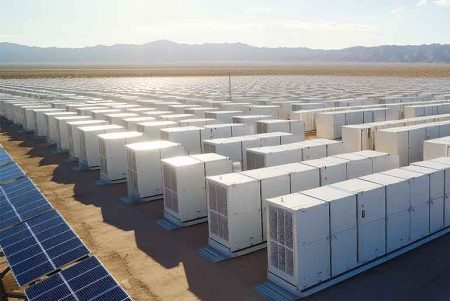
The investment bank projects that global energy-storage demand may rise by nearly 40% year-on-year in 2026, as more utilities, developers and data-centre operators integrate large-scale battery systems. In the U.S., UBS expects renewable energy to remain the only power-generation category showing significant expansion over the next five years. However, because wind and solar are variable, utilities will be forced to pair them with storage solutions, particularly multi-hour lithium-ion and emerging long-duration systems.
The report also highlights that Chinese battery manufacturers currently hold about 20% of the U.S. energy-storage market, but warns that geopolitical risks and the U.S. administration’s evolving clean-tech policies could disrupt this supply chain. Proposed legislation such as the “One Big Beautiful Bill” could sharply restrict Chinese technology participation, potentially reshaping global battery procurement and pricing.
Beyond the U.S., UBS identifies emerging markets such as the Middle East, Latin America, Africa and Southeast Asia as the next hotspots for storage installations. These regions could witness 30–50% growth rates, powered by strong renewable-energy pipelines and increasing industrialisation. Many countries are also exploring utility-scale storage to enhance grid stability, reduce blackouts and support ongoing electrification.
China is expected to continue leading global storage installations, with UBS emphasising supportive policies such as market-based renewable pricing and prospective “capacity payments” for storage assets. Even a relatively modest difference between peak and off-peak electricity prices—around 0.4 yuan per kWh—could make standalone storage projects financially viable.
For India, the findings offer a strong directional signal. With rapid expansion of domestic data centres, AI-computing clusters and renewable energy, analysts believe India may also experience an accelerated need for grid-scale storage. The sector could benefit from policy interventions such as storage tenders, viability-gap funding, and domestic manufacturing incentives.
UBS concludes that the intersection of AI infrastructure + renewable energy + storage will define the next decade of global power investment. As hyperscale data centres race to meet AI demand, energy storage will shift from being a support technology to a central pillar of digital-economy infrastructure.
 Electrify your feed! Click here to join our Whatsapp group and to get the latest updates, expert insights, and innovations driving India’s energy storage revolution.