“Put the fire out. Put the electrons back in.”
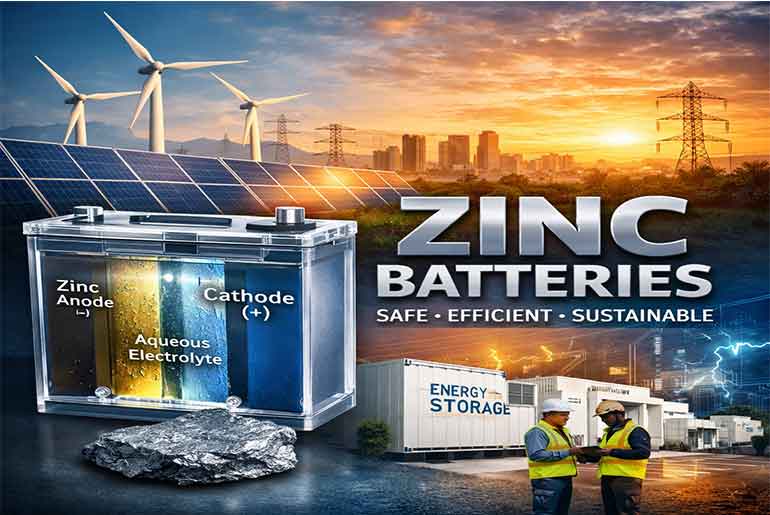
This simple phrase — almost poetic in its clarity — captures the promise of a new class of rechargeable batteries that refuse to burn, cost less, and could finally let us treat energy storage the way we treat pipes and pumps — safe, robust, and heavy-duty. Welcome to the world of aqueous zinc batteries.
As grid scale storage grows rapidly in India and around the world, utility operators and industry leaders are waking up to a harsh reality: traditional lithium-ion technology, while energy-dense and powerful, carries real safety risks and long-term cost uncertainties. Aqueous zinc batteries, by contrast, offer a water-based electrolyte, abundant materials, and a safety profile that could change how we build and operate large energy storage systems.
How Big Is This Market? The Numbers Leaders Should Watch
Forecasts for aqueous battery systems show robust growth. While definitions vary across reports — some include different chemistries under the aqueous umbrella — reputable analysts project a compound annual growth rate (CAGR) in the teens to mid-20s over the next five to seven years, depending on geography, industry uptake, and regulatory support.
To put this in perspective:
Aqueous battery markets are expected to grow at roughly 13–25% CAGR through the late 2020s, depending on the region and application.
Zinc battery segments — especially those targeting stationary storage — are attracting significant investment due to lower raw material costs and intrinsic safety advantages compared to lithium chemistry.
This is not a fringe category anymore. Venture capital, government funding, and major utilities are all watching and acting.
Why the Industry Is Paying Attention: Safety, Cost, and Materials
When battery makers talk about aqueous zinc systems, three words come up again and again:
1. Safety
Lithium-ion uses flammable organic electrolytes. In contrast, aqueous systems use water-based electrolytes — water is non-flammable, dramatically reducing the risk of thermal runaway and fire. For large installations near urban areas, industrial parks, hospitals, telecom sites, or defence facilities, safety is paramount, and a higher safety margin is a competitive advantage.
2. Cost
Zinc is abundant and inexpensive compared to lithium, cobalt, and nickel. Battery cost is not only upfront CAPEX — it’s total cost of ownership over decades of operation. A lower bill of materials and simpler recycling pathways point to lower lifecycle costs.
3. Domestic Raw Materials
For countries like India, which import much of their lithium and other critical minerals, zinc may become a strategic advantage. India is one of the world’s largest zinc producers — this presents an opportunity to localize battery value chains and reduce reliance on far-flung supply lines.
Where Are We Today? The Current Scenario
Aqueous zinc batteries are no longer theoretical. Several initiatives — industrial, military, and research-oriented — are moving beyond the lab into real-world demonstrations:
Commercial Manufacturing Momentum
Some companies are currently expanding capacity and planning commercial manufacturing facilities. For example, Zinc8 Energy Solutions in the United States is actively advancing commercial production of zinc-air based systems, attracting both investors and regional economic development support.
This is significant. Moving from prototypes to manufacturing planning is a major industry milestone — it signals that suppliers see scalable demand.
Mission-Critical Use Cases
Defense facilities and mission-critical sites are using zinc systems in pilot deployments precisely because of safety. For instance, a reported multi-million-dollar installation at Naval Base San Diego uses zinc-based storage to improve resiliency while minimizing fire risk. This isn’t speculative, it’s operational.
India-Specific Research & Partnerships
India’s industrial research ecosystem is already engaging with the zinc battery opportunity. A notable collaboration between Hindustan Zinc Ltd. — one of the country’s biggest zinc producers — and the Jawaharlal Nehru Centre for Advanced Scientific Research (JNCASR) has led to prototype zinc-ion pouch cells designed for renewable energy storage applications.
This is important for two reasons:
- It leverages local mineral strength.
- It builds foundational expertise for scaling zinc batteries domestically.
These activities show promise and momentum, though commercial maturity is still in early phases.
Engineering Challenges: Not All Sunshine Yet
For all their promise, aqueous zinc systems face real engineering challenges that industry leaders must understand:
Zinc Dendrites
Zinc metal electrodes can grow needle-like structures called dendrites during cycling. These can bridge the cell and cause shorts. If unchecked, dendrites reduce reliability and cycle life.
Side Reactions
Side reactions — like hydrogen evolution in aqueous environments — can reduce efficiency and shorten battery life.
Researchers are actively addressing these issues through electrolyte additives, interface engineering, and advanced anode structures. But the challenge is translating lab success into commercial reliability across thousands of cycles and varied climates.
Industry leaders evaluating these systems must insist on third-party validation and extended field data before deploying at scale.
Comparing Zinc Aqueous to Lithium-ion: Practical Differences
While each technology has its place, here’s a simple comparison for context:
| Factor | Aqueous Zinc Batteries | Lithium-ion Batteries |
| Safety | Very high (non-flammable) | Moderate (organic electrolyte risk) |
| Cost | Lower raw materials | Higher raw materials |
| Energy Density | Moderate | High |
| Best Fit | Stationary grid storage, mission-critical backup | EVs, portable electronics |
| Material Security | High (zinc abundant) | Moderate to low (critical imports) |
For large, stationary storage systems where safety and cost dominate, zinc systems are attractive. For space-constrained, high energy demand uses such as EVs, lithium remains dominant.
Actionable Insights for Industry Leaders
If you’re responsible for strategy, procurement, or deployment of energy storage, here’s a clear playbook:
1. Run Parallel Pilots
Deploy a small to medium-scale zinc system alongside your existing lithium assets. Measure real performance, degradation, maintenance, and BOS differences. Treat it as data acquisition, not speculation.
2. Supply Chain Strategy
Explore partnerships with local mineral producers or research institutions. India’s zinc capacity and technical expertise can be catalysts for a domestic ecosystem.
3. Third-Party Validation
Require UL/IEC level safety testing and independent performance data before committing major capital.
4. Flexible Design Contracts
Insist on modular system architecture so that future chemistry transitions don’t force complete replacements.
5. Engage with Standards Bodies
Zinc and other aqueous systems are influencing evolving safety and grid interconnection standards — be a participant, not a spectator.
Final Thought
Technology decisions are not purely technical — they are societal, reputational, and future-proofing decisions. Choosing safer chemistry doesn’t just reduce risk; it signals responsibility to employees, customers, regulators, and communities. In energy storage — where installations are often close to people’s workplaces and homes — that matters.
Zinc aqueous batteries will not replace lithium overnight. But they can — and likely will — become a key pillar in diversified storage portfolios, especially for utility and industrial sites that think long term.
 Electrify your feed! Click here to join our Whatsapp group and to get the latest updates, expert insights, and innovations driving India’s energy storage revolution.