Avaada Group is accelerating its expansion in India’s renewable energy sector with a planned investment of ₹22,000 crore across solar generation, battery energy storage systems (BESS), and pumped hydro projects. The move comes as renewable energy penetration rises and the need for grid-balancing solutions becomes increasingly critical.
Focus on Storage and Solar Capacity Expansion
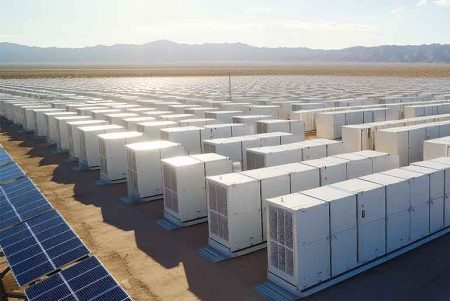
The investment includes ₹7,500 crore allocated for pumped storage projects, alongside a 2,500 MWh battery energy storage system under development in Rajasthan. In addition, the company is preparing to commission nearly 1,000 MW of solar capacity by March.
“We are planning around ₹7,500 crore in pumped storage. As renewable capacity increases, long-duration storage becomes essential to manage peak shifts and maintain grid stability,” said Vineet Mittal, chairman of Avaada Group.
The company expects to operationalise between 800 MW and 1 GW of solar capacity within the current fiscal year.
“Most substations are ready. Synchronisation will happen as grid processes are completed. We are targeting close to 1,000 MW by March,” he added.
Balancing Short- and Long-Duration Storage Needs
Avaada’s 2,500 MWh battery project, expected to be commissioned next year, forms a key component of its broader investment strategy. The change shows that storage needs have changed, with tenders now being built to last four to six hours of delivery to meet longer periods of peak demand.
Mittal emphasized the importance of deploying both battery and pumped hydro solutions to support grid reliability.
“Battery systems address immediate peak requirements, while pumped storage supports longer-duration balancing,” he said.
Policy Support and Tariff Stability
The company noted that renewable consumption enforcement is strengthening, with over 130 compliance notices issued. As power purchase agreements (PPAs) are formalised, project execution is expected to accelerate.
Highlighting cost advantages, Mittal stated, “At comparable utilisation levels, renewables with storage provide stable pricing structures,” positioning them as a competitive alternative to thermal power, where tariffs tend to rise over time.
Global Supply Chain and Hydrogen Outlook
Global market dynamics are also influencing the company’s strategy. Changes in production levels in China have led to recent increases in module prices.
“This could create opportunities in markets such as Europe and the Middle East, though the US market remains constrained due to tariff conditions,” Mittal said.
On green hydrogen and ammonia projects, he added, “Without binding long-term contracts, financial closure remains difficult. We will proceed only when firm demand is secured.”
The Solar Storage investment by Avaada underscores it’s focus on integrated renewable and storage solutions to support India’s evolving energy landscape.
 Electrify your feed! Click here to join our Whatsapp group and to get the latest updates, expert insights, and innovations driving India’s energy storage revolution.