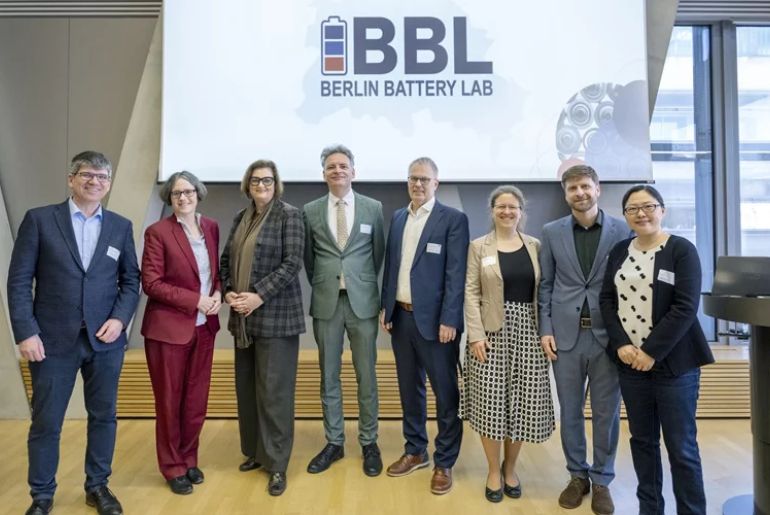
The Federal Institute for Materials Research and Testing (BAM), Helmholtz Zentrum Berlin (HZB), and Humboldt-Universität zu Berlin (HU) have officially inaugurated the Berlin Battery Lab (BBL), a new joint research platform focused on developing resource-efficient and sustainable battery technologies. The lab emphasizes sodium-based systems while also exploring lithium-sulfur batteries and other innovative chemistries.
The Berlin Battery Lab will make new materials, research new cell chemistries, and make battery prototypes. It is open to outside partners from both science and business, with the goal of speeding up the process of turning research into useful products.
In the past few years, Berlin has become a major center for battery research. More and more people are paying attention to sustainable alternatives like sodium-ion and lithium-sulfur systems. The Berlin Battery Lab combines the best parts of the three institutions:
- BAM contributes expertise in battery safety and the development of advanced energy materials.
- HU Berlin is recognized for academic leadership in sodium-ion battery research.
- HZB brings long-standing experience in lithium-sulfur batteries and operates BESSY II, a world-class X-ray facility for battery studies.
Together, the lab consolidates fundamental research, materials development, cell design, and safety testing at a single location, bridging the gap between research and industrial application. Start-ups and technology-oriented companies are expected to benefit from the lab’s collaborative environment.
Official Statements:
Dr. Ina Czyborra, Berlin Senator for Science, Health and Care, said, “The Berlin Battery Lab illustrates Berlin’s strength in strategically bringing together top-level research and technological needs…Battery research is a key technology on the High-Tech Agenda. The State of Berlin is supporting this goal with an additional €2.4 million from the European Regional Development Fund between 2026 and 2028.”
Prof. Dr. Ulrich Panne, President of BAM, stated, “Many new battery technologies are being developed in Germany, but they are not reaching application quickly enough. The Berlin Battery Lab helps transfer sustainable innovations into practice.”
Prof. Dr. Julia von Blumenthal, President of HU, added, “The Berlin Battery Lab consolidates the expertise of three outstanding research institutions…It will facilitate collaboration with industry and accelerate processes leading to practical application.”
Prof. Dr. Bernd Rech, Scientific Director of HZB, noted, “We combine our diverse competencies to accelerate development and technology transfer to industry, establishing a new pouch-cell lab for sodium-ion batteries at BESSY II.”
During the inauguration, Prof. Dr. Philipp Adelhelm (HU) received the Wilhelm-Ostwald Fellowship from BAM, recognizing his contributions to sodium-ion battery research and fostering interdisciplinary collaboration within the Berlin Battery Lab.
The Berlin Battery Lab is set to play a pivotal role in advancing sustainable battery technologies and supporting Germany’s energy transition.
 Electrify your feed! Click here to join our Whatsapp group and to get the latest updates, expert insights, and innovations driving India’s energy storage revolution.