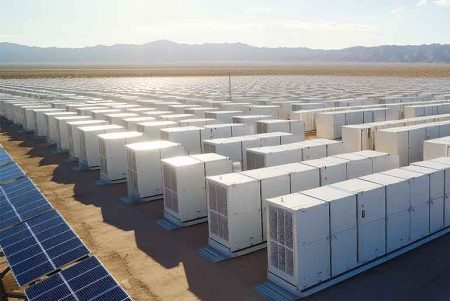
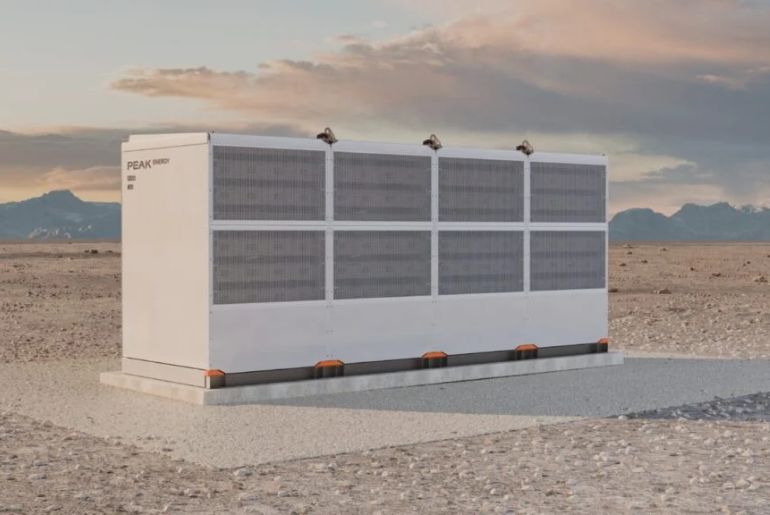
Peak Energy, in partnership with RWE Americas, is set to deploy the first sodium-ion battery in the Midcontinent Independent System Operator (MISO) service area in eastern Wisconsin. The system is passively cooled, which significantly reduces auxiliary power use by 90% and lowers lifetime storage costs by around $70 per kWh.
According to Peak Energy, this new battery could be a “first ripple indicating MISO’s pivot toward next-gen, non-lithium storage” as the grid operator faces rising costs, capacity constraints, and solar project delays.
Why Sodium-Ion Batteries?
Sodium-ion technology is well-suited for the Midwest because it can operate safely across a wide temperature range without losing performance. The passive cooling design and low degradation focus help reduce overbuild, cut maintenance, and save energy. Peak Energy’s proprietary energy storage system (ESS) claims to cut the lifetime cost of stored energy by roughly half compared to traditional lithium-ion systems.
“This system can reduce the lifetime cost of energy stored by an average of $70/kWh,” the company said, emphasizing its efficiency and cost-effectiveness.
Impact on the US Grid
MISO has lagged behind states like California and Texas in energy storage deployment. A 2025 report from Aurora Energy Research suggested that installing 10 GWh of battery storage by 2035 could save up to $27 billion in total system costs. Using Peak Energy’s sodium-ion systems could further cut costs by another 25% compared to lithium-ion alternatives.
Industry experts see this pilot project as a significant step toward adopting advanced storage solutions to meet growing energy demands while controlling costs.
Peak Energy and RWE’s collaboration marks a notable milestone for next-generation energy storage in the US, potentially shaping the future of grid-scale battery deployment.
 Electrify your feed! Click here to join our Whatsapp group and to get the latest updates, expert insights, and innovations driving India’s energy storage revolution.