As India accelerates its journey towards becoming a global clean energy powerhouse, the conversation around solar manufacturing is rapidly evolving from scale alone to resilience, technology leadership, materials innovation, and supply-chain self-reliance. Among the few companies that have consistently championed this transformation is RenewSys India Private Limited, one of India’s most integrated solar manufacturing companies with capabilities spanning encapsulants, backsheets, solar cells, and modules.
At a time when the industry is navigating rapid technology transitions, increasing localization imperatives, and the convergence of solar with storage and digital energy ecosystems, the role of manufacturing has become more strategic than ever before.
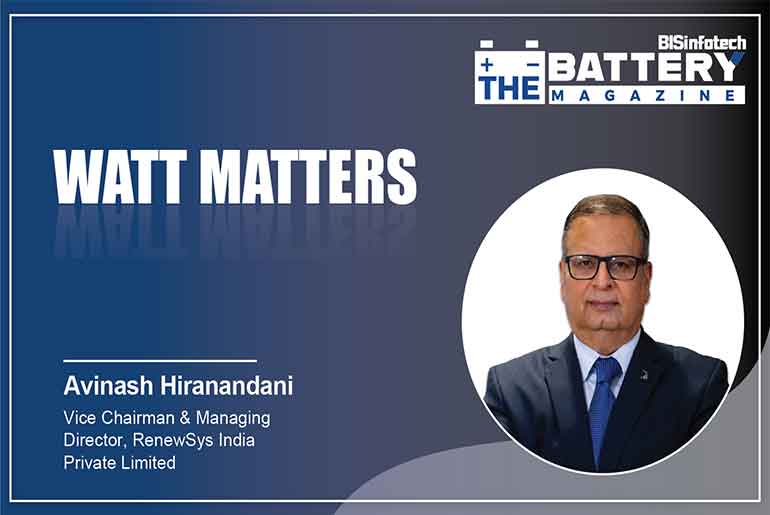
In an exclusive interaction with The Battery Magazine, Shweta Kumari, Sub-Editor, engaged in a thought-provoking discussion with Avinash Hiranandani, Vice Chairman & Managing Director, RenewSys India Private Limited, to understand how the company views the future of India’s solar manufacturing ecosystem. The conversation delves into critical themes including vertical integration versus specialization, emerging cell technologies beyond TOPCon, the importance of materials science in enhancing module reliability, the future of integrated clean energy manufacturing facilities, and the challenges of building a truly self-reliant upstream ecosystem.
Mr. Hiranandani also shares his perspective on balancing aggressive capacity expansion with long-term competitiveness and outlines the factors that will ultimately define global manufacturing leadership in the coming decade.
Let’s delve into the Interview to know more.
RenewSys was among the earliest companies to pursue deep manufacturing integration across modules, cells, encapsulants, and backsheets. Looking ahead, do you believe vertical integration will become the defining competitive advantage in India’s solar manufacturing landscape, or will specialization ultimately prevail?
Vertical integration provides significant strategic advantages because it enables greater control over quality, supply-chain reliability, product development, and cost optimization. At RenewSys, our integrated manufacturing model has allowed us to innovate across multiple product categories while ensuring consistent quality for our customers.
That said, there is no single model that will define success. The industry will likely see both integrated manufacturers and highly specialized technology leaders coexist. Success will depend less on structure and more on execution.
The differentiator will be how effectively companies leverage their chosen strategy to create value through technology, operational excellence, and customer trust.
The global solar industry is undergoing one of its fastest technology transitions, with TOPCon rapidly emerging as the mainstream architecture. Beyond TOPCon, which technologies do you believe could redefine competitiveness over the next decade, and how is RenewSys preparing for this future?
TOPCon represents a significant step forward and will remain the dominant technology for the foreseeable future. However, innovation never stops in this industry.
Technologies such as Back Contact (XBC), Heterojunction (HJT), tandem architectures, and eventually perovskite-silicon combinations have the potential to redefine efficiency and manufacturing economics over the next decade.
At RenewSys, we continuously evaluate emerging technologies while investing in manufacturing flexibility. The objective is not simply to adopt every new technology, but to introduce commercially viable solutions that deliver long-term value to customers.
Future competitiveness will depend on balancing innovation with manufacturing maturity, reliability, and scalability.
India’s manufacturing ambitions are increasingly being linked to energy security. In your view, what are the most critical gaps that still exist within India’s upstream solar manufacturing ecosystem, particularly across wafers, polysilicon, equipment, and critical materials?
India has made significant progress in module and cell manufacturing, but the next phase of our manufacturing journey lies in developing a robust upstream ecosystem. Today, we continue to rely on imports for wafers, polysilicon, manufacturing equipment, specialty chemicals, and several critical materials, creating supply-chain vulnerabilities and exposing manufacturers to global market disruptions.
Addressing these gaps will require substantial capital investment, advanced technology, and long-term policy support. It is a complex transition that cannot happen overnight, but it is essential if India is to build a truly resilient and globally competitive solar manufacturing ecosystem. A self-reliant industry can only be achieved when every layer of the value chain is strengthened.
The solar industry often focuses on cells and modules, while critical components such as encapsulants and backsheets receive comparatively less attention. How important will materials science and component innovation become in improving module reliability, bankability, and lifecycle performance?
Materials science is often the hidden driver of long-term module performance.
Cells generate power, but encapsulants, backsheets, glass, junction boxes, and other materials determine how reliably that power is delivered over twenty-five to thirty years.
As module technologies become more advanced—with thinner wafers, higher efficiencies, bifacial architectures, and larger formats—the demands on encapsulation materials and protective components become even greater.
Innovation in materials directly influences durability, degradation rates, safety, and long-term energy yield. Ultimately, bankability is built not only on efficiency but also on confidence that a module will continue performing reliably throughout its operating life.
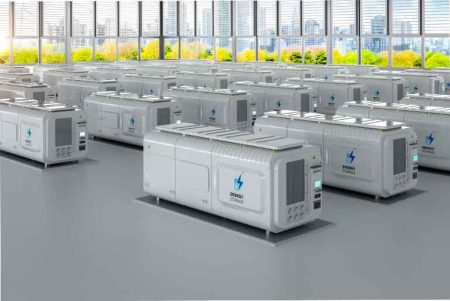
As solar deployment increasingly converges with Battery Energy Storage Systems (BESS), smart inverters, and digital energy platforms, how do you envision the future solar manufacturing facility evolving? Will tomorrow’s gigafactories become integrated clean energy manufacturing hubs rather than standalone module plants?
Absolutely.
The energy transition is moving beyond individual products toward integrated energy solutions.
Future manufacturing campuses are likely to combine solar modules, storage technologies, power electronics, digital monitoring systems, and advanced automation within interconnected ecosystems.
Manufacturing itself will also become significantly more digital through AI-driven quality control, predictive maintenance, robotics, digital twins, and real-time process optimization.
The future factory will not simply manufacture components—it will manufacture complete clean energy solutions.
India is witnessing unprecedented manufacturing expansion supported by PLI, ALMM, and import substitution policies. However, several industry observers caution against potential overcapacity risks. How should manufacturers balance aggressive capacity expansion with long-term financial sustainability and global competitiveness?
Capacity expansion should always be driven by sustainable market demand rather than optimism alone.
Scale is important because it improves manufacturing efficiency, but scale without competitiveness creates long-term challenges.
Manufacturers must focus equally on technology leadership, operational efficiency, product differentiation, financial discipline, and export competitiveness.
Government policies have provided a strong foundation, but ultimately every manufacturer must remain globally competitive without relying indefinitely on policy support.
Long-term success comes from building resilient businesses rather than simply building larger factories.
Looking ahead to 2035, what do you believe will ultimately determine leadership in global solar manufacturing—manufacturing scale, technology leadership, supply-chain control, digital intelligence, sustainability performance, or something entirely different?
By 2035, leadership will no longer be defined by any single metric.
Scale will remain important, but it will only be one component of competitiveness.
The true leaders will combine advanced technology, integrated supply chains, manufacturing intelligence, operational agility, sustainability, and continuous innovation.
Customers increasingly evaluate manufacturers not only on product performance but also on traceability, carbon footprint, ESG performance, and long-term reliability.
The companies that succeed will be those capable of continuously adapting to technological change while maintaining quality, resilience, and customer confidence.
In the coming decade, manufacturing excellence will evolve from being an operational capability to becoming a strategic advantage.
 Electrify your feed! Click here to join our Whatsapp group and to get the latest updates, expert insights, and innovations driving India’s energy storage revolution.