Battery Energy Storage Systems are rapidly moving from being an emerging technology to becoming an essential pillar of India’s clean energy transition. As commercial and industrial consumers look beyond backup power towards energy optimisation, peak demand management and greater renewable energy utilisation, software-defined storage solutions are creating new opportunities for businesses to reduce costs while improving reliability. Founded with the vision of building intelligent Battery Energy Storage Systems for India’s commercial and industrial sector, VoltSeal combines indigenous engineering with in-house Battery Management Systems (BMS), Energy Management Systems (EMS) and advanced software to deliver application-driven energy storage solutions that help industries maximise the value of every unit of electricity.
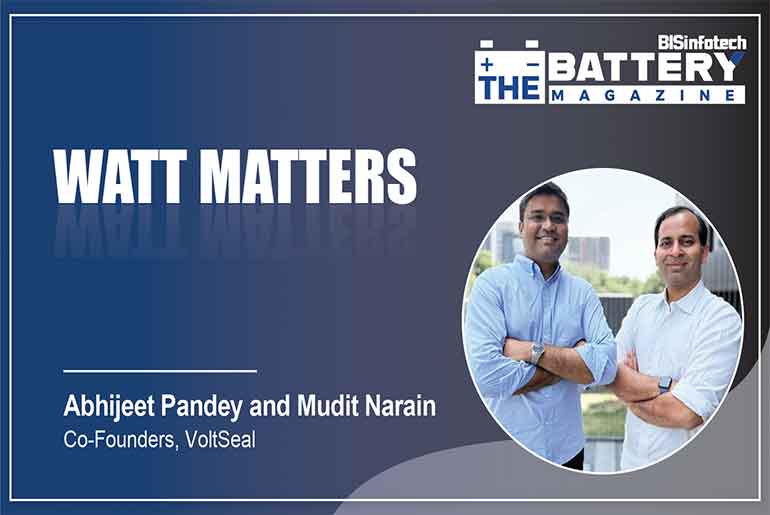
At India Energy Storage Week (IESW) 2026, Shweta Kumari, Sub-Editor, The Battery Magazine, spoke with Abhijeet Pandey and Mudit Narain, Co-Founders of VoltSeal, about the company’s approach to indigenous BESS development, software-enabled energy optimisation, the evolving commercial and industrial storage market, and why they believe battery energy storage will play a defining role in strengthening India’s energy security and accelerating the country’s clean energy ambitions.
VoltSeal is a relatively young company in India’s rapidly evolving Battery Energy Storage System (BESS) ecosystem. Could you introduce the company and the solutions you are showcasing at India Energy Storage Week?
VoltSeal was founded with the vision of developing intelligent Battery Energy Storage Systems that are engineered specifically for Indian applications. While battery cells are currently sourced from global suppliers, almost every other critical component of our systems is designed and developed in-house. Our Battery Management System (BMS), Energy Management System (EMS), power electronics, software architecture and overall system integration are all built by our engineering teams.
This level of vertical integration gives us complete control over product quality, system performance and long-term reliability, which we believe is one of our biggest strengths.
At India Energy Storage Week, we are showcasing our commercial and industrial Battery Energy Storage Systems ranging from 300 kWh to 5 MWh. These solutions are engineered around customer applications rather than being generic storage products. Every deployment is designed to deliver maximum operational value depending on the customer’s energy profile and business requirements.
Beyond storing electricity, how does VoltSeal help commercial and industrial customers optimise their energy consumption?
We believe that a battery, by itself, is only one part of the solution.
The real value is unlocked when storage is intelligently integrated into a customer’s electrical infrastructure. Once a Battery Energy Storage System becomes part of an industrial facility—whether it is a factory, warehouse, dairy or manufacturing plant—it opens multiple opportunities for energy optimisation.
Our software continuously analyses energy consumption and enables applications such as peak shaving, demand charge optimisation, diesel generator replacement, renewable energy integration and overall energy conservation.
One philosophy we strongly believe in is that our battery system is not a product looking for a problem. Instead, we design every solution around the actual operational challenges faced by industries. Because we develop both the BMS and EMS ourselves, customers gain much deeper visibility into how their storage assets perform and how they can extract maximum value throughout the system’s lifecycle.
Battery Energy Storage Systems are gaining significant policy support in India. What opportunities and challenges do you currently see for the industry?
Battery Energy Storage Systems are still relatively new assets for many industries. Electrical engineers have spent decades working with transformers, capacitor banks and conventional electrical equipment, but energy storage introduces an entirely new way of managing electricity.
As with any emerging technology, customer education remains one of the biggest challenges. Businesses need to understand where storage creates value, how it should be deployed and which applications generate the strongest returns.
Fortunately, the policy environment has become extremely encouraging. We are seeing significant support from the Government of India, regulatory bodies and various state governments that increasingly recognise storage as an essential component of the country’s renewable energy transition.
The ecosystem is also maturing rapidly. Manufacturers, software companies, system integrators and EPC players are all contributing to a much stronger Battery Energy Storage value chain.
One challenge that still remains is India’s dependence on imported battery cells, particularly from China. However, as domestic cell manufacturing continues to develop, we believe localisation will accelerate significantly and further strengthen India’s energy storage ecosystem.
Interestingly, we believe Battery Energy Storage today is at a stage similar to where solar energy was around 2011-12. The difference is that storage adoption will happen much faster because the market has already witnessed the success of renewable energy over the last decade.
What major market trends are you observing across India’s commercial and utility-scale Battery Energy Storage sector?
The commercial and industrial market is evolving very quickly, and we are seeing adoption driven by regional energy requirements.
For example, industries in Maharashtra are increasingly deploying Battery Energy Storage Systems for peak shaving, while customers across northern India are showing strong interest in diesel generator replacement. These application-specific requirements are shaping regional demand patterns.
Another encouraging trend is that commercial customers are beginning to understand that Battery Energy Storage Systems are no longer simply backup power solutions—they are strategic assets that help reduce overall electricity costs and improve energy efficiency.
On the utility side, we are witnessing growing participation in Front-of-the-Meter (FTM) projects. Earlier, only a handful of companies dominated this space. Today, startups like VoltSeal are also contributing alongside established players, creating a far more competitive and innovative ecosystem.
Government mandates, state-level policies and large-scale BESS tenders are further accelerating market adoption, giving confidence to both investors and technology developers.
Safety, reliability and long-term performance are becoming increasingly important as Battery Energy Storage Systems scale across India. How is VoltSeal addressing these priorities?
Industry standards and certification frameworks are still evolving, but we believe safety should never be limited to meeting minimum compliance requirements.
Our engineering philosophy is to build systems that continue performing reliably throughout their operational life, not just during laboratory testing or certification.
Battery Energy Storage Systems are expected to remain operational for 10 to 12 years, often under demanding environmental conditions. Therefore, every design decision must consider real-world operating scenarios rather than ideal laboratory conditions.
Every battery cell entering our systems undergoes detailed evaluation, while our electronics, software, BMS and EMS are all developed in-house at our Noida facility. This integrated design approach ensures complete system integrity, improves reliability and enables us to deliver a cohesive solution instead of assembling components from multiple suppliers.
India has set ambitious renewable energy targets while pursuing Net Zero goals. In your view, what role will Battery Energy Storage Systems play in this journey?
There is one statistic that has always fascinated me.
India receives an extraordinary amount of solar energy every single day. As is often highlighted within the renewable energy industry, the solar radiation falling on the country in just one day has the potential to meet a substantial share of our annual energy requirements if it can be effectively captured and stored.
That changes the conversation entirely.
The challenge is no longer whether renewable energy is available—the challenge is how efficiently we can store it and make it available whenever industries, businesses and consumers actually need it.
This is precisely where Battery Energy Storage Systems become indispensable. Storage transforms intermittent renewable energy into dependable, dispatchable power.
In many ways, we believe storage is the bridge between India’s renewable energy ambitions and true energy sovereignty. It reduces dependence on imported fossil fuels, strengthens energy security and supports long-term economic growth.
At VoltSeal, we believe we are building much more than Battery Energy Storage Systems—we are helping build the technological foundation for India’s energy-independent future.
Looking ahead, what is VoltSeal’s vision for the next five years?
Our immediate priority is to continue developing highly reliable Battery Energy Storage Systems that deliver long-term value for customers across different applications.
As we deploy more systems and gain experience across diverse industries, we will continue strengthening our engineering capabilities, software intelligence and overall product robustness.
Over the next five years, we aim to expand across both the Behind-the-Meter (BTM) and Front-of-the-Meter (FTM) segments while maintaining our focus on indigenous engineering, product quality and customer-centric innovation.
For us, sustainable growth will come from building dependable products that customers can confidently operate for more than a decade, while contributing meaningfully to India’s rapidly expanding energy storage ecosystem.
How do you see software intelligence evolving as a competitive differentiator in the next generation of BESS?
BESS is shifting from a hardware category to a systems-intelligence category, and software will be the primary differentiator going forward, not cell chemistry or enclosure design, which are increasingly commoditised.
Today, the gap in India’s grid is temporal: solar floods the market midday, crashing exchange prices to Rs 1–2/unit, while evening tariffs spike to Rs 10–12/unit as thermal plants take over, and diesel backup runs at Rs 30–40/unit. Capturing this arbitrage — buying cheap, storing, discharging expensive — requires continuous, real-time decision-making that static hardware cannot perform alone.
This is why VoltSeal builds its BMS, EMS, and optimisation layer in-house rather than treating the battery as the product. Over time, this shifts individual batteries from isolated backup assets into a coordinated infrastructure, laying the foundation for aggregation into Virtual Power Plants that deliver grid-balancing services at scale.
As LFP costs fall and hardware margins compress industry-wide, the durable competitive moat in BESS will belong to whoever owns the intelligence layer — the software that decides when to store, discharge, trade, and eventually participate in markets, not whoever assembles the battery.
What ROI misconceptions do you encounter with C&I customers, and how do you address them?
The most common misconception is that BESS is evaluated like diesel: a pure cost-avoidance, backup-only asset whose value is capped at “insurance against outages.” This framing undersells the economics. VoltSeal counters it by showing customers the active arbitrage case: at current system costs, BESS delivers a 3–4 year payback based entirely on today’s energy cost savings with no dependence on future policy changes or further price declines, since cell prices have already fallen from over $1,500/kWh in 2010 to roughly $50 today.
A second misconception is that returns are speculative or back-loaded. Customers often assume payback depends on future regulatory shifts (like VPP monetisation) materialising. In reality, the core ROI — diesel displacement plus daytime-cheap/evening-expensive tariff arbitrage, peak shaving — is bankable now, on current tariffs alone; VPP and market participation are upside, not the basis of the investment case.
A third is underestimating operational value: customers frequently don’t realise the software layer actively manages dispatch, so returns compound rather than stay flat, unlike a diesel genset, whose value degrades with fuel cost volatility. We address this with transparent, site-specific payback modelling using the customer’s actual load profile and current tariff structure, rather than generic industry assumptions, making the ROI case concrete rather than aspirational.
With India’s domestic battery manufacturing ecosystem gradually expanding, how do you envision VoltSeal’s technology roadmap evolving as indigenous cell production becomes commercially available?
VoltSeal aims to develop the best BESS management and control systems. We will work with cell manufacturers to optimise the products for emerging market needs. We would want to grow with the cell manufacturers, as India’s energy storage ecosystem expands. Currently, we will use LFP Li-ion cells, and even give a chance to manufacturers of new chemistries such as sodium-ion, etc for testing.
 Electrify your feed! Click here to join our Whatsapp group and to get the latest updates, expert insights, and innovations driving India’s energy storage revolution.