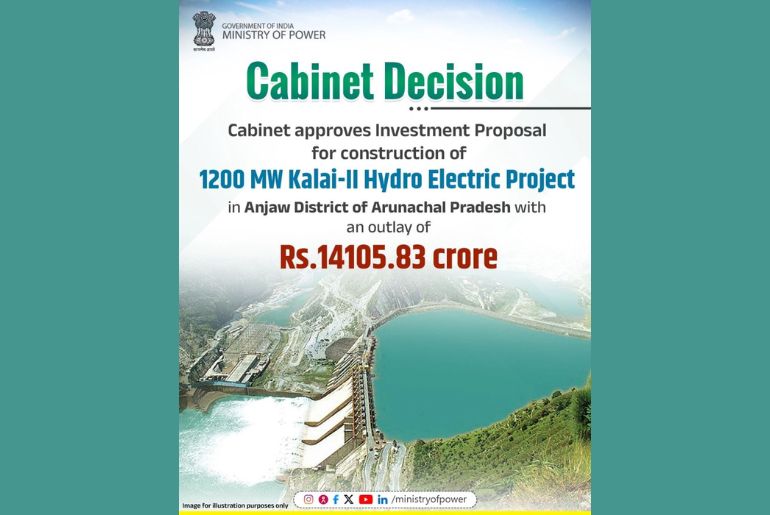
The Cabinet Committee on Economic Affairs (CCEA), chaired by Prime Minister Narendra Modi, has approved an investment of ₹14,105.83 crore for the construction of the Kalai-II Hydro Electric Project (HEP) on the Lohit River in Anjaw district of Arunachal Pradesh. The project is expected to be completed within a period of 78 months.
Project Capacity and Energy Generation
There will be six 190 MW units and one 60 MW unit in the Kalai-II HEP, giving it a total installed capacity of 1,200 MW. When the project is done, it is expected to produce about 4,852.95 million units (MU) of electricity every year.
As the first hydroelectric project in the Lohit Basin, it is expected to significantly enhance power availability in the region, support peak demand management, and contribute to balancing the national power grid.
Implementation and Financial Support
THDC India Limited and the Government of Arunachal Pradesh will work together to build the project. The Indian government will give 599.88 crore in budgetary support to help with the project. This money will go toward building the infrastructure needed, such as roads, bridges, and transmission lines.
Additionally, a Central Financial Assistance of ₹750 crore will be extended towards the state’s equity share in the project.
Benefits for the State and Local Communities
As part of the project, Arunachal Pradesh will get 12% of its power for free, plus 1% more for the Local Area Development Fund (LADF). These rules are likely to bring about long-term social and economic benefits.
The project will also drive infrastructure development in Namsai and Anjaw districts, including the construction of approximately 29 kilometres of roads and bridges, which will largely be accessible for local use.
Socio-Economic Impact
In addition to improving infrastructure, the project is expected to create jobs and give the local people pay and corporate social responsibility (CSR) benefits. The Kalai-II Hydro project is seen as an important step toward improving the region’s development and India’s ability to produce more renewable energy.
 Electrify your feed! Click here to join our Whatsapp group and to get the latest updates, expert insights, and innovations driving India’s energy storage revolution.