As India continues to accelerate its renewable energy transition, companies operating in the EPC and project development space are increasingly diversifying their portfolios to include emerging technologies such as battery energy storage systems (BESS) and green hydrogen. With policy support strengthening and large-scale renewable projects expanding, energy developers are exploring integrated solutions that combine generation, storage, and advanced energy infrastructure.
At The smarter E India 2026 exhibition, several renewable energy developers showcased their evolving project portfolios and expansion strategies. Among them was Greenpill Renewable Energy Private Limited, a company that has grown from a solar EPC player into a diversified renewable energy developer.
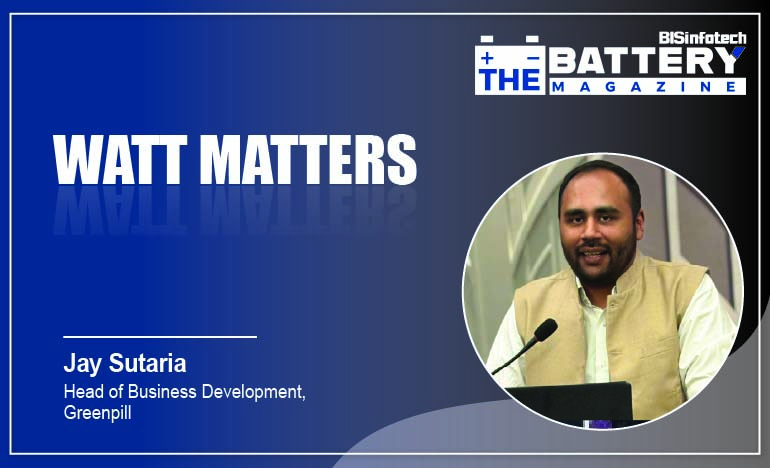
During the exhibition, The Battery Magazine interacted with Jay Sutaria, Head of Business Development at Greenpill, who shared insights into the company’s solar EPC experience, upcoming BESS projects, and its long-term growth vision leading up to 2030.
How has the exhibition been so far, and what kind of response are you receiving at your booth?
The exhibition has been very encouraging. Even though it is just the first day, we are already seeing strong visitor engagement at the booth. We are meeting a wide range of stakeholders, including developers, land aggregators, and investors who are exploring opportunities in renewable energy projects.
Events like this are important because they bring together industry participants who are actively working in the renewable ecosystem and looking for collaboration opportunities.
Could you briefly explain Greenpill’s core business and how the company has evolved over the years?
Greenpill started primarily as a solar EPC company, and we have been operating in this space for more than 13 years.
Over time, we have expanded our capabilities and gradually transitioned into an Independent Power Producer (IPP) as well. Our focus today is not limited to solar generation; we are also exploring several emerging sectors within renewable energy, including battery energy storage systems (BESS), hydrogen, and green methanol projects.
Currently, the company is on track to achieve a turnover of approximately ₹250 crore this year, and we are also planning to launch an IPO in the near future.
What does your current project portfolio look like?
Over the last 12 years, we have executed more than 500 MW of solar projects. In the current year alone, we expect to add another 100 MW of capacity, primarily in solar generation projects.
So far, our focus has largely been on generation assets. However, with the recent developments in state policies related to energy storage, we are now beginning to expand into the BESS segment as well.
Are there specific technologies or battery chemistries you plan to adopt for your energy storage projects?
At present, we are primarily looking at lithium-ion battery technologies for our storage projects. Several global suppliers are offering solutions, and we are evaluating multiple options.
Most of the systems we are considering currently offer 4-hour or 6-hour storage configurations, which are commonly used for grid balancing and renewable integration.
While emerging technologies such as sodium-ion batteries may become relevant in the future, the market today is largely centered around lithium-ion solutions.
How do you decide which storage technologies to deploy in your projects?
The choice of technology depends on multiple factors. In many cases, project decisions are influenced by state policies, regulatory requirements, and tender conditions.
For example, recent policy updates from the Ministry of New and Renewable Energy (MNRE) have encouraged developers to integrate BESS with renewable energy projects. This allows projects to supply electricity for longer durations and offer more reliable power.
Without storage, solar plants typically provide effective generation for around 7–8 hours a day. With battery storage integrated, the supply window can extend to 13–14 hours, which significantly improves grid stability and project economics.
How do you see battery storage influencing project economics in the future?
Currently, integrating battery storage into solar projects roughly doubles the project cost compared to standalone solar installations.
However, we expect storage costs to decline significantly in the coming years. As manufacturing capacity expands and more battery manufacturers enter the market, prices could fall substantially over time.
Technological advancements and economies of scale will also play an important role in bringing down costs.
You mentioned hydrogen earlier. How do you see hydrogen technologies evolving in India?
Green hydrogen is still in its early stages in India. At present, its primary applications are in industrial sectors such as steel and specialty manufacturing, where hydrogen is used in certain production processes.
Several companies are exploring hydrogen production using electrolyzer technologies, and we are evaluating solutions from established technology providers.
While hydrogen storage and large-scale hydrogen infrastructure will take time to develop, it is certainly an area that will gain importance in the coming years.
Greenpill has outlined a Vision 2030. Could you share what the company aims to achieve by then?
Currently, our turnover stands at around ₹250 crore, and our target is to cross ₹1,000 crore in revenue by 2030.
Our projected growth will come from multiple segments:
- Around 50% from solar EPC projects
- Approximately 20% from battery energy storage systems
- Additional revenue from manufacturing solar structures and battery components
- Expansion into power transmission infrastructure, including 66 kV transmission line projects
We are also exploring manufacturing facilities for solar structures and battery components in Gujarat, particularly in regions such as Sanand and Becharaji, where industrial policies and ease of doing business are favorable.
How has the Atmanirbhar Bharat initiative influenced your manufacturing plans?
The Atmanirbhar Bharat initiative has definitely encouraged companies to strengthen domestic manufacturing capabilities.
For us, entering manufacturing is also part of a backward integration strategy. For example, in the current year alone, we used nearly 2,500 tons of metal for solar project structures.
By manufacturing these components ourselves, we can reduce project costs and offer more competitive pricing to our clients.
What message would you like to share with your customers and project partners?
Our goal is to provide end-to-end renewable energy solutions. From project development and EPC services to energy storage and infrastructure, we aim to support clients throughout the entire project lifecycle.
We believe collaboration and long-term partnerships will be key to accelerating renewable energy adoption, and we look forward to working closely with our customers in the years ahead.
 Electrify your feed! Click here to join our Whatsapp group and to get the latest updates, expert insights, and innovations driving India’s energy storage revolution.