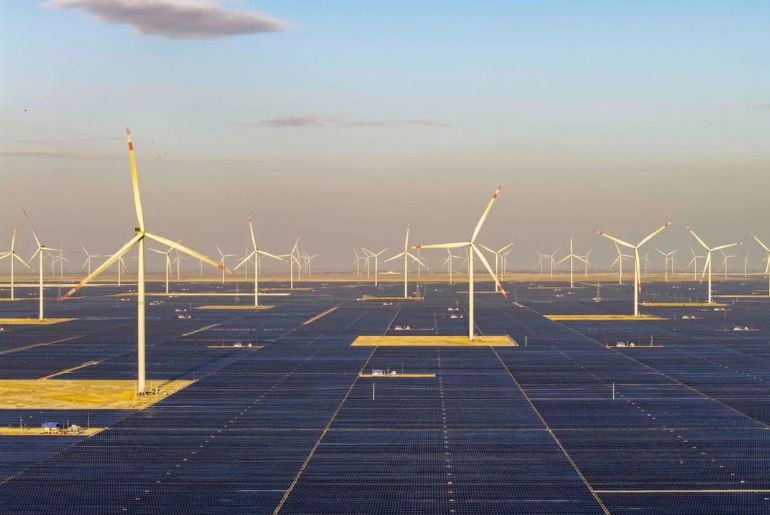
India has achieved a historic milestone in its renewable energy journey by adding 6.05 GW of wind power capacity during FY 2025–26, marking the highest annual addition to date. This surpasses the previous record of 5.5 GW set in FY 2016–17 and reflects a significant acceleration in the country’s onshore wind deployment.
Strong Growth and Sector Momentum
The newest addition is almost 46% more than FY 2024–25, which shows that the wind energy sector is picking up speed again. India’s total installed wind power capacity has now gone over 56 GW, making it one of the top wind energy markets in the world.
The surge in capacity addition is attributed to improved policy clarity, enhanced transmission infrastructure readiness, competitive tariff discovery, and a robust project pipeline across key states.
Key State Contributions and Policy Support
States such as Gujarat, Karnataka, and Maharashtra played a major role in driving this growth. Their contributions have been supported by a rising pipeline of wind-solar hybrid projects and the gradual implementation of green energy open access frameworks, which are encouraging greater participation from industries.
The government’s ongoing policy support has also played a big role in this growth. Some of the most important steps are to lower customs duties on wind turbine parts and raw materials, to gradually lower Inter-State Transmission System (ISTS) charges until June 2028, to set up competitive bidding systems, and to set up a separate Wind Renewable Consumption Obligation (RCO) framework.
Additionally, technical support from the National Institute of Wind Energy has further strengthened project development and execution capabilities.
Supporting India’s Clean Energy Goals
The record capacity addition greatly improves India’s renewable energy portfolio and helps the country reach its goal of having 500 GW of non-fossil fuel-based energy capacity by 2030.
India’s wind energy programme, which began in the early 1990s, has evolved into a mature and well-structured ecosystem. The country has built a strong policy and regulatory framework over the past 30 years to support wind power projects connected to the grid and attract investments.
 Electrify your feed! Click here to join our Whatsapp group and to get the latest updates, expert insights, and innovations driving India’s energy storage revolution.