India is racing to build a domestic battery-storage industry. But factories, gigawatt-hour announcements and government incentives are only the beginning. The real test is whether India can build storage that is competitive, intelligent, bankable — and trusted beyond its borders.
India’s battery-storage story has reached an uncomfortable but important stage. For years, the conversation was about whether India would need BESS. That question is rapidly disappearing. The country’s renewable-energy ambitions are creating a storage requirement measured not in megawatts, but in hundreds of gigawatt-hours.
The National Electricity Plan projects India’s BESS requirement at 47.24 GW/236 GWh by 2031–32, with an estimated investment requirement of about ₹3.49 lakh crore.
The industry’s own projections are even more expansive. The India Energy Storage Alliance (IESA), in its 2026 market outlook, has projected India’s installed energy-storage capacity could cross 346 GWh by 2033, while the BESS project pipeline has already reached around 92 GWh.
And the market is no longer waiting for policy promises to become reality. IESA’s H1 2026 update reported 8.7 GWh of cumulative installed BESS capacity, with another 42 GWh under execution and an approximately 260 GWh ESS tender pipeline.
That creates the first great paradox of India’s BESS ambition:
The country is creating demand for batteries faster than it is creating domestic depth to manufacture them.
India’s cell-manufacturing ambitions are substantial, backed by the government’s Advanced Chemistry Cell PLI programme and a push to localise the battery value chain. But announced capacity is not the same as commercial production. The gap is stark: India’s energy-storage tender pipeline has reached around 260 GWh, according to the IESA/CES India BESS Market Review 2026, while domestic lithium-ion cell manufacturing capacity remains around 2 GWh. The challenge goes beyond cells. India must develop packs, BMS, PCS, EMS, thermal management, controls, power electronics, software, safety, testing, certification and lifecycle services. A BESS is not simply a box of cells; it is a long-life grid asset.
THE QUESTION INDIA MUST ANSWER
A country can assemble a battery system without owning much of the technology inside it. It can import cells, integrate foreign power electronics, configure software developed elsewhere and still put a “Made in India” label on the finished system. But is that enough to create a globally competitive BESS industry?
The distinction matters because India’s ambition is becoming much larger than import substitution.
India wants to become a global manufacturing base.
That means eventually competing for projects in markets where buyers can choose between established Chinese, Korean, Japanese, European and American suppliers — companies with years of operating data, international certifications, warranties, balance sheets and bankable project references.
China currently dominates the global battery manufacturing ecosystem, while Chinese-headquartered integrators also command a substantial share of the global BESS market. At the same time, governments and utilities across major markets are increasingly looking to diversify critical-energy supply chains.
That creates India’s opening. But it also raises the standard. The world will not buy an Indian BESS simply because it is made in India. It will buy it if the system can demonstrate cost competitiveness, safety, performance, reliability, lifecycle economics and bankability.
That is the test this cover story by Shweta Kumari sets out to examine.
FROM GIGAWATTS TO GLOBAL TRUST
India has already assembled many of the ingredients required for a manufacturing ecosystem:
a huge future domestic market, government-backed manufacturing incentives, renewable-energy demand, growing BESS deployment, a large engineering talent pool, and an increasingly sophisticated policy framework.
The government itself now projects BESS requirements of 236 GWh by 2031–32, while recent policy moves are pushing storage deeper into renewable-energy planning.
But the missing pieces are harder.Can India achieve competitive cell yields? Can it localise critical upstream materials? Can it build globally competitive PCS and BMS technology? Can domestic manufacturers accumulate enough operating data to prove degradation and reliability? Can an Indian supplier offer warranties that an international lender will trust? Can it build an overseas service network?
And ultimately:
Can a utility in Australia, Europe, Saudi Arabia or the US look at an Indian BESS and say — yes, we will finance this, insure this and operate this for the next 15 years?
That is where the manufacturing story becomes a global competitiveness story.
And that is where our investigation begins.
THE CENTRAL THESIS
India does not need to become the next China to become a BESS manufacturing power. But it does need to move beyond capacity announcements and assembly — towards technology ownership, manufacturing depth, proven performance and global bankability.
The race, therefore, is not simply to manufacture the most gigawatt-hours. It is to manufacture a BESS that the world is willing to trust.
INDIA’S BESS MANUFACTURING MAP
The factories are coming. But the map looks very different when we separate announced capacity from cells actually being produced.
India’s manufacturing ambition is already measured in hundreds of gigawatt-hours. India’s proven cell-production base is still measured in gigawatt-hours.
That gap is where the real story begins.
THE MAP IS BIGGER THAN THE CELL
The government’s PLI-ACC programme was designed to establish 50 GWh of domestic Advanced Chemistry Cell manufacturing capacity, backed by an ₹18,100-crore outlay. Of that, 40 GWh has been awarded to four beneficiaries: ACC Energy Storage in Karnataka, Ola Cell Technologies in Tamil Nadu, and two Reliance entities in Gujarat. But the most revealing number is not the 40 GWh. It is 1 GWh. As of the government’s March 2026 update, only 1 GWh of installed capacity existed among those four PLI beneficiaries — at Ola Cell Technologies’ Krishnagiri facility. The other three had reported zero installed capacity at that point.
The government subsequently noted that at least 10 manufacturers outside the PLI beneficiary group had announced another approximately 178 GWh of cumulative cell-manufacturing capacity over the following five years.
INDIA’S BESS MAP: FROM MATERIALS TO MEGA-PROJECTS
India’s battery manufacturing ecosystem is becoming increasingly distributed, stretching from upstream materials and components to cells, packs, BMS, PCS, EMS and complete BESS integration. Companies such as HEG/TACC, Neogen Chemicals and Gujarat Fluorochemicals are building capabilities in materials and chemicals, while Ola Cell Technologies, Reliance and Exide Energy are developing cell and integrated battery manufacturing. Karnataka, Tamil Nadu and Gujarat are emerging as important manufacturing clusters, but the ecosystem extends far beyond cell factories into system integration, EPC and O&M.
This broader picture matters because India’s manufacturing challenge is not simply about building gigafactories. The government has identified technology availability, skilled manpower, imported machinery and limited upstream components as key challenges under the PLI-ACC programme. A cell plant still depends on its material and equipment supply chain, while BESS integrators need competitive domestic cells, BMS, PCS and other components.
The new 10 GWh PLI-ACC tender for grid-scale stationary storage also signals that BESS is beginning to receive its own manufacturing focus rather than relying entirely on EV-driven battery demand.
At the same time, India needs to distinguish between announced, awarded, installed and producing capacity. A 20 GWh announcement does not equal 20 GWh of output. Real manufacturing strength ultimately depends on yield, utilisation, quality, cost and reliability—not capacity announcements alone.
India has announced large-scale cell manufacturing capacity. What are the hardest parts of actually achieving competitive cell production at scale—and which parts of the value chain will remain import-dependent for the foreseeable future?
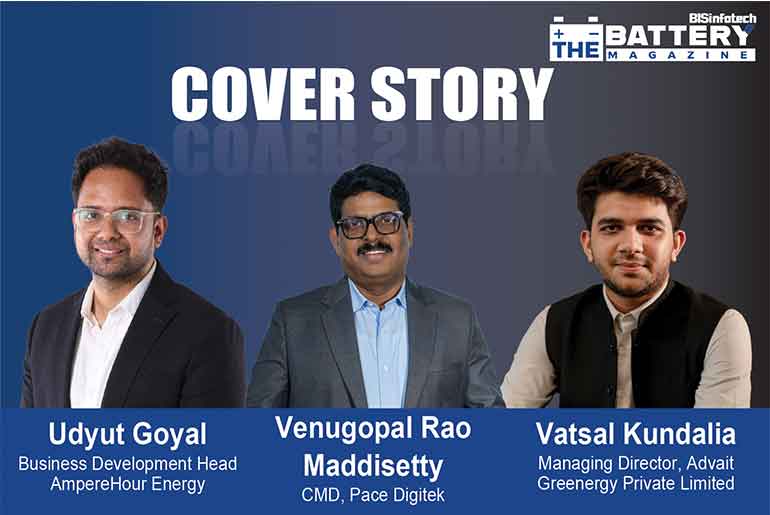
Venugopal Rao Maddisetty – CMD, Pace Digitek, said, “The hardest part isn’t building gigafactories. India has announced enough capacity on paper. It’s the upstream chemistry: cathode active material, precursor, and electrolyte production, where China controls 70-80% of global refining and processing capacity. Cell-grade LFP powder, separator films, and battery-grade electrolyte salts will remain import-dependent for at least a decade, because that dependency sits on rare-earth and lithium processing economics, not manufacturing skill. Even with PLI-backed gigafactories coming online, most will start as cell assembly on imported precursor chemistry before backward integration is credible. Expect India to be competitive in cell assembly and pack integration well before it’s competitive in cathode material chemistry.”
Vatsal Kundalia, Managing Director, Advait Greenergy Private Limited, said “Announcing cell manufacturing capacity and producing competitive cells consistently at scale are two very different milestones. The difficult part is not simply installing a production line. Cell manufacturing demands tight control over chemistry, material quality, yields, process stability, safety and consistency across very large production volumes. A plant also needs time to stabilise after commissioning. Until yields improve and utilisation rises, the economics can look very different from the capacity announced on paper. India therefore has to build manufacturing know-how alongside manufacturing capacity, particularly in process engineering, quality control, testing and skilled manpower.
Import dependence will not disappear immediately either. Parts of the upstream battery ecosystem, including certain active materials, specialised components and processing technologies, remain concentrated in established global supply chains. The practical approach is to localise progressively rather than pretend that the entire value chain can become domestic overnight. Cells are important, but India can simultaneously build strong domestic capabilities in packs, BMS, PCS, EMS, thermal management, enclosures and system engineering. The objective should be to reduce critical dependencies year after year while ensuring that localisation improves competitiveness rather than merely changing the source of procurement.”
Udyut Goyal, Business Development Head, AmpereHour Energy, said, “India has made an important start towards building domestic cell manufacturing capacity, but achieving globally competitive production at scale will require more than setting up plants. The key challenges will be achieving consistent quality, high manufacturing yields, process efficiency and cost competitiveness while building a reliable supply chain.
For BESS applications, cells must deliver predictable performance, safety, cycle life and long-term reliability, as these directly influence project economics and bankability. Some import dependence is likely to remain in the foreseeable future, particularly for specialised battery materials, advanced manufacturing equipment and certain critical upstream components.India’s localisation journey should therefore be viewed as progressive rather than immediate. The priority should be to establish reliable cell manufacturing while gradually developing the broader upstream ecosystem. At the same time, strengthening domestic capabilities in BMS, PCS, EMS and system integration will be important. A competitive Indian BESS ecosystem will ultimately depend on building depth across the entire value chain, not cells alone.”
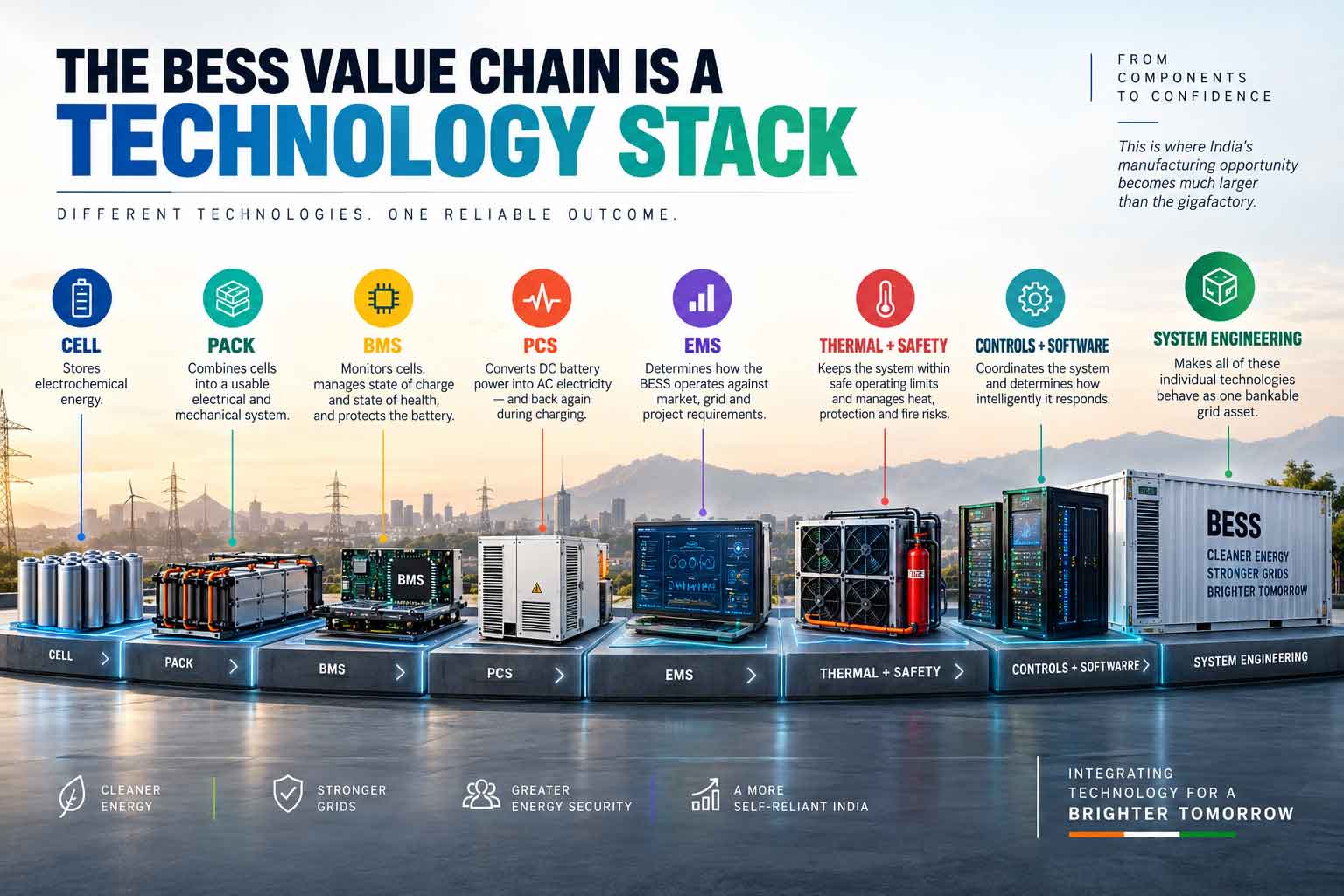
India’s battery ecosystem is expanding from cell manufacturing to packs, BMS, PCS, EMS and complete BESS integration, but the next challenge is technology ownership. A system assembled in India is not necessarily an Indian technology platform if its critical cells, controls, software and power electronics remain dependent on overseas technology. A BESS is a complex system where batteries work alongside BMS, PCS, EMS, thermal management, protection and software to deliver safe, efficient and intelligent grid response. Therefore, localisation should be measured beyond domestic assembly. GWh tells us how much India can manufacture, but not how much technology India owns. The bigger opportunity lies in developing indigenous power electronics, controls, software and storage IP, using operating data on degradation, temperature, cycling and failures to continuously improve BESS technology.
When an Indian company says it manufactures BESS, what percentage of the technology and system architecture is genuinely owned or engineered in India? Where does integration end and technology ownership begin?
Venugopal Rao Maddisetty – CMD, Pace Digitek, said, “Be honest about where “manufactured in India” actually starts. For most Indian BESS players today, ownership is real at the system architecture, thermal design, enclosure engineering, and EMS/controls layer, that’s genuine IP. But the cell itself, and often the PCS module internals, are sourced from established Chinese or Korean suppliers under supply agreements. Integration is not the same as technology ownership, and buyers should ask specifically: who owns the BMS algorithm, who owns the EMS dispatch logic, and where was the cell manufactured, not just assembled.”
Vatsal Kundalia, Managing Director, Advait Greenergy Private Limited, said, “There is no meaningful single percentage that can answer this across the industry because every manufacturer’s architecture and sourcing model is different. More importantly, domestic content by value does not necessarily tell us who owns the technology. A BESS may use globally sourced cells while significant pack engineering, electrical architecture, thermal management, controls, safety systems, BMS, PCS and EMS integration are developed locally. Conversely, a system can contain a high proportion of locally procured hardware while still depending on an overseas technology provider for critical engineering decisions. That is why the industry needs to be careful about equating assembly with technology ownership.
Integration ends and ownership begins when the manufacturer can independently understand, modify and improve the system. Can the engineering team diagnose why a system is underperforming? Can it adapt the architecture for different grid or C&I applications? Can it improve thermal behaviour, safety, controls and performance without depending on an external partner every time? Those are more meaningful tests. For India, the progression should be visible from one generation of BESS to the next: more Indian engineering, more qualified domestic vendors, greater control over critical subsystems and more know-how retained within the organisation. That is how an integrator eventually develops into a technology-led manufacturer.”
Udyut Goyal, Business Development Head, AmpereHour Energy, said, “For a BESS, technology ownership should not be measured simply by the percentage of components manufactured in India. A system can use globally sourced cells, PCS or other components while still having significant Indian engineering through system architecture, controls, software, thermal management, safety systems and project-specific integration.
The distinction between integration and technology ownership comes from who controls the system design and engineering. Integration is primarily about assembling and configuring components to work together. Technology ownership begins when the company develops the architecture, engineers interfaces between subsystems, optimises controls, validates performance and uses operating data to continuously improve the system.For India, this distinction is important because localisation should not be reduced to an assembly percentage. The larger opportunity lies in building deep engineering and intellectual capabilities across the BESS stack.
From AmpereHour Energy’s perspective, experience in BESS deployment shows that the real value lies in making the entire system perform reliably as one integrated asset over its lifecycle. India’s ambition should therefore be to build systems that are engineered in India, rather than merely assembled in India.”
India’s BESS opportunity is moving beyond simply assembling imported components. Technology ownership will depend on who controls system architecture, engineering, BMS, PCS, EMS, software and critical interfaces. India does not need to manufacture every component immediately, but it needs the ability to design, validate, modify and improve complete systems. The strategic shift is from “assembled in India” to “engineered in India” and eventually “owned in India.” While cells remain the largest cost component, the intelligence around them — PCS, BMS, EMS, controls and power electronics — determines efficiency, safety, response and lifetime performance. India’s existing strengths in software, power electronics and engineering could provide a route to competitiveness. Companies including Delta Electronics India, Ador and Pace Digitek are already expanding capabilities across PCS, EMS, controls and integrated BESS systems, showing that India’s manufacturing ecosystem is beginning to grow horizontally around the cell.
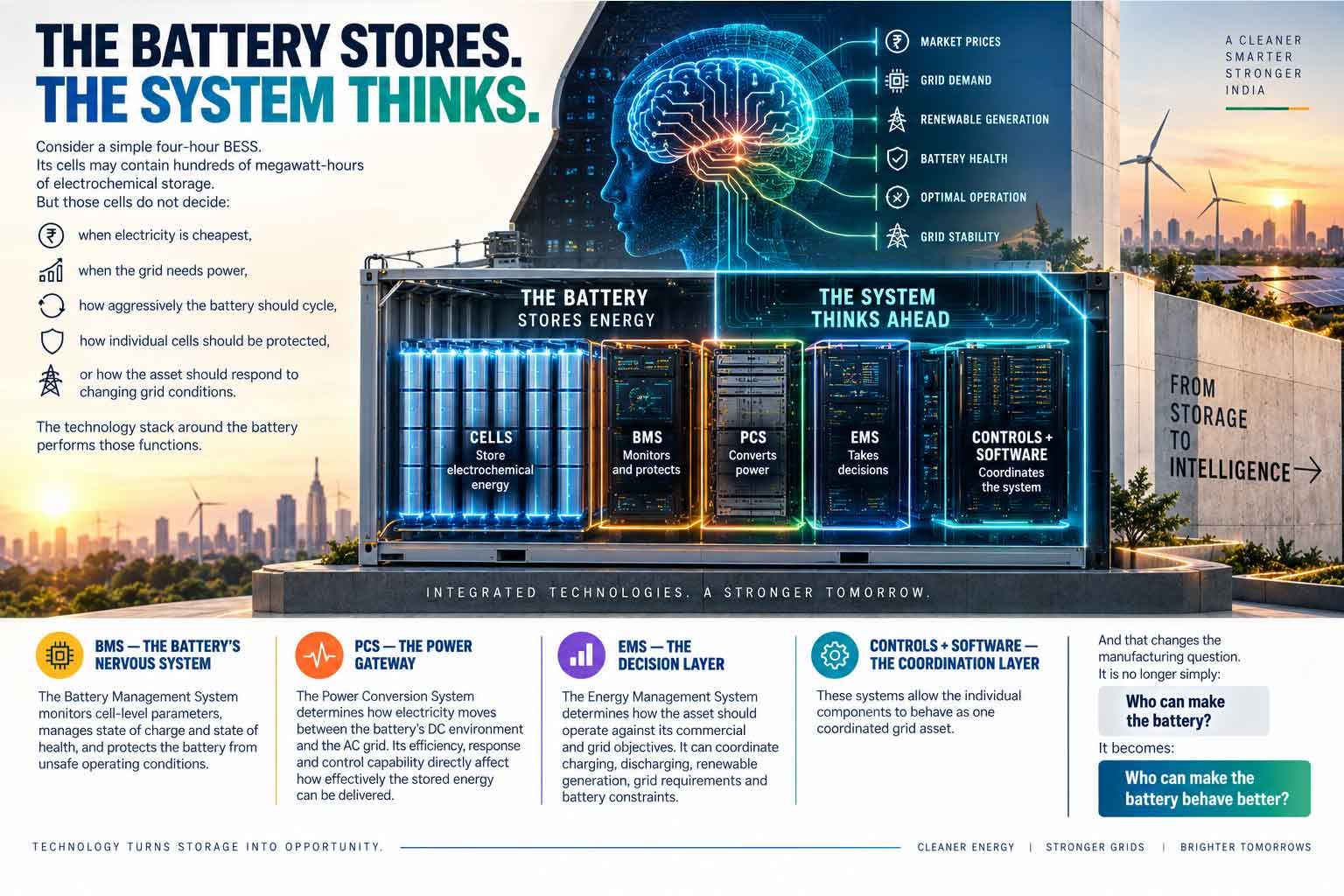
BUT THERE IS A WARNING: ASSEMBLY IS NOT OWNERSHIP
We should not equate domestic assembly with domestic technology.
The real questions are: Who designed the architecture? Who owns the controls and software? Who can modify the system? Who owns the operating data? Who can troubleshoot it independently?
These determine whether India is building technology capability or simply assembling imported technology.
The localisation conversation is therefore moving beyond:
“Are we making batteries?”
to the more important question:
“Which parts of the BESS can India actually design, control and improve?”
India’s BESS ambitions often focus on battery cells. Is the bigger strategic gap actually elsewhere — in PCS, BMS, EMS, controls and power electronics?
Venugopal Rao Maddisetty – CMD, Pace Digitek, said, “Cells are a cost-and-trade problem. Large line item, import-heavy, politically charged, so they get the headlines and the incentives. But a cell is ultimately a commodity: LFP is globally fungible, prices keep falling, and domestic manufacturing is coming. Capital and time solve it.
Power electronics and controls, PCS, BMS, EMS, the grid-forming layer, are a different class of problem: strategic, not just commercial. Here’s the distinction. A battery cell stores energy. The PCS, BMS and EMS decide what the grid does with it. With CEA’s move to 100% grid-forming inverters, the PCS actively holds voltage and frequency and provides black-start; the EMS runs dispatch in real time. So, the intelligence that will stabilise the Indian grid sits in this layer, and it’s the layer where the core IP, firmware and power modules are almost imported.
Over a 15-to-20-year asset life, that’s a serious exposure, un-auditable foreign firmware in thousands of grid-controlling nodes, plus total dependence on overseas OEMs for spares and updates. We risk localising the part that’s commoditising (cells) and importing the part that’s appreciating in strategic value (the controls).
The good news: India is built to close this, semiconductor design, embedded software, systems integration. What’s missing is policy that treats power electronics and controls as strategic infrastructure, the way we’ve treated cells. The 20% domestic-content rule already names EMS. That instinct is right; we should build the whole strategy around it.”
Vatsal Kundalia, Managing Director, Advait Greenergy Private Limited, said, “Cells naturally receive attention because they account for a significant part of a battery system and remain an important area of supply-chain dependence. But focusing on cells alone risks understating where a large part of the intelligence of a BESS actually sits. The BMS determines how batteries are monitored and protected, the PCS manages the conversion and flow of power, while the EMS determines how the asset responds to its operating environment. Thermal management, controls, protection architecture and software are equally important to safety, availability and long-term performance. A globally competitive BESS industry therefore cannot be built by localising the container while importing most of the intelligence inside it.
This is also where India has an opportunity. We already have considerable engineering capability across power electronics, software, electrical systems and industrial automation. The next step is to deepen those capabilities specifically for storage and build intellectual property through actual deployments. Every commissioned BESS generates operating knowledge about temperatures, cycling behaviour, grid interaction, degradation and control strategies. Manufacturers that capture that learning and feed it back into product engineering will become stronger with every project. In the longer term, India’s competitive advantage could come not only from manufacturing batteries at scale, but from engineering better energy-storage systems around them.”
Udyut Goyal, Business Development Head, AmpereHour Energy, said, “India’s focus on building domestic cell manufacturing is important, but the bigger strategic opportunity may lie in developing capabilities across the rest of the BESS technology stack particularly PCS, BMS, EMS, controls and power electronics.
A BESS is ultimately a combination of electrochemistry, power electronics, software and controls. The cell stores energy, but the ability to safely manage, convert, optimise and dispatch that energy determines how effectively the system performs. PCS efficiency, BMS intelligence, EMS optimisation and control architecture directly influence response time, battery utilisation, degradation, grid interaction and overall project economics.
For India, the objective should therefore be to build capabilities across the entire system rather than viewing localisation through the lens of cells alone. While some hardware components may continue to be sourced globally in the near term, developing strong Indian engineering, software, controls and system-integration capabilities can create significant technology ownership.
This is also where India can build a differentiated advantage. Our experience at AmpereHour Energy shows that BESS value increasingly comes from how effectively multiple technologies work together as one reliable asset. If India can combine cell manufacturing with strong power-electronics, software and systems engineering, it can build BESS solutions that are not only locally deployed but globally competitive.”
THE DATA LOOP COULD BECOME INDIA’S SECRET WEAPON
Every operating BESS generates valuable data on degradation, temperature, cycling, battery health, grid response and failures. Manufacturers that turn this data into better controls, safer systems and improved designs can create a powerful learning loop:
Deploy → Collect data → Analyse → Improve → Deploy again
India’s growing BESS market could give domestic manufacturers something increasingly valuable: real-world operating experience at scale.
THE BANKABILITY GAP
This is where an Indian BESS manufacturer faces a fundamentally different test from the domestic market.
An Indian developer buying a BESS may already know the supplier, understand local regulations and have direct access to the company’s engineering and service teams. An international utility and its lenders may ask a much longer list of questions:
Where has this system operated? For how many years? What is the measured degradation? What is the availability? What certifications does it carry? Who independently validated the performance? Who stands behind the warranty? What happens if the battery fails after year eight? Where are the replacement components coming from? Can the supplier provide service in the project country? What happens to the project if the manufacturer disappears?
These are not merely technical questions. They are financing questions.
THE EXPORT PRODUCT IS THE RISK PROFILE
India can compete on BESS manufacturing cost, but global buyers compare lifetime risk, not price alone.
They want predictable degradation, reliable performance, safety, warranties and long-term support.
A cheaper system can become costlier if uncertainty is high. A reliable system can be easier to finance.
India’s next challenge is therefore simple:
Turn technical capability into commercial confidence.
FROM “CAN IT WORK?” TO “CAN I FINANCE IT?”
Bankability requires evidence — and evidence takes time.
A manufacturer can prove laboratory performance quickly, but lenders need confidence across thousands of cycles, varying operating conditions, grid disturbances and years of real-world use.
This creates a catch-22:
You need operating history to win large projects → You need large projects to build operating history.
The way forward is domestic deployments, rigorous testing, transparent data and independently validated performance.
INDIA’S DOMESTIC MARKET COULD BECOME ITS EXPORT LABORATORY
India has a rare advantage: its domestic BESS market is expanding as manufacturers are scaling up.
The opportunity is to use India as a proving ground:
Deploy → Measure → Validate → Build references → Certify → Export
Every successful project can strengthen an Indian manufacturer’s global credibility.
The domestic market should therefore be seen not only as a revenue opportunity, but as a launchpad for exports.
THE CERTIFICATION QUESTION
Technical capability must translate into internationally recognised assurance.
Export markets can demand evidence on fire safety, thermal runaway, electrical protection, grid interaction, environmental performance and cybersecurity.
Domestic compliance gets a product into the market. International certification helps open global markets. Operating history builds lasting confidence.
THE OTHER SIDE OF THE WARRANTY
A warranty is only as credible as the company behind it. Large BESS projects may require guarantees covering capacity retention, availability, efficiency, response and safety for years.
For newer manufacturers, that raises a financial question: who stands behind the promise?
Insurance, guarantees, parent-company strength, warranty reserves, replacement strategies and independent testing will increasingly shape bankability.
Bankability is therefore not just an engineering attribute. It is an ecosystem.
What would prevent an Indian BESS manufacturer from winning a major international utility-scale project today — not technically, but commercially and financially?
Venugopal Rao Maddisetty – CMD, Pace Digitek, said, “Technically, Indian BESS can already meet spec. What blocks exports is track record: no 5-10-year operational performance data at scale, no established warranty/insurance backing recognized by international lenders, and thin balance sheets relative to project scale. Global utilities buy bankability, proven degradation curves, credit-rated parent guarantees, and DFI-grade financing structures, not just a compliant datasheet.”
Vatsal Kundalia, Managing Director, Advait Greenergy Private Limited, said, “The biggest barrier may not always be whether an Indian manufacturer can build the system. A large international utility or project financier wants confidence that the system will perform for years after commissioning and that the company standing behind it can honour its obligations throughout that period. That brings warranties, performance guarantees, degradation commitments, safety certifications, operating track record, insurance, balance-sheet strength and long-term service capability into the discussion. A technically competitive product can therefore still struggle to win a global project if the buyer or lender does not yet have enough evidence to underwrite its lifecycle risk.
This is why Indian BESS manufacturers have to think beyond cost competitiveness from the beginning. The path to exports will be built through operating references, independently validated performance, internationally accepted testing and certification, strong documentation and projects that demonstrate reliability over time. Domestic deployment can play an important role here because every successfully operating project adds to the evidence base that future international customers can evaluate. India will know that it has built a globally competitive BESS industry not when an Indian system is simply cheaper, but when an overseas utility is comfortable placing a long-duration, mission-critical asset in the hands of an Indian manufacturer on the strength of its technology, execution record and bankability.”
Udyut Goyal, Business Development Head, AmpereHour Energy, said, “For an Indian BESS manufacturer, the biggest hurdle to winning a major international utility-scale project is likely to be bankability rather than technology. Global buyers and lenders need confidence that the supplier can deliver predictable performance over the full asset life, not simply offer a competitive upfront price. This means demonstrating a credible operating track record, robust safety credentials, long-term warranties, degradation and availability guarantees, and strong O&M capabilities.
For Indian companies, building international references, securing recognised certifications, establishing overseas service capabilities and demonstrating predictable lifecycle economics will therefore be critical. The opportunity is significant, but global competitiveness will ultimately be determined by trust, track record and bankability alongside cost and technology. India needs to make “Made in India” synonymous with dependable long-term performance, not simply competitive pricing.”
WHY CHINA+1 IS AN OPPORTUNITY — NOT A GUARANTEE
Global supply-chain concentration is creating a China+1 opportunity for Indian BESS manufacturers. But diversification alone will not win orders. The world does not simply need another supplier. It needs another supplier it can trust. India’s stronger proposition therefore has to combine engineering, quality, safety, lifecycle economics, service and bankability — not just lower upfront cost.
THE EXPORT LADDER
Domestic projects → Independent validation → International certification → Reference projects → Overseas service → Financial bankability → Global utility projects
India will have to climb this ladder before it can compete consistently for major international BESS contracts.
THE LAST MILE OF “MADE IN INDIA”
India has the foundations: demand, manufacturing capacity, engineering capability, policy support and a growing project pipeline. What it needs now is evidence — that Indian BESS can perform reliably, degrade predictably, operate safely, honour warranties, deliver returns and remain bankable over its lifetime. That is why the first major BESS export could matter more than the first gigafactory. The gigafactory proves India can make.
The export project proves the world trusts what India makes. And that brings us to the final page.
THE VERDICT: INDIA HAS THE BLUEPRINT — NOW IT HAS TO PROVE THE PRODUCT
India has demand, policy support, engineering talent and an emerging manufacturing base. What it does not yet have is the complete depth, scale and bankability required to call itself a global BESS manufacturing hub.
For much of India’s battery journey, success was measured by one question:
How many GWh can India manufacture?
That was the right question when India was building its domestic battery industry. It is no longer enough. A global BESS hub needs more than factories. But above all, it needs something no policy or factory can create overnight: A track record.
India has demand, policy support and growing manufacturing capacity. The government estimates a 236 GWh BESS requirement by 2031–32, while around 178 GWh of additional cell capacity has been announced outside the PLI beneficiary pool.
The opportunity is clearly emerging.
But so is the real challenge: India has announced the capacity. Can it build the capability?
THE FIVE TESTS INDIA MUST PASS
- TEST 1 — CAN INDIA MAKE, NOT JUST ANNOUNCE?
- TEST 2 — CAN INDIA CONTROL THE TECHNOLOGY?
- TEST 3 — CAN INDIA BUILD THE SUPPLY CHAIN BEHIND THE FACTORY?
- TEST 4 — CAN INDIA TURN DEPLOYMENT INTO BANKABILITY?
- TEST 5 — WILL THE WORLD BUY IT?
SO, CAN INDIA BECOME A GLOBAL BESS MANUFACTURING HUB?
YES — BUT NOT YET.
And that is not a negative verdict. It is actually the more interesting one. India already possesses the ingredients that many countries would struggle to assemble:
a massive future domestic market, renewable-energy demand, government support, industrial capacity, engineering talent, a growing BESS project pipeline, emerging cell manufacturing, power-electronics capability, system integrators, and an opportunity created by global supply-chain diversification.
What remains is to connect those pieces into a competitive industrial ecosystem.
THE BIGGEST MISTAKE WOULD BE TO MEASURE SUCCESS IN GWh ALONE
The number that matters most in India’s BESS story is not:
“How many gigawatt-hours did we announce?”
It is:
“How many gigawatt-hours can we manufacture competitively, operate reliably and sell globally?”
Those are very different numbers. The first measures ambition. The second measures industrial capability.
India does not need to manufacture every battery material, every component or every cell domestically to become a global BESS power. It needs something more difficult.
It needs to know which parts of the value chain it must own, which dependencies it can safely manage, and where Indian engineering can create an advantage that competitors cannot easily replicate. The country can build factories. It can build gigawatt-hours. It can build battery systems. But the real milestone will arrive when an overseas utility looks at an Indian BESS and does not ask:
“Where was this assembled?”
It asks:
“How soon can we buy one?
 Electrify your feed! Click here to join our Whatsapp group and to get the latest updates, expert insights, and innovations driving India’s energy storage revolution.