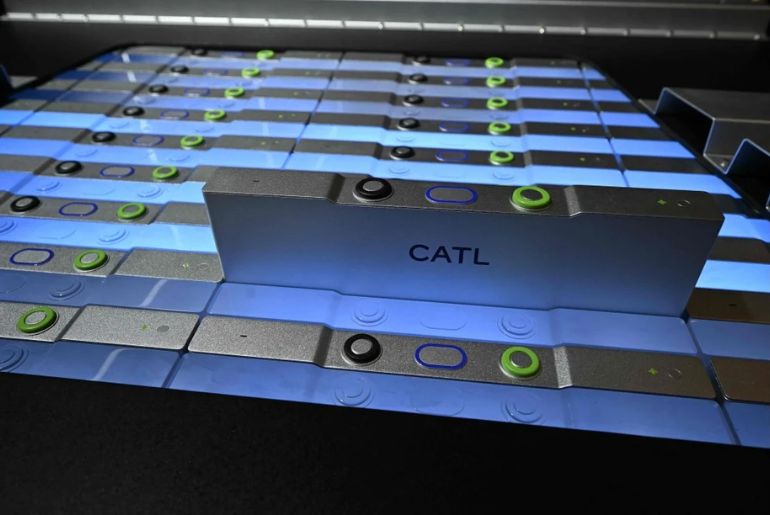
Contemporary Amperex Technology Co. Limited (CATL) has reported strong financial and operational results in its 2025 Annual Report, highlighting global expansion, major technology developments, and progress toward becoming a leading zero-carbon technology company.
Strong Financial Performance
In 2025, CATL’s operating revenue was RMB 423.7 billion, which was 17% more than the previous year. Net profit for shareholders rose by 42% to RMB 72.2 billion, and net cash flow from operating activities was RMB 133.2 billion.
The company continued to invest heavily in research and development, allocating RMB 22.1 billion to R&D in 2025. Over the past decade, CATL’s cumulative R&D spending has exceeded RMB 90 billion, reinforcing its focus on technological advancement and product innovation.
Global Battery Market Leadership
CATL further strengthened its global position in the battery industry during 2025.
Key highlights include:
- Lithium battery sales reached 661 GWh, a 39% increase year on year
- Global power battery market share rose to 39.2%, according to SNE Research
- CATL maintained the No.1 global ranking for nine consecutive years
- Overseas market share increased to 30%
- Batteries installed in more than 24 million vehicles worldwide
In the energy storage sector, CATL’s battery shipments accounted for 30.4% of the global market in 2025, maintaining the top position for the fifth consecutive year.
Around 2,300 energy storage projects using CATL technology have been deployed globally, while shipments from its energy storage system integration business grew over 160% year on year.
The company’s storage technology is also supporting energy infrastructure for artificial intelligence. One example is an AI data center operated by SenseTime in Shanghai, where the system reportedly saves more than 10 million kWh of electricity annually, reduces electricity costs by 7%, and avoids approximately 3,000 tonnes of CO₂ emissions each year.
Expansion into New Electrification Sectors
CATL is also expanding into new electrification segments under its “all-domain growth” strategy.
- Its subsidiary AutoFlight completed the first public flight of the world’s largest 5-ton-class eVTOL aircraft.
- In maritime applications, CATL battery systems received type approval from five international classification societies across China, the United States, Norway, France, and Italy.
- The company’s batteries are now used in nearly 1,000 electric vessels worldwide.
CATL also introduced a “Ship–Shore–Cloud” integrated zero-carbon shipping solution to support maritime decarbonisation.
Innovation and Technology Development
Innovation remains a key driver of CATL’s competitiveness. The company operates six global R&D centers and employs around 23,000 R&D professionals.
By the end of the reporting period, CATL held 54,538 domestic and international patents, including pending applications.
One of its research initiatives, “Augmented Intelligence Leading Next-Generation Lithium-ion Battery Design,” received the MINDS award from the World Economic Forum.
During 2025, CATL introduced several new battery technologies, including:
- Second-generation Shenxing Superfast Charging Battery
- Shenxing Pro Battery
- Freevoy Dual-Power Battery
- Naxtra Battery
- Super Hybrid Battery
The company expects wider adoption of sodium-ion batteries from 2026, particularly in battery-swapping systems, passenger vehicles, commercial vehicles, and energy storage applications.
Expanding Manufacturing Capacity
To meet increasing global demand, CATL continued expanding its production capacity.
- Total production capacity reached 772 GWh by the end of 2025
- 321 GWh additional capacity currently under construction
The World Economic Forum has also recognised the company’s “Lighthouse” factories, including the battery sector’s only “Sustainability Lighthouse.”
CATL currently has about 1,200 after-sales service stations in 75 countries and regions to help customers.
Building a Zero-Carbon Energy Ecosystem
As part of its long-term strategy, CATL is developing a broader zero-carbon energy ecosystem.
The company’s Choco-Swap battery-swapping network expanded to more than 1,000 stations across 45 cities in China.
Meanwhile, QIJI Energy operates over 300 battery-swapping stations for heavy-duty trucks across 26 provinces, covering 78,000 km of green logistics routes.
Together, these networks completed more than 1.15 million battery-swapping services in 2025.
CATL is also advancing zero-carbon energy systems including:
- Green power direct connection
- Grid-forming energy storage
- Source-grid-load-storage integration
- Zero-carbon industrial parks
In Shandong, CATL is developing what it describes as the world’s first off-grid zero-carbon industrial park, powered entirely by direct green electricity to supply 100% renewable energy to a 40 GWh lithium-ion battery plant.
Sustainability and Circular Economy
CATL reported progress in sustainability and circular economy initiatives during 2025.
- Achieved AA ESG rating from MSCI
- Included in the S&P Global Sustainability Yearbook and the FTSE Emerging Index for the first time
- Achieved carbon neutrality in core operations
The Global Energy Circularity Commitment (GECC) was also started by the company to encourage battery recycling and circular energy systems.
CATL recycled 210,000 tonnes of used batteries in a year, which is 63.2% more than the year before. They also recovered 24,000 tonnes of lithium salts, which is 40.4% more than the year before.
CATL said that in the future, it will keep focusing on developing new technologies, growing its global ecosystem, and strengthening its partnerships with customers around the world to solidify its position as a leading global zero-carbon technology company.
 Electrify your feed! Click here to join our Whatsapp group and to get the latest updates, expert insights, and innovations driving India’s energy storage revolution.