As India’s renewable energy capacity continues to expand, Battery Energy Storage Systems (BESS) are emerging as a crucial technology for balancing intermittent solar generation and ensuring reliable power supply. While solar energy provides abundant electricity during the daytime, storage technologies are increasingly necessary to supply power during evening and nighttime demand peaks.
At Intersolar India 2026, several companies showcased innovations aimed at strengthening the solar-plus-storage ecosystem. Among them was Cosmic PV Power Ltd., a company traditionally known for its solar module business and now expanding into the energy storage segment.
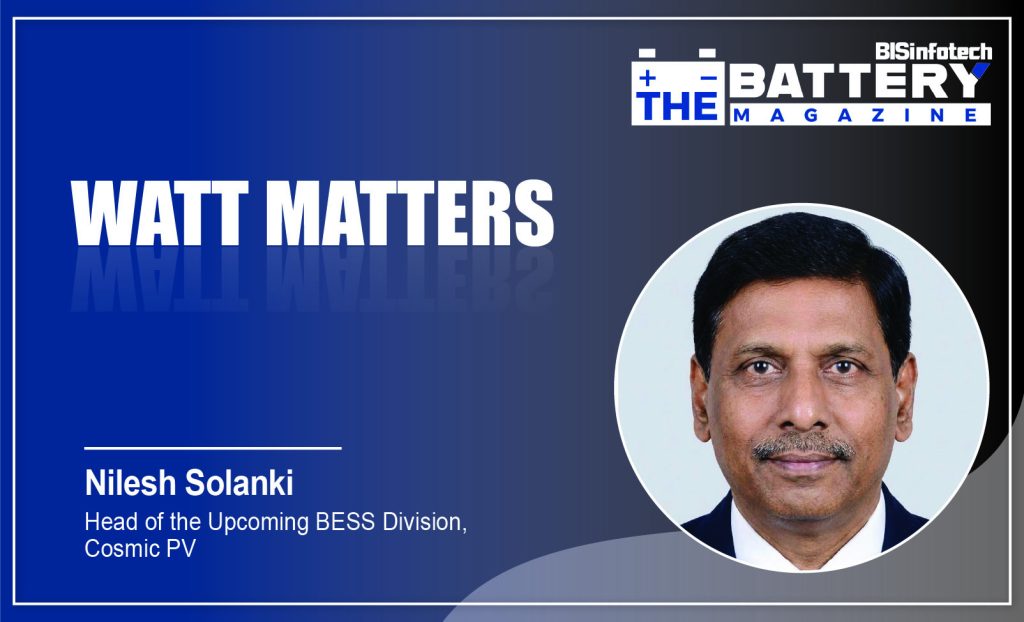
During the exhibition, The Battery Magazine interacted with Nilesh Solanki, Head of the Upcoming BESS Division at Cosmic PV, to discuss the company’s plans to establish a large-scale battery manufacturing facility and its strategy for entering India’s growing energy storage market.
Your booth has been witnessing significant footfall at the exhibition. Could you tell us what Cosmic PV is showcasing here and how the company is expanding into the battery segment?
Cosmic PV has traditionally been known for its solar module business. However, as the renewable energy sector evolves, we recognized that energy storage will play a critical role in the future of power systems.
Therefore, we have decided to diversify our portfolio and enter the Battery Energy Storage System (BESS) segment. We are currently setting up a 2 GWh battery manufacturing facility, which is expected to become operational soon.
Energy storage is becoming increasingly important as governments and utilities focus on balancing renewable energy generation with grid stability. This makes BESS a key component in the future energy ecosystem.
Could you tell us more about your planned product portfolio within the battery segment?
In the initial phase, our focus will be on two primary segments.
The first is the Commercial and Industrial (C&I) segment, where energy storage systems can help businesses manage peak demand and improve energy efficiency.
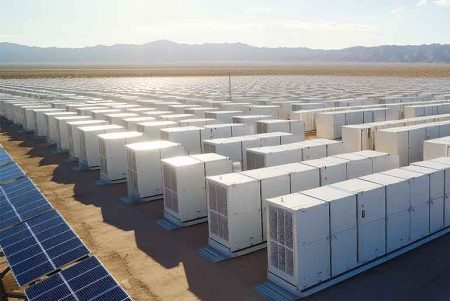
The second is the containerized BESS segment, which is designed for larger-scale deployments such as utility or grid-support applications.
In terms of production planning, we initially expect the capacity distribution to be approximately 50% for C&I solutions and 50% for containerized systems. However, this allocation is flexible and can be adjusted depending on market demand. Additionally, we are planning to expand further by adding another 2 GWh production line in the following year as the market grows.
How do you plan to manage raw material procurement, especially considering the global dependence on battery cells?
Currently, battery cell manufacturing is still heavily concentrated in countries such as China. Therefore, for the time being, battery cells will continue to be sourced internationally.
However, for other critical components such as cooling systems, fire protection systems, battery management systems (BMS), and energy management systems (EMS), we are actively working with Indian vendors.
Our objective is to maximize localization wherever possible, and in the future we are also exploring the possibility of developing Power Conversion Systems (PCS) in-house.
Battery safety has been a major topic of discussion in recent years. How is Cosmic PV addressing safety concerns in its storage solutions?
Safety is a critical consideration not only for batteries but for any energy system. We are designing our systems with advanced safety mechanisms, including integrated fire protection systems and thermal management solutions.
Both containerized BESS systems and smaller C&I storage solutions will include safety features designed to mitigate risks associated with high temperatures or operational stresses.
Additionally, modern lithium battery cells are being developed to withstand higher temperature conditions, which further enhances system reliability.
Which battery chemistry will your systems primarily use, and are you exploring alternatives for the future?
In the initial phase, our systems will primarily use Lithium Iron Phosphate (LFP) chemistry, which is currently the most widely adopted technology for stationary energy storage due to its safety and durability.
However, we are also monitoring emerging technologies such as sodium-ion batteries, which could become viable alternatives in the future. For the next few years, though, LFP will remain our primary focus.
How important has government support been in encouraging companies like Cosmic PV to enter the energy storage market?
Government support has played a very important role. As solar capacity increases across the country, the need for energy storage becomes more evident.
Solar plants generate electricity during the day, but energy demand continues even after sunset. Battery storage systems help bridge this gap by storing excess solar energy generated during the daytime and delivering it when required.
This is why many government tenders now include energy storage requirements, and we expect this trend to grow significantly in the coming years.
Cosmic PV has built a strong reputation in the solar sector. How do you plan to maintain the same sustainability principles as you expand into batteries?
Sustainability and ethical business practices have always been fundamental to Cosmic PV’s operations. As we expand into the battery segment, we are committed to maintaining the same values. Concepts such as circular economy, responsible manufacturing, and sustainable energy solutions will continue to guide our approach.
Our aim is not only to grow in the energy storage sector but also to ensure that the company continues to operate with the same ethical standards that have defined our journey in the solar industry.
What is your long-term vision for the company’s energy storage business?
We expect the battery energy storage business to grow rapidly in the coming years.
Our goal is to scale operations significantly and build a strong presence in the energy storage sector. Over time, we also plan to diversify further into other emerging energy technologies, enabling Cosmic PV to become a broader clean energy solutions provider.
With the rapid growth of renewable energy, we believe that battery storage will become one of the most important pillars of the energy transition, and we aim to play a meaningful role in that transformation.
 Electrify your feed! Click here to join our Whatsapp group and to get the latest updates, expert insights, and innovations driving India’s energy storage revolution.