
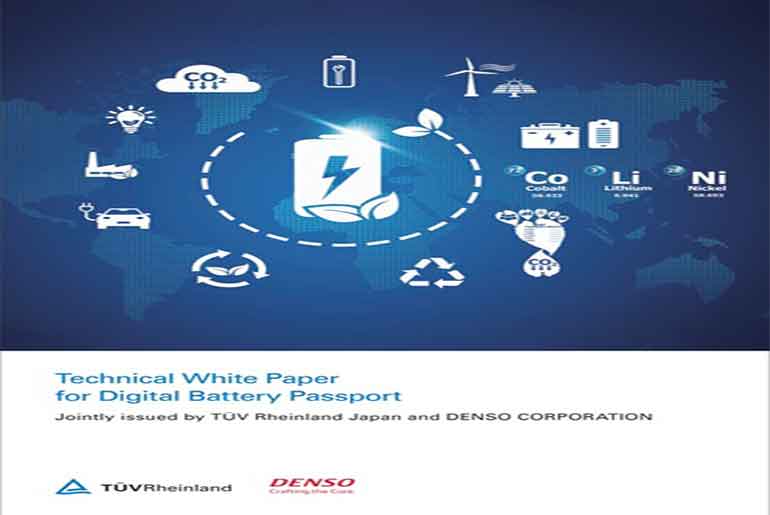
As the European Union moves towards mandatory implementation of Battery Passports from February 2027 under the EU Battery Regulation, the focus is rapidly shifting from policy discussions to practical execution. To support this transition, DENSO Corporation and TÜV Rheinland Japan Ltd. have jointly published a technical white paper that examines the key technological and operational requirements for Battery Passport implementation. The document addresses critical challenges such as unique battery identification, lifecycle data management, stakeholder access control, and interoperable system architectures, offering valuable guidance to manufacturers and industry stakeholders preparing for compliance in the evolving battery ecosystem.
Against this backdrop, DENSO and TÜV Rheinland Japan signed a Memorandum of Understanding (MoU) in September 2025 to promote Digital Product Passports*2. Based on this collaboration, the two companies combined their respective expertise to develop this white paper as a resource to support consideration of Battery Passport implementation, with a particular focus on compliance with the EU Battery Regulation.
The white paper provides an overview of global developments surrounding Battery Passports and summarizes key regulatory requirements under the EU Battery Regulation and the Ecodesign Regulation*3, including data definitions and IT architecture requirements.
The detailed specifications and related standardization activities for Battery Passports are expected to continue evolving in the coming years. Through this white paper, DENSO and TÜV Rheinland Japan aim to support the development of a common understanding of Battery Passport implementation while continuing to provide insights into regulatory developments, standardization efforts, data-space interoperability, and practical implementation challenges.
The white paper is intended for economic operators responsible for Battery Passport compliance, such as automotive manufacturers and battery manufacturers, as well as related businesses—including component manufacturers and cell manufacturers—that may be required to provide Battery Passport-related data to those operators.
*1 EU Battery Regulation: A regulation that entered into force in the European Union in August 2023 to promote the production and use of sustainable battery products.
*2 DENSO and TÜV Rheinland Japan Sign Memorandum of Understanding to Realize Sustainable Product Development and to Promote Digital Product Passport | Newsroom | News | DENSO Global Website
*3 Ecodesign Regulation: A comprehensive framework covering nearly all products placed on the European market, designed to improve environmental performance from the product design stage. The regulation establishes requirements related to Digital Product Passports (DPPs), as well as product durability, recyclability, repairability, and energy efficiency. It entered into force in the European Union in July 2024.
 Electrify your feed! Click here to join our Whatsapp group and to get the latest updates, expert insights, and innovations driving India’s energy storage revolution.