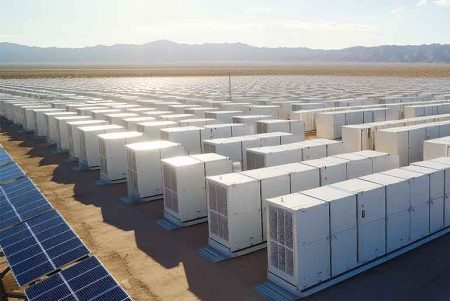
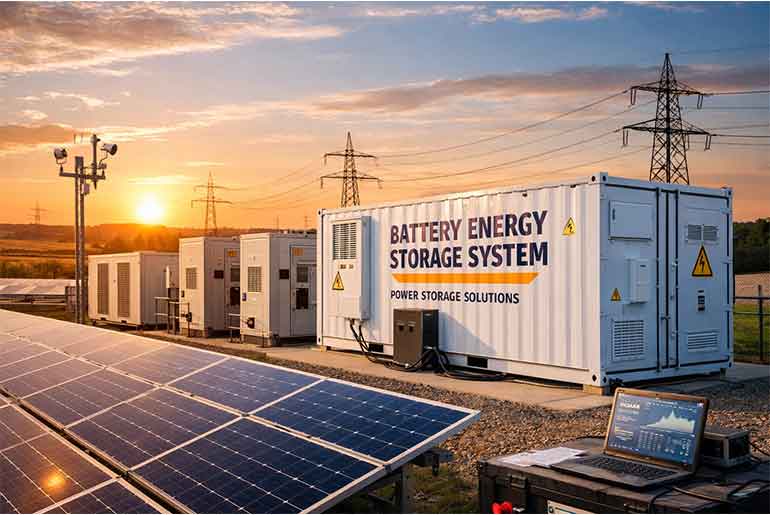
Utility-scale solar power plants are increasingly coupled with battery energy storage (BESS) to ensure reliable, continuous delivery of renewable energy. By carefully sizing and coordinating the PV array, inverters/PCS (Power Conversion Systems), and batteries, developers can harvest maximum energy while honoring PPA commitments (e.g. firm power delivery during peak demand hours). As an industry veteran with 18+ years in PV and BESS systems, the author emphasizes a few key technical considerations:
- Optimal PV Loading: Intentionally oversizing the PV array (DC capacity > inverter AC rating) increases energy yield. Although some midday clipping may occur, the extra generation can be stored or trimmed, lowering LCOE[1]. Oversizing boosts inverter utilization and annual output. Crucially, any surplus solar energy beyond PPA draw is directed to charge the BESS rather than being wasted[1].
- Inverter/PCS Sizing for PPA Compliance: The inverter (and PCS) rating must match the continuous power export required by the PPA during peak hours. In practice, designers size the AC output to meet contractual power obligations. If a PPA demands firm power at times when PV isn’t producing (e.g. evening peak), the BESS must discharge to cover the shortfall[2]. In other words, the combined PV+BESS output must meet or exceed the PPA’s peak-capacity requirement. Grid codes or PPAs often explicitly require energy delivery during defined peak hours when VRE would otherwise be zero[2]. This means the PCS/inverter system must be able to dispatch both battery and PV power seamlessly, ensuring the grid sees steady output at PPA capacity even as insolation varies.
- Site-Specific Weather & Modeling: Hybrid system sizing must be based on hourly weather profiles. Designers use multi-year hourly irradiance and temperature data (e.g. TMY or NASA data for the location) to simulate plant performance. For instance, in India one might use Meteonorm or PVsyst with Indian solar data to capture monsoon vs. clear-sky seasons. The hourly generation profile and battery duty cycle are then optimized together. For example, one guideline shows that to fully charge a 100 MW/250 MWh BESS in about 5 sun-hours requires roughly 50 MW net DC power output (≈58.8 MWp accounting for ~15% losses)[3]. In practice, developers often oversize the PV further (e.g. 120–150 MWp in that example) to handle cloud cover and to supply both the battery and export to grid[3]. Simulation tools (PVsyst, Homer, etc.) take these hourly inputs to tune the PV-BESS capacity ratio so that grid export meets PPA and battery usage is optimized through the day.
- Minimizing System Losses (Auxiliaries): Every hybrid plant has parasitic loads and losses – from inverters, transformers, cables, to fans and pumps. These auxiliary losses directly subtract from net output. Industry analyses note that system-level losses (soiling, shading, inverter inefficiency, and auxiliaries like cooling fans) can significantly impact yield[4]. In tools like PVsyst, auxiliary consumption (e.g. for drives, sensors, lighting, cooling) is explicitly modeled to calculate net generation[4]. Design choices – such as using high-efficiency inverters, optimal cable sizing, and minimizing transformer use – help reduce losses. Likewise, battery system auxiliaries (thermal management, ventilation) must be carefully accounted. For example, batteries need HVAC, especially in hot climates, and these loads consume power even before storing/discharging any kWh.
- Battery Auxiliary Consumption: Modern utility-scale BESS containers have non-negligible own loads (pumps, chillers, control electronics). Data from Dr. B.S. Rathore – a noted BESS expert – shows that a liquid-cooled 5 MWh container in a hot desert environment consumes about 17–22 kW for cooling and balance-of-system[5]. This is roughly 1.3–1.6% of the PCS rating, significantly lower than older estimates (26–34 kW) which were based on outdated designs[5]. In moderate or cold climates the load is even lower (~11–16 kW, 0.8–1.2% of PCS)[5]. These benchmarks are critical. They show that modern designs (e.g. Li-ion with LFP chemistries) require only ~8–13 kW inside the battery container itself (plus 1–3 kW for the PCS unit) to run auxiliaries[5]. Key takeaway: Base the PV-BESS net-export calculations on realistic aux loads. Using excessive conservative aux assumptions (from old 2010s plants) will undervalue the hybrid’s performance and could make viability appear worse than it is. Correctly modeling BESS aux as ~1–2% of rated power is now considered the new Indian benchmark[5].
- Intelligent EMS/Control: The Energy Management System (EMS) is the brain of the hybrid plant. It monitors generation, battery SOC, grid conditions and controls charging/discharging. A robust, field-proven EMS is crucial, as its algorithms directly affect energy harvest and contractual performance. In hybrid plants, the EMS typically has a two-layer structure[6]: the primary control handles real-time grid interface (voltage/frequency, inverter set-points) while the secondary control (including the Battery Management System) oversees battery health and auxiliaries[6]. A good EMS will optimize when to store versus export, smooth PV ramp rates, handle curtailment situations, and participate in ancillary services if allowed. It must be chosen carefully: an unreliable or immature EMS can lead to missed charge cycles or even damage batteries if thermal limits are violated. By contrast, a proven EMS that efficiently dispatches BESS for peak support and sustains PPA deliveries can significantly enhance plant economics and reliability. (For example, Tata’s BESS engineering guide emphasizes that the EMS/BMS is central to managing grid services and battery safety[6].)
- Reliability & Testing (FAT/SAT): With emerging technologies, quality assurance is essential. BESS projects should include thorough Factory Acceptance Testing (FAT) and Site Acceptance Testing (SAT) by competent third parties. FAT is the final check at the manufacturer’s factory, where every component is tested against specs. As industry sources explain, the purpose of FAT is to verify in a controlled environment that the BESS “meets the design requirements” and operates safely before shipping[7]. Only after passing FAT does hardware leave the factory. Upon installation, SAT is performed – this confirms the system meets performance/safety criteria under real grid and environmental conditions[8]. Proper FAT/SAT ensures defects are caught early, avoiding delays or failures in the field. Similarly, monitoring during production (e.g. vendor quality audits) and independent testing of cells/modules can prevent manufacturing issues. While these measures add cost up front, they reduce risk of failures, fires, and costly retrofits – thereby protecting plant IRR and reputation.
- Project Scheduling & Logistics: Finally, a realistic commissioning timeline is crucial. The BESS equipment (containers, transformers, switchgear) can have long lead times – often on the order of several weeks. Batteries and large PCS racks are heavy, classified as dangerous goods, and need specialized transport. For instance, a logistics case study notes that a BESS shipment might involve dozens of 30-ton, non-stackable containers, which require specific ships and careful planning[9]. If a vessel slot is missed, it can delay delivery by months. To mitigate this, many projects schedule PV construction such that a major portion (e.g. 70–80%) of the solar array is commissioned first, then hold off on final tie-in until the BESS units arrive. This way, the plant begins earning revenue on the solar portion while batteries are en route. (Notably, current regulations allow part commissioning – e.g. first 50% of capacity – without penalty[10].) Delaying the BESS arrival until after most PV is in place ensures the battery isn’t idle waiting for solar, and avoids pushing the critical launch date. Once on site, rapid integration is important: any lag in PV commissioning can erode project IRR or shorten battery useful life (if the BESS just sits unused).

In summary, an optimized hybrid PV+BESS plant requires holistic design: size the PV array to capture all available solar (often oversizing relative to inverter rating), ensure inverters/PCS are rated to meet PPA power during critical hours, and model the system with real hourly weather data. Account for all losses – especially battery cooling loads, which in hot Indian climates can be 3% –5% of plant rating[5] – so that net export is not overestimated. Use a proven EMS to orchestrate PV-BESS operation, maximizing yield and grid support. Insist on quality: enforce rigorous FAT/SAT and vendor QA for every battery component. And finally, plan commissioning strategically, recognizing that shipping BESS modules can take 5–7 weeks or more[9]. By following these practices (backed by industry data and global experience[1][2]), a developer can maximize energy harvest, guarantee PPA delivery, and protect the project’s returns in a hybrid solar+BESS installation.
Bess utilisation for DSM penalty risk mitigation: Deviation Settlement Mechanism (DSM) has become increasingly challenging due to evolving Central Electricity Authority (CEA) regulations, which demand tighter grid discipline and forecasting accuracy. Renewable energy generators, particularly utility-scale solar PV and wind power plants, often face variability in generation, leading to deviations and consequent DSM penalties. To address this, integrating Battery Energy Storage Systems (BESS) is emerging as a practical and economical solution.
For existing plants, retrofitting BESS with a base minimum capacity of around 5.025 MWh—adjusted based on plant size—can significantly reduce deviations by storing excess generation and supplying power during shortfalls. This helps smooth output and align actual generation with scheduled dispatch. For upcoming solar and wind projects, incorporating BESS as a default component, typically around 10% of installed capacity, offers even greater advantages. It enables better forecasting compliance, enhances grid stability, and reduces financial risks associated with DSM penalties.
Moreover, BESS integration supports ancillary services, peak shifting, and improved plant dispatchability. Overall, combining renewable generation with strategically sized storage systems provides a balanced approach to regulatory compliance, economic optimization, and reliable power delivery to the grid.
Sources: Industry reports and expert analyses on hybrid PV+BESS design have informed these recommendations[1][2][5][3][4][9][7][10], alongside real-world case studies and logistical references[9][7].
- [1] How PV Overloading and BESS Lower Solar Costs | Mradul Gupta posted on the topic | LinkedIn
- https://www.linkedin.com/posts/mradul-gupta-76734014_how-pv-overloading-and-bess-drive-down-lcoe-activity-7377759047548260352-kRDe
- [2] World Bank Document
- https://documents1.worldbank.org/curated/en/099536501202316060/pdf/IDU0edcfc32c0825f040f509c0b0bbf49294e569.pdf
- [3] How to Build a 100MW / 250MWh BESS with Solar Power for Grid Connection
- https://sunlithenergy.com/100mw-250mwh-bess-solar-grid-connection/
- [4] PVsyst integrates BESS for hybrid renewable projects in India | Estradove SATHEESH posted on the topic | LinkedIn
- https://www.linkedin.com/posts/estradove-satheesh-72190a16a_pvsyst-bess-energystorage-activity-7398227942830534656-3FSf
- [5] BESS Auxiliary Consumption Myths Debunked: India’s New Benchmark | Dr. Bhawani Singh Rathore-Global BESS Expert PSSC Certified Master RE Trainer and Consultant posted on the topic | LinkedIn
- https://www.linkedin.com/posts/drbhawanisinghrathorerenewableenergyprojectmanagertrainercoachconsultant_bess-5-mwh-auxiliary-consumption-activity-7402287945984172032-QBPx
- [6] tataconsultingengineers.com
- https://www.tataconsultingengineers.com/case_study/case-study-grid-connected-battery-energy-storage-system-bess/
- [7] [8] Blog – Guide to Factory Acceptance Tests (FAT) for BESS
- https://www.accure.net/blogs/factory-acceptance-test-bess
- [9] Solving international BESS shipping challenges within tight deadlines | Kuehne+Nagel
- https://www.kuehne-nagel.com/success-stories/renewables/specialised-logistics-for-bess-shipments
- [10] Ministry Issues Guidelines to Procure Power from Battery Energy Storage Systems
- https://www.mercomindia.com/bess-power-procure-guidelines
 About the Author :Mr. Satish Pandey, a Solar PV veteran professional, holds an M.Tech in Instrumentation and an M.Sc in Physics (Gold Medalist in both disciplines) and has 18 years of diverse experience in BESS/ESS system design, Solar PV module strategy, PV innovation, performance analysis of PV plants, design and engineering of utility-scale Solar PV plants, technical due diligence of solar plants, R&D, process engineering, production, and quality control. He has worked with Indosaw from 2007 to 2008, Moser Baer Solar Ltd. from 2008 to 2013, Mahindra Susten from 2013 to 2019, SB Energy (SoftBank Group) from 2019 to 2021, Mahindra Teqo from 2022 to 2023, and is currently associated with Sembcorp since 2023.
Disclaimer : The views and opinions expressed in this article are solely those of the author and do not necessarily reflect the views of the publication or its editorial team.
 Electrify your feed! Click here to join our Whatsapp group and to get the latest updates, expert insights, and innovations driving India’s energy storage revolution.