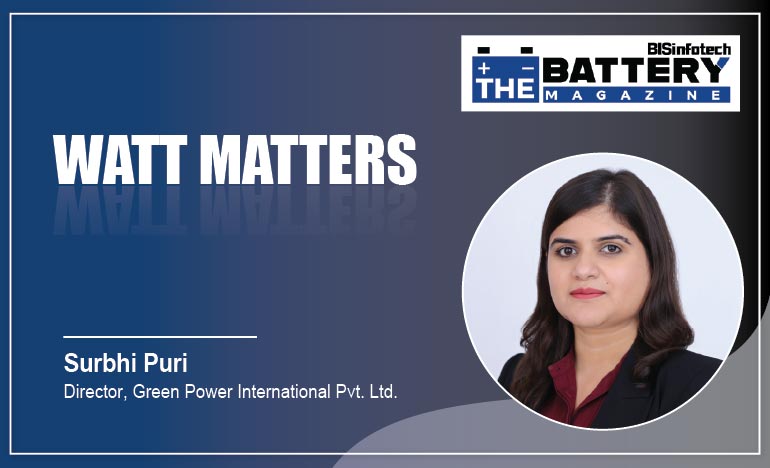
The energy and infrastructure sectors have traditionally been seen as male-dominated fields, especially in core technical roles. But as India moves faster toward clean and reliable energy, things are changing. A new kind of leadership is emerging one that combines strong technical knowledge with confidence, empathy, and the courage to challenge old mindsets. Surbhi Puri, Director at Green Power International, is one of the leaders driving this change.
In a recent conversation with Rashmi Verma, Ms. Surbhi Puri spoke openly about her journey. She shared how she worked her way through spaces where women were often underrepresented, focusing on performance rather than perception. With deep experience in EPC projects and gas-based power solutions, she explained how she moved from constantly proving herself to confidently taking key decisions simply by delivering consistent results and building strong domain expertise.
She also highlighted that while it’s important to recognize bias, real change comes from building strong talent pipelines. According to her, more women need opportunities in core engineering and technical roles not just support functions so they can grow into leadership positions based on skill and impact.
On the business front, Ms. Puri explained how Green Power International is balancing growth with sustainability. The company sees gas-based power as an important bridge in India’s energy transition while also exploring future-focused areas like hydrogen and carbon capture. This balanced approach helps meet today’s industrial energy needs while preparing for a cleaner tomorrow.
Her journey is a reminder that leadership today is not about fitting into old molds it’s about staying authentic, building expertise, and leading with purpose in a changing energy world.
The energy and infrastructure sector has traditionally been male-dominated. How would you describe your leadership journey and what helped you redefine leadership on your own terms?
My leadership journey has been rooted in a strong belief that traditions show us what has worked so far, but they do not define the limits of what can work in the future. Entering a male-dominated energy and infrastructure sector sometimes created discomfort, not out of resistance, but often due to lack of exposure to women in core technical and decision-making roles. I approached this by strengthening my technical competence, execution discipline, and domain expertise so that conversations remained anchored in performance and outcomes.
Much like a nurturing but firm leadership approach, I have believed in creating confidence through consistency, for myself and my teams. At Green Power International, working across EPC execution, gas-based power solutions, and infrastructure delivery taught me that leadership is about owning complex decisions while ensuring operational reliability, sustainability outcomes, and long-term energy efficiency for industries.
I have also learned that awareness of bias is important. Ignoring it does not solve it, and neither does allowing it to define your journey. There have been situations where stakeholder behaviour required me to be mindful, adaptive, and strategic in my communication and engagement approach, ensuring progress continues without turning challenges into personal or gender battles.
Over time, I have seen that the more women show up in technical leadership roles, the more normalised and inclusive these spaces become. For me, redefining leadership has meant leading with authenticity, emotional intelligence, and technical credibility, shifting the conversation from representation alone to meaningful value creation in India’s evolving energy transition landscape.
Many women speak about moving from “proving their worth” to confidently owning decision-making spaces. How did that transition happen for you?
I believe the idea of constantly “proving worth” is limiting, as it creates unnecessary competition. My focus has always been on continuous self-improvement and building competence rather than seeking validation.
As I strengthened my skills and clarity in my work, confidence in participating in decision-making spaces developed naturally, supported by consistent results and accountability.
When faced with resistance or doubt, I focused on finding constructive ways to deliver outcomes instead of engaging in validation battles, allowing my work to speak for itself.
My transition came from shifting my mindset from fitting into spaces to contributing unique value, perspectives, and solutions, which helped me grow into leadership roles organically.
What stereotypes did you encounter early in your career, and how did you learn to break them without compromising your authentic self?
Early in my career, I encountered stereotypes suggesting that women may not remain consistent or committed over the long term. However, through the dedication, growth mindset, and performance of women in my team, I have seen these assumptions being strongly challenged and disproven.
Personally, I chose to respond to such perceptions by focusing on my own professional growth and performance, rather than trying to directly counter stereotypes.
While opinions and biases can affect you at times, I learned the importance of not allowing them to become barriers, and instead using them as motivation to stay focused and keep progressing.
I have tried to break stereotypes by staying authentic, delivering consistent results, and demonstrating commitment through actions rather than changing who I am or how I lead.
In leadership roles, how important is competence over conformity, especially for women operating in core industrial sectors?
In leadership roles, competence is fundamental, as strong knowledge, sound decision-making, and the ability to deliver results establish credibility and trust.
I believe leadership should not be about conformity. Being authentic and bringing your genuine perspective is what truly strengthens leadership, including for women in core industrial sectors.
Focusing on continuous learning, skill-building, and nurturing teams creates long-term impact, which is far more valuable than simply trying to fit into existing norms.
Especially in traditionally structured industries, women leaders can drive meaningful change by leading with capability, confidence, and authenticity rather than adapting to limiting expectations.
Do you think leadership today is moving beyond gender labels? How can organizations encourage this shift more meaningfully?
Leadership paradigms are gradually shifting beyond gender-based classifications; however, structural and systemic gaps still exist. Leadership selection and progression should be driven by demonstrated technical competence, domain expertise, and performance metrics, rather than perception-based biases.
Organizations must invest in building robust leadership pipelines by ensuring equitable access to technical training, cross-functional exposure, operational responsibilities, and strategic decision-making platforms for women professionals.
Driving sustainable inclusion requires institutional interventions at multiple levels, including structured mentorship, succession planning, competency mapping, and leadership development frameworks that ensure readiness for complex industrial and managerial challenges.
A meaningful shift can be accelerated by designing capability-building ecosystems, including skill enhancement programs, role rotation, and equal participation in high-impact projects, enabling women to build comprehensive technical and leadership proficiency.
As a woman leader, how do you consciously create space and opportunities for the next generation of women professionals in energy and infrastructure?
I focus on building capability pipelines by ensuring women professionals get exposure to technical decision-making, project execution, and client-facing operational roles, which are critical for leadership readiness in infrastructure sectors.
I encourage participation in cross-functional energy projects and site-level exposure because leadership in this sector requires hands-on understanding of engineering, commercial, and operational integration.
I actively support structured mentorship and skill development, helping women professionals develop technical depth, strategic thinking, and stakeholder management capabilities.
Creating inclusive ecosystems also involves advocating for equal access to high-impact assignments, training opportunities, and leadership development platforms, enabling women to transition from support roles to core energy leadership positions.
From a business and technology perspective, how is Green Power International balancing commercial growth with cleaner, gas-based and sustainable energy solutions?
Green Power International balances growth and sustainability by positioning gas-based power generation as a transitional and cleaner alternative to conventional diesel-based power, enabling industries to improve efficiency while reducing emissions.
The company integrates EPC expertise across plant design, engineering, construction, and O&M services, allowing clients to adopt cost-efficient and environmentally optimized power solutions across industrial sectors.
From a technology standpoint, the organisation is expanding into advanced sustainability domains including carbon capture, compressed biogas, and hydrogen-based energy solutions, supporting long-term decarbonisation goals.
Commercial scalability is supported through strategic partnerships and advanced gas genset technologies that improve fuel efficiency and reliability while aligning with evolving industrial ESG requirements.
With India’s energy transition gaining pace, what role do gas-based power and distributed energy solutions play in supporting industrial and grid resilience, and how is Green Power International positioned in this space?
Gas-based power generation plays a critical role as a flexible and lower-emission bridging technology, helping industries maintain reliable energy supply while transitioning toward renewable and green fuel ecosystems.
Distributed energy solutions, such as modular gas genset-based plants, support decentralized power reliability, peak load management, and operational continuity, which is critical for energy-intensive industrial clusters.
Green Power International is strongly positioned through its ability to deliver gas genset-based power plants ranging from small-scale distributed solutions to large-scale EPC projects up to 100 MW capacity.
The company’s expanding focus on hybrid energy technologies, including carbon capture, hydrogen integration, and clean fuel solutions, enables it to support industries in building resilient, low-carbon, and future-ready energy infrastructure.
 Electrify your feed! Click here to join our Whatsapp group and to get the latest updates, expert insights, and innovations driving India’s energy storage revolution.