

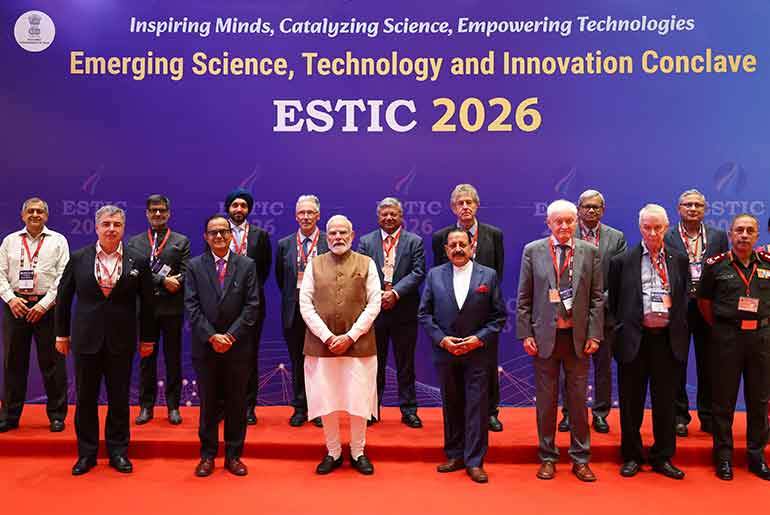
Prime Minister Narendra Modi has called on India’s scientific community, researchers and young innovators to develop scalable technologies and translate scientific research into practical applications at the Emerging Science, Technology and Innovation Conclave (ESTIC) 2026 in New Delhi. The conclave, held at Bharat Mandapam on October 27, brought together more than 5,000 delegates, including scientists, policymakers, industry representatives and deep-tech startups, to discuss research, innovation and industrial development.
For India’s battery and renewable energy sectors, the discussions on advanced manufacturing, indigenous technology development, deep-tech funding and research commercialisation are relevant to the broader effort to strengthen domestic manufacturing capabilities. These areas can support the development of advanced materials, battery technologies and energy storage solutions, although the conclave’s inaugural-day programme did not announce a specific battery manufacturing or energy storage initiative.
India Focuses on Translating Research into Commercial Technologies
In his inaugural address, Prime Minister Narendra Modi emphasised the need for measurable and scalable technological outcomes within a three-year operational horizon. He called for scientific breakthroughs to move beyond laboratories and address practical challenges, while strengthening India’s self-reliance under the Atmanirbhar Bharat vision.
The Prime Minister also highlighted frontier technology areas, including artificial intelligence, quantum technologies, advanced materials and biotechnology. The emphasis on translating research into real-world applications is relevant to industries that depend on continued innovation, including battery manufacturing, renewable energy and electricity storage.
For the battery sector, the broader challenge is to move promising research in battery chemistry, materials science and manufacturing processes towards commercially viable products. This requires coordination among research institutions, manufacturers, investors and government agencies.
Dr. Jitendra Singh, Union Minister of State (Independent Charge) for Science and Technology and Earth Sciences, highlighted India’s growing role in developing scientific and technological solutions. He also pointed to the expansion of the country’s startup ecosystem, which has grown from approximately 400 startups in 2014 to more than 2.3 lakh.
The minister’s remarks highlighted the importance of building domestic research capabilities and supporting innovation across India’s technology ecosystem.
Advanced Manufacturing Takes Centre Stage
Advanced manufacturing was one of the key technical themes discussed at ESTIC 2026. The session, chaired by Dr. N. Kalaiselvi, Director General of the Council of Scientific and Industrial Research (CSIR), featured a keynote address by Dr. G. Satheesh Reddy, former Chairman of the Defence Research and Development Organisation (DRDO).
The session examined technologies such as digital twins, collaborative robotics, additive manufacturing and metrology, alongside measures to strengthen supply chains for micro, small and medium enterprises (MSMEs).
These technologies have potential applications across industrial manufacturing, including the production and quality control of battery components. Digital twins can help manufacturers simulate production processes, while automation and precision measurement can support manufacturing consistency and process efficiency.
For India’s battery industry, developing stronger domestic manufacturing capabilities is important as demand for batteries grows across electric vehicles, renewable energy storage and industrial applications. Improvements in production technology, quality control and supply chain capabilities can help manufacturers scale operations and reduce dependence on imported components.
However, the advanced manufacturing session focused on industrial technologies broadly rather than announcing specific battery production projects.
Deep-Tech Funding and Research Commercialisation
The conclave also highlighted the importance of connecting scientific research with industrial development and commercial applications. Discussions on research funding, intellectual property commercialisation and technology transfer focused on the mechanisms required to move innovations from research institutions into the market.
The closing summary of the inaugural-day proceedings identified the ₹1 lakh crore Research, Development and Innovation Fund and mechanisms associated with the Anusandhan National Research Foundation (ANRF) as potential avenues for advancing deep-tech development through different technology-readiness stages towards commercialisation.
Such funding and institutional mechanisms could be relevant to battery technology developers working on next-generation chemistries, advanced battery materials, recycling processes and energy storage systems. These areas often require substantial investment in research, testing, pilot production and commercial-scale manufacturing.
For emerging battery technology companies, the transition from laboratory research to commercial production remains a significant challenge. Access to funding, testing infrastructure and industry partnerships can help bridge this gap.
The conclave’s emphasis on research commercialisation therefore aligns with the broader need to strengthen India’s domestic innovation ecosystem, although no battery-specific funding allocation was announced in the reported proceedings.
Artificial Intelligence and Industrial Technology Development
ESTIC 2026 also featured a session on generative and autonomous artificial intelligence, chaired by Saurabh Vijay, Chief Executive Officer of IndiaAI, with a keynote address by Professor Mitesh M. Khapra of IIT Madras.
Discussions covered the development of domestic large language models, access to high-performance computing under IndiaAI, agentic artificial intelligence and frameworks for safe deployment.
Although the session was not specifically focused on batteries, artificial intelligence has potential applications in battery research and manufacturing. It can support materials discovery, battery performance analysis, manufacturing quality control and predictive maintenance.
AI-enabled systems can also help analyse battery operating data and identify performance changes that may indicate degradation or maintenance requirements. In renewable energy applications, digital intelligence tools can support the monitoring and optimisation of battery energy storage systems.
The development of domestic AI capabilities could therefore create opportunities for technology integration across India’s battery and energy sectors. However, these are potential applications of the technologies discussed, rather than specific outcomes announced at ESTIC 2026.
Advanced Materials and Indigenous Technology Development
Prime Minister Narendra Modi’s emphasis on advanced materials and the conclave’s wider focus on frontier research also connect with India’s efforts to develop domestic technological capabilities.
Materials science plays an important role in battery performance, influencing energy density, charging characteristics, safety, durability and manufacturing costs. Research into alternative battery chemistries, improved electrode materials and more efficient manufacturing processes can contribute to the development of next-generation energy storage technologies.
For India, strengthening domestic research and industrial capabilities in these areas could help support the growing requirements of electric mobility and renewable energy integration.
The conclave also brought together researchers, policymakers, industry representatives and startups, providing a platform for discussions on how scientific knowledge can be translated into industrial applications.
Nevertheless, the reported programme did not identify a particular battery chemistry, battery manufacturing investment or energy storage project arising from the event.
Connecting Scientific Research with India’s Industrial Growth
ESTIC 2026 brought together scientific research, industrial development and policy discussions across 12 thematic priority domains. Its inaugural-day programme covered advanced manufacturing, artificial intelligence, synthetic biology and developments in the life sciences, alongside discussions on deep-tech funding and technology transfer.
For India’s battery and renewable energy industries, the broader significance lies in the emphasis on indigenous innovation, industrial scale-up and commercialisation. Progress in these areas could support the development of domestic capabilities across battery materials, manufacturing equipment, energy storage technologies and digital energy management.
The conclave’s discussions reinforce the importance of connecting research institutions with industry and investment to accelerate technology development. While ESTIC 2026 did not announce a dedicated battery-sector initiative in the reported proceedings, its focus on advanced manufacturing and deep-tech innovation reflects wider priorities relevant to India’s emerging battery and energy storage ecosystem.
 Electrify your feed! Click here to join our Whatsapp group and to get the latest updates, expert insights, and innovations driving India’s energy storage revolution.