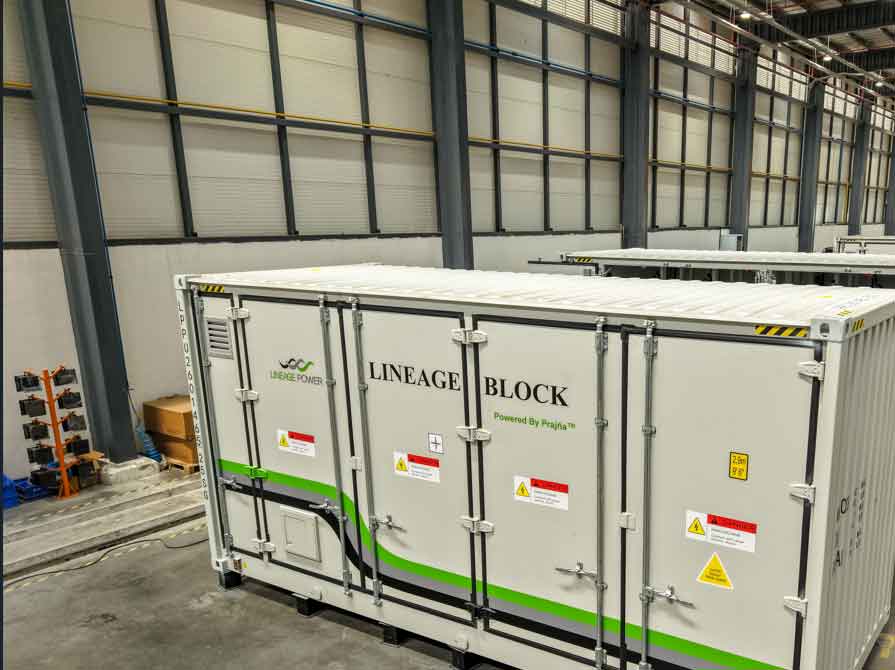
India’s clean energy transition is entering a defining phase—one where generating renewable power is no longer enough. The real challenge lies in storing that energy efficiently and delivering it precisely when it is needed. As Battery Energy Storage Systems (BESS) move from pilot projects to becoming an integral part of the country’s power infrastructure, companies that can offer end-to-end expertise—from manufacturing and engineering to deployment and lifecycle support—are poised to shape the next chapter of India’s energy story. One such company is PACE Digitek, which has steadily evolved from its strong foundation in telecom power infrastructure into a comprehensive provider of renewable energy and battery storage solutions. Underscoring this momentum, Lineage Power, a PACE Digitek company, dispatched its 300th BESS container on July 27, marking a cumulative 1.5 GWh of BESS manufacturing and dispatches. The milestone reflects the company’s growing execution capability as India scales energy storage to support its clean-energy ambitions.
Drawing on decades of experience in power systems, the company today delivers integrated BESS solutions encompassing manufacturing, EPC, commissioning and long-term operations and maintenance, while continuing to expand its footprint across India’s rapidly growing energy storage landscape.
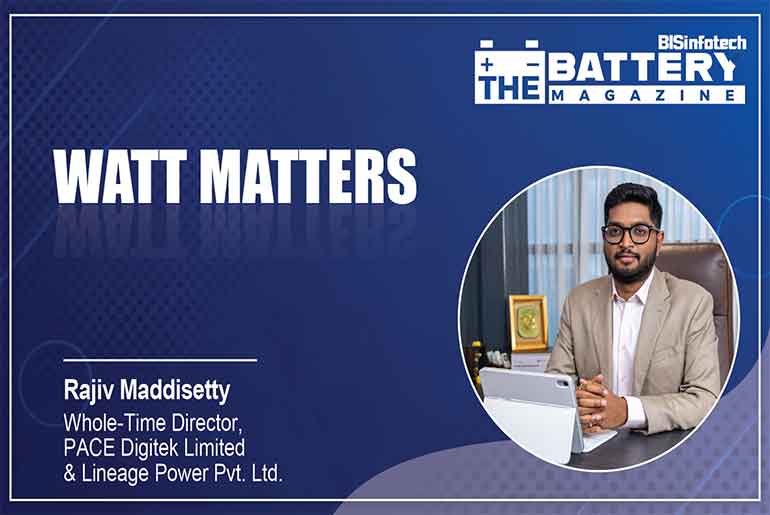
During India Energy Storage Week (IESW) 2026, Shweta Kumari, Sub-Editor, The Battery Magazine, sat down with Rajiv Maddisetty, Whole-Time Director, PACE Digitek Limited & Lineage Power Pvt. Ltd., to look beyond products and capacities and understand the vision driving the company’s transformation. The conversation explored how PACE Digitek’s telecom heritage paved the way for its entry into Battery Energy Storage Systems, why integrated execution is becoming increasingly important for large-scale projects, and how the company views the immense opportunities unfolding as India steps into what many describe as the decade of energy storage.
Could you introduce PACE Digitek and Lineage Power, and tell us about the solutions you are showcasing at India Energy Storage Week?
PACE Digitek and Lineage Power are engaged in delivering turnkey power solutions across the telecom and energy sectors. In telecom, we execute end-to-end power infrastructure projects for telecom towers, while in the energy segment we offer solar, solar-plus-BESS and standalone Battery Energy Storage System (BESS) solutions.
Our capabilities span manufacturing, EPC, commissioning, operations and maintenance, allowing us to provide complete project execution under one umbrella.
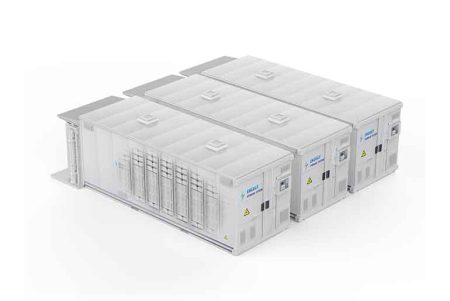
At IESW, we are showcasing our 5.015 MWh containerized BESS, a 261 kWh commercial and industrial (C&I) energy storage cabinet, and a 600 Ah telecom battery cabinet, demonstrating solutions for both telecom and large-scale energy storage applications.
PACE Digitek has evolved from telecom power solutions to Battery Energy Storage Systems. What inspired this transition?
Our journey into renewable energy began over a decade ago. Traditionally, telecom infrastructure relied on grid electricity supported by diesel generators. Around 2013, we started integrating solar power and battery storage into telecom tower applications, which marked our entry into renewable energy solutions.
As the demand for Battery Energy Storage Systems accelerated over the past few years, we recognized the enormous opportunity in this sector. This encouraged us to expand our capabilities and establish a dedicated BESS manufacturing facility. Today, we are executing multiple projects across the country and continue to strengthen our presence in the energy storage market.
What differentiates PACE Digitek in an increasingly competitive BESS market?
Our biggest strength lies in offering an end-to-end solution rather than operating as only a manufacturer or only an EPC contractor.
We provide the complete value chain under one roof—from manufacturing and engineering to project execution, installation, commissioning, operations and maintenance. Our dedicated service teams ensure timely support throughout the lifecycle of every BESS installation, enabling customers to work with a single, reliable technology partner.
As many experts describe this as the ‘decade of energy storage’, what trends do you see shaping the BESS industry over the next five years?
India is witnessing significant growth in renewable energy as the country works towards greater energy security and reduced dependence on conventional energy sources. However, renewable power generation is inherently intermittent—solar energy is available only during daylight hours, while wind generation depends on weather conditions.
Battery Energy Storage Systems play a crucial role in addressing this challenge by storing excess renewable energy and delivering it during periods of peak demand. As renewable capacity continues to expand, the need for energy storage will grow alongside it. We believe BESS will become a fundamental pillar of India’s clean energy transition over the coming years.
What can the industry expect from PACE Digitek in the near future?
We are currently expanding our manufacturing capabilities with an additional 5 GWh of production capacity, which is expected to be operational by October. This expansion will take our cumulative manufacturing capacity to 10 GWh.
Alongside capacity expansion, our focus remains on securing more projects, strengthening our market presence and continuously improving our technology and execution capabilities. Our long-term vision is to become one of India’s leading players in the Battery Energy Storage System industry.
As India rapidly scales up BESS deployment, what do you believe will be the biggest challenge for project developers over the next three to five years, and how can the industry address it?
One of the biggest challenges will be managing cost volatility, particularly because the industry still relies heavily on imported Battery solutions (DC blocks, packs, cells), which account for a significant share of the overall BESS cost. Fluctuations in global cell prices and exchange rates can directly impact project viability, making long-term planning more challenging for developers.
Another equally important aspect is operations and maintenance. BESS is a highly sophisticated and safety-critical asset that requires continuous monitoring, preventive maintenance and disciplined asset management throughout its lifecycle. As India enters the large-scale deployment phase, the next three to five years will be a significant learning curve for the industry. Building strong service capabilities, adopting global best practices and focusing on long-term asset performance will be just as important as deploying new capacity.
PACE Digitek provides manufacturing, EPC and lifecycle services under one roof. How does this integrated approach benefit customers compared to working with multiple vendors?
An integrated approach gives customers a single point of accountability throughout the project lifecycle—from manufacturing and engineering to EPC execution and long-term operations and maintenance.
It also gives customers greater confidence because the same products we manufacture are deployed in our own utility-scale projects. We have already commissioned and are successfully operating more than 600 MWh of BESS installations in Maharashtra, providing us with valuable field experience and proven O&M practices. These learnings are directly incorporated into every project we deliver, enabling customers to benefit from real-world operational expertise rather than only product knowledge.
Looking ahead, what are your key priorities for PACE Digitek and Lineage Power in terms of technology, manufacturing and market expansion over the next five years?
Over the next five years, our focus will be on strengthening our position as a fully integrated energy storage company. We are expanding our cell-to-DC block and C&I BESS cabinets manufacturing capabilities beyond 10 GWh annually, while also increasing backward integration through in-house container fabrication and other critical manufacturing processes to enhance quality, efficiency and supply chain resilience.
We are also very keen for ACC manufacturing in India under the Government’s PLI framework. In this direction, Lineage Power has partnered with IISER to support research and technology adoption for next-generation battery solutions. Alongside manufacturing expansion, we will continue to invest in technology, engineering capabilities and project execution as we expand our presence across utility-scale, commercial and industrial, and telecom energy storage markets
 Electrify your feed! Click here to join our Whatsapp group and to get the latest updates, expert insights, and innovations driving India’s energy storage revolution.