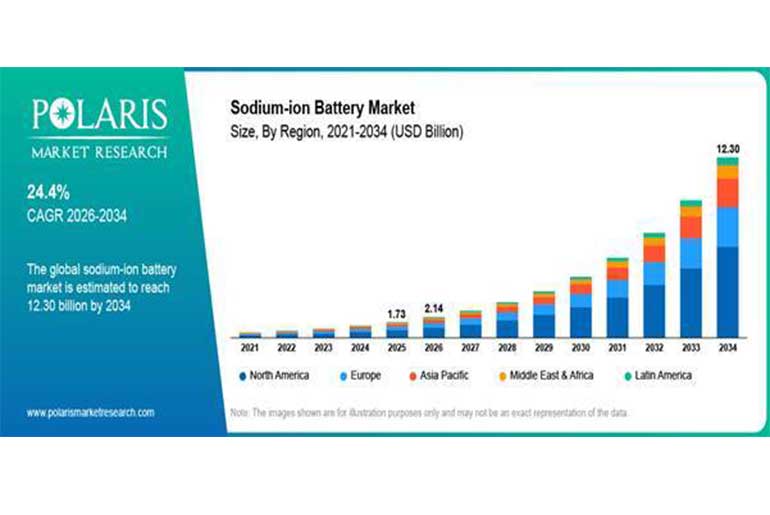
The global sodium-ion battery market is entering a rapid growth phase as rising demand for affordable energy storage, supply chain diversification and renewable energy integration accelerate the adoption of alternative battery chemistries. According to a report by Polaris Market Research, the global sodium-ion battery market was valued at USD 1.73 billion in 2025 and is projected to reach USD 12.30 billion by 2034, expanding at a compound annual growth rate (CAGR) of 24.4% between 2026 and 2034. The market is estimated to reach USD 2.14 billion in 2026.
Sodium-ion technology is gaining attention as manufacturers and energy companies seek alternatives to lithium-ion batteries amid concerns over lithium, cobalt and nickel availability, raw material prices and geopolitical risks associated with concentrated supply chains. Sodium is more abundant and widely distributed than lithium, offering potential cost and supply security advantages for applications where high energy density is not the primary requirement.
Like lithium-ion batteries, sodium-ion cells store and release energy through the movement of ions between the cathode and anode. However, sodium-ion batteries generally offer lower energy density than advanced lithium-ion technologies. Their potential advantages in terms of cost, thermal stability and raw material availability are making them increasingly relevant for stationary energy storage, grid applications and cost-sensitive electric mobility.
Asia Pacific accounted for the largest share of the global sodium-ion battery market in 2025, contributing approximately 47.8% of total revenue. The region’s leadership is supported by its extensive battery manufacturing ecosystem, strong clean-energy policies and substantial investments in next-generation storage technologies. China’s established battery production capabilities and expertise in large-scale manufacturing are also supporting the commercialisation of sodium-ion technology.
North America is expected to be the fastest-growing regional market, supported by investments in grid modernisation, transmission infrastructure and domestic battery manufacturing. Europe is also witnessing rising demand as countries accelerate clean energy deployment and seek cost-effective storage technologies to support renewable power integration.
By battery type, sodium layered oxide batteries held the largest market share in 2025 at approximately 52.4%. Their relatively mature technology, cost advantages and suitability for large-scale storage have contributed to their early adoption. Sodium polyanionic batteries, meanwhile, are expected to record the fastest growth as research and development efforts focus on improving safety, cycle life and thermal stability.
Stationary energy storage remained the largest application segment, accounting for nearly 58.6% of the market in 2025. The growth of solar and wind power, alongside the need to modernise electricity grids, is expected to support demand for cost-efficient storage solutions. Electric vehicles currently represent a smaller share but are projected to be the fastest-growing application as automakers explore sodium-ion batteries for affordable and entry-level vehicle segments.
Utilities accounted for nearly 49.3% of the market by end user, supported by growing deployment of batteries for grid reliability and renewable energy integration. Automotive manufacturers are expected to register the fastest growth among end-user categories as companies seek to reduce battery costs while maintaining safety.
Commercial developments are also strengthening the technology’s outlook. CATL and CHANGAN jointly introduced a commercial sodium-ion passenger vehicle in February 2026, while CATL announced a commercially operational sodium-ion battery energy storage system in June 2026. Other developments, including Nuvve Japan’s 2 MW/8 MWh grid-scale storage project and Changhong Sanjie’s planned USD 1.3 billion battery plant investment in Malaysia, reflect increasing industry interest.
Despite its growth potential, sodium-ion technology faces challenges, including lower energy density than lithium-ion batteries, high initial manufacturing investment, certification requirements and the need for continued research. Key players include CATL, Faradion, HiNa Battery Technology, Natron Energy, Northvolt, Peak Energy, TIAMAT and Altris.
With the market projected to expand nearly sevenfold by 2034, sodium-ion batteries are increasingly emerging as a commercial contender in the global energy storage landscape.
 Electrify your feed! Click here to join our Whatsapp group and to get the latest updates, expert insights, and innovations driving India’s energy storage revolution.