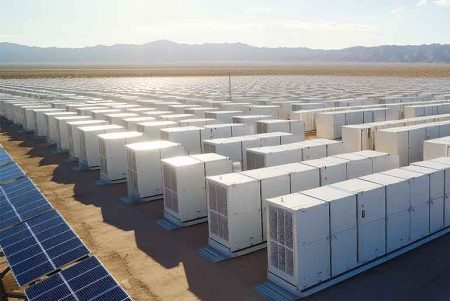
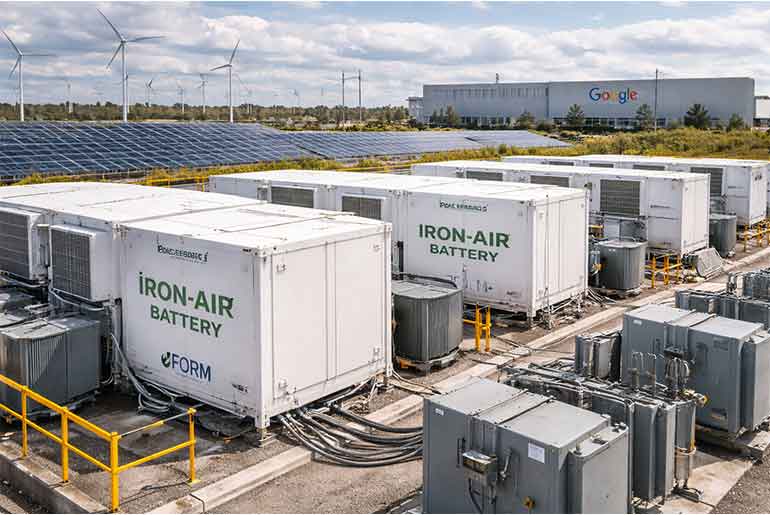
Google has announced plans to deploy a 300 MW / 30 GWh iron-air battery energy storage system in partnership with Xcel Energy and U.S.-based storage startup Form Energy, marking what could become the largest battery installation ever announced globally by energy capacity. The project will support a new Google data center in Pine Island, Minnesota, as the tech giant accelerates efforts to power AI infrastructure with carbon-free energy.
The massive battery system is designed to deliver electricity for up to 100 hours of continuous discharge, enabling multi-day energy storage that goes far beyond conventional lithium-ion battery systems. The deployment is expected to play a critical role in stabilizing power supply for data centers that rely heavily on renewable energy sources such as wind and solar.
The project forms part of a broader clean-energy package developed with Xcel Energy that will include 1.4 GW of wind power and 200 MW of solar capacity, bringing the total renewable energy portfolio supporting the data center to roughly 1.9 GW. These renewable resources will charge the battery system, enabling Google to store excess electricity and dispatch it during periods when renewable generation is low.
Form Energy’s iron-air battery technology relies on a chemical process that uses iron, water, and oxygen. During discharge, the iron reacts with oxygen to form rust, releasing electrons and generating electricity. When the battery is recharged, the process reverses, converting the rust back into iron and storing energy again. This design allows energy storage for multiple days at relatively low cost, making it attractive for large-scale grid applications.
The system will deliver 300 MW of power continuously for 100 hours, resulting in a total storage capacity of 30 gigawatt-hours, a scale that surpasses any previously announced grid battery project. Form Energy CEO Mateo Jaramillo described the project as a major milestone for multi-day energy storage and a significant step toward enabling reliable clean power systems.
Industry analysts say the project highlights the growing energy demands of AI-driven data centers, which require massive amounts of electricity and reliable round-the-clock power. By combining renewable energy generation with multi-day battery storage, the project aims to provide consistent electricity supply even during periods of low renewable generation or extreme weather events.
Despite its advantages in long-duration storage, iron-air battery technology has some trade-offs. Its round-trip efficiency is lower than lithium-ion batteries, meaning a larger portion of stored energy is lost during charging and discharging cycles. However, iron-air batteries are expected to be significantly cheaper due to the abundance and low cost of iron compared with lithium and other battery materials.
Form Energy, founded in 2017 and headquartered in Massachusetts, has raised over $1 billion in funding and is scaling production at its manufacturing facility in Weirton, West Virginia. The Google deployment represents one of the company’s largest commercial deals to date and its first major application supporting a hyperscale data center.
If successfully implemented, the project could set a precedent for how long-duration battery storage technologies help balance renewable energy systems while powering the rapidly expanding digital and AI economy.
 Electrify your feed! Click here to join our Whatsapp group and to get the latest updates, expert insights, and innovations driving India’s energy storage revolution.