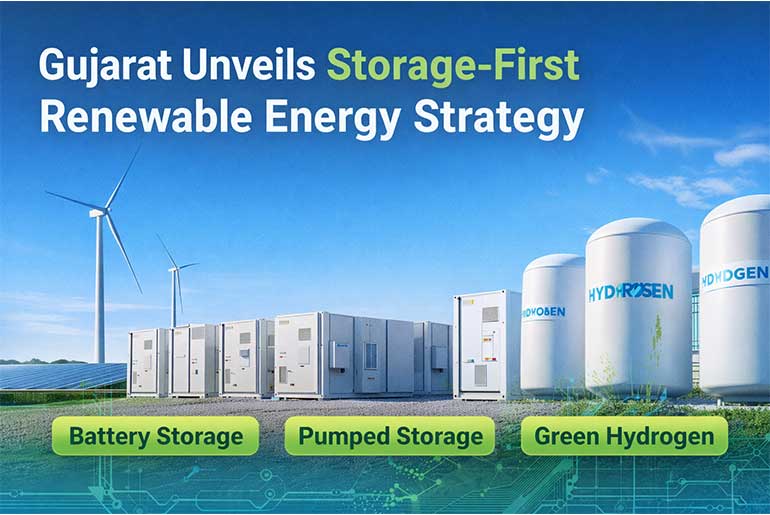
India’s renewable energy transition has entered a decisive new phase—one where storage, not generation alone, defines success. Recognising this shift, the Government of Gujarat has unveiled a cohesive, storage-led clean energy framework through the Gujarat Integrated Renewable Energy Policy 2025, supported by three landmark policy pillars: Pumped Storage Projects (PSP), Battery Energy Storage Systems (BESS), and Green Hydrogen.
Together, these policies mark one of the most comprehensive state-level efforts in India to integrate renewable energy with short-, medium-, and long-duration storage—moving beyond capacity addition to grid reliability, flexibility, and deep decarbonisation.
Why This Policy Is Relevant Now
As of late 2025, India has crossed significant renewable capacity milestones, yet the power system faces growing challenges:
- Intermittency from high solar and wind penetration
- Peak demand stress on grids
- Limited flexibility during non-solar hours
- Seasonal mismatch between renewable supply and industrial demand
Gujarat’s policy framework directly responds to these challenges, aligning with India’s COP26 Panchamrit commitments, the Nationally Determined Contributions (NDCs), and the National Green Hydrogen Mission.
This makes the policy forward-looking, timely, and system-critical, not merely aspirational.
A Shift in Thinking: From Megawatts to Megawatt-Hours
The most important takeaway from the Gujarat Integrated Renewable Energy Policy 2025 is philosophical:
Renewable energy is no longer treated as standalone generation—but as a dispatchable, storage-backed system.
The policy explicitly integrates wind, solar, hybrid projects, and storage under a single regulatory and planning framework, signalling that future renewable growth must be firm, reliable, and grid-responsive.
Policy Pillar 1: Pumped Storage Projects (PSP) — Long-Duration Backbone
Pumped Storage Projects are positioned as the foundation of long-duration energy storage in Gujarat’s energy transition.
Key intent:
- Enable bulk energy shifting across day-night and seasonal cycles
- Provide peak load management and frequency regulation
- Reduce reliance on fossil-fuel-based peaking power plants
By promoting PSPs, Gujarat acknowledges that battery storage alone cannot meet long-duration and seasonal balancing needs—a lesson already evident in global power systems.
This aligns India with international best practices, where pumped storage remains the largest source of grid-scale energy storage worldwide.
Policy Pillar 2: Battery Energy Storage Systems (BESS) — Grid Stability and Speed
Where PSPs provide scale, BESS provides speed and precision.
The Gujarat policy gives BESS a central, non-discriminatory role across the power ecosystem:
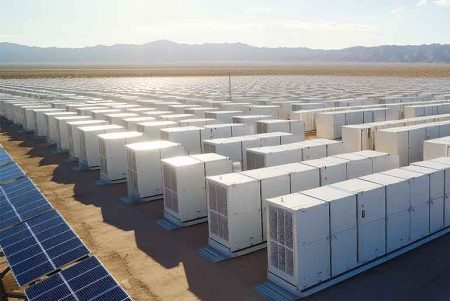
- Standalone grid-connected BESS projects
- Co-located storage with solar, wind, and hybrid projects
- BESS as a transmission and distribution support asset
- Participation in ancillary services, capacity markets, and grid services
Importantly, the policy allows BESS to support:
- Peak shaving
- Renewable firming
- Grid congestion management
- Load balancing and reliability services
This reflects a clear understanding that batteries are not just energy assets—but grid infrastructure.
Policy Pillar 3: Green Hydrogen — Seasonal Storage and Industrial Decarbonisation
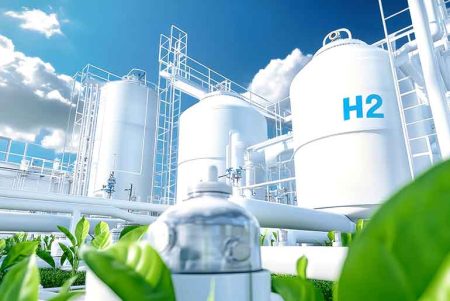
Perhaps the most strategic component of Gujarat’s approach is the explicit recognition of Green Hydrogen as a seasonal storage vector.
While batteries and PSPs address short- and medium-duration needs, green hydrogen is positioned to:
- Store excess renewable energy over weeks or months
- Decarbonise hard-to-abate industrial sectors
- Support future fuel, fertiliser, and export ecosystems
The policy aligns Gujarat’s renewable planning with the National Green Hydrogen Mission, ensuring that renewable generation, storage, and hydrogen production evolve in coordination, not silos.
This is critical for states aiming to become industrial decarbonisation hubs, not just power exporters.
Integrated Planning: Wind, Solar, Hybrids, and Storage
The document repeatedly emphasises integration:
- Wind–solar hybrid projects (with or without BESS)
- Repowering of old wind assets to improve efficiency
- Hybridisation to reduce variability and optimise land and transmission use
- Storage co-location to enhance dispatchability
This integrated approach addresses one of India’s biggest clean energy gaps: the mismatch between renewable growth and grid readiness.
Why Gujarat Matters Nationally
Gujarat is not starting from zero.
Between 2002 and 2025, the state expanded its renewable capacity from 0.16 GW to over 41 GW, with ambitions to cross 100 GW by 2030. Its strengths include:
- Strong wind corridors
- High solar irradiation
- Robust port and transmission infrastructure
- Large industrial power demand
By anchoring storage into renewable planning, Gujarat positions itself as a template state—one whose policy architecture could influence national thinking.
Implications for India’s Energy Transition
Gujarat’s integrated storage-first framework reflects a broader national realisation:
- Renewable capacity alone does not guarantee energy security
- Storage is essential for reliability, affordability, and decarbonisation
- Policy coherence across generation, storage, and demand is non-negotiable
As India scales towards 500 GW of non-fossil capacity, such state-level execution models will determine whether targets translate into stable power systems or stressed grids.
The Real Test: Execution
While the policy framework is robust, execution will define impact. Key watch areas include:
- Speed of PSP clearances and land acquisition
- Commercial viability and tariff discovery for BESS
- Grid readiness to absorb storage-backed renewables
- Coordination between state agencies, DISCOMs, and regulators
The inclusion of mid-term review provisions suggests the government recognises the need for adaptive governance.
 Electrify your feed! Click here to join our Whatsapp group and to get the latest updates, expert insights, and innovations driving India’s energy storage revolution.