From its origins in carbon chemistry to its growing stature as a global speciality materials and battery-solutions player, Himadri Speciality Chemical Ltd has steadily rewritten its own growth narrative. What sets Himadri apart in India’s industrial landscape is not just scale, but its ability to anticipate transitions early—whether it is the shift toward high-value speciality carbon materials or the accelerating global move toward clean energy and advanced battery ecosystems. Today, as battery demand surges worldwide and supply chains seek credible non-Chinese alternatives, Himadri finds itself uniquely positioned at the intersection of materials science, sustainability, and global energy transformation.
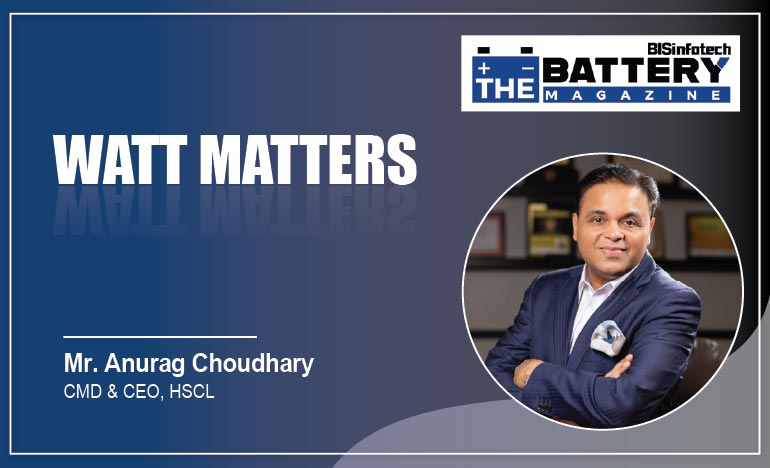
In a candid and forward-looking conversation, Shweta, Sub-Editor at The Battery Magazine, spoke with Anurag Choudhary, CMD & CEO, Himadri Speciality Chemical Ltd who outlined how Himadri’s long-term R&D focus, disciplined capital allocation, and deeply integrated carbon value chain are enabling the company to scale into lithium-ion battery materials, including cathode and next-generation anode solutions. He highlighted Himadri’s ambition to emerge as a globally relevant energy-materials powerhouse, its role in strengthening India’s self-reliance while serving international markets, and the growing importance of partnerships, sustainability, and circular-economy thinking in shaping the company’s next phase of growth.
As Himadri steps into what it calls “Himadri Reloaded,” this conversation offers valuable insight into how legacy chemistry players are redefining themselves for a battery-powered future. Let’s delve into the interview to explore this transformation in greater depth.
Himadri has evolved from a carbon chemistry player into a global speciality chemicals and battery materials player. What key milestones have driven this transformation, and how do you view Himadri’s current global positioning?
At Himadri, our transformation has been shaped by a series of deliberate and forward-looking decisions. We began by strengthening our core carbon materials business, followed by strategic investments to move up the value chain into speciality carbon black, refined naphthalene, and other high-value speciality chemicals. A key inflection point was Himadri’s early recognition of the global clean energy transition followed by sustained investments in R&D, process integration, and advanced materials capabilities. This vision laid the foundation for our entry into battery materials, including anode and cathode components, that form the backbone of the lithium-ion battery ecosystem.
Today, Himadri stands at the intersection of accelerating global demand and superior margin potential. With global LiB demand expected to quadruple by 2030, we are well-positioned to capitalize on this opportunity. Increasingly, Himadri is being recognized globally as a technology-driven, integrated speciality solutions company that has a robust platform and stable footing required to scale and compete in high-growth energy markets.
How does Himadri balance R&D and capital allocation across carbon black, coal tar derivatives, and battery materials while embedding sustainability into its manufacturing processes and product design?
Himadri’s growth is anchored on science-led in-house innovation, with R&D as the principal enabler of sustainability. Our commitment towards developing ground breaking technology built as a function of our R&D efforts is reflected in sustained investments in scaling our R&D team and associated capabilities over the last 12–14 years. Our efforts continue to be driven by a strong in-house team that put all their efforts in not just redesigning processes, materials, and products to be cleaner, safer, and more resource-efficient, but reimagining what is possible. Our capital allocation is deliberately prioritised toward technologies that combine scalability with cost efficiency. In battery materials, this discipline has translated into focused investments in commercialising LFP and developing LMFP cathode chemistries, which offer superior safety, stability, and economics over legacy technologies.
Across our manufacturing footprint, we operate eight zero-liquid-discharge facilities, ensuring responsible water stewardship. Our products today are available in 56 countries around the globe. We meet 100 per cent of our electrical energy requirements through clean power, including waste heat and waste gas recovery systems. We have also laid out a clear ‘Net Zero by 2050 roadmap’ well ahead of India’s 2070 target. We have been recognised with an EcoVadis Platinum rating in Sustainability for the second consecutive year, placing Himadri in the top 1 per cent of over 1,50,000 companies assessed globally. Our sustainability performance is further enhanced by global recognitions such as ISCC PLUS certification and an ‘A’ rating in the CDP Supplier Engagement Assessment.
With Himadri’s entry into lithium-ion battery materials positioning it as a potential non-Chinese supplier, which battery material segments are you currently focusing on, where do you see the strongest growth opportunities, and how are you balancing India’s self-reliance priorities with your global expansion strategy?
Our focus in lithium-ion battery materials is firmly anchored in the most value-critical and high-impact components of the cell — cathode and anode materials, which together account for nearly 65% of total cell cost. On the cathode side, we’re prioritising Lithium Iron Phosphate (LFP) and its advanced variants. Himadri is setting up world’s first commercial LFP cathode active material facility outside China in phases, with a total planned capacity of 2,00,000 MTPA. This pioneering initiative will propel Himadri as a credible non-Chinese supplier to global OEMs and battery manufacturers.
On the anode side, we are uniquely positioned owing to our deep expertise across the carbon value chain and our long term association with Aluminium smelters, that are driving our research work on commercialising a complete solution suite for anode materials- synthetic , natural, hybrid and next-generation silicon-carbon for anodes. In parallel, our strategic investments in International Battery Company (IBC) and our partnership with Australia–based Sicona Battery Technologies are enabling us to have a joint innovative roadmap in place with solutions being developed for various sunrise industries.
As we strive to balance India’s “Atmanirbhar” (self-reliance) priorities with global expansion, our strategy is to build scale and capability in India while serving both domestic and international markets. A key example of this dual focus is our recent milestone -our first-ever export shipment of 3,600 tonnes of liquid coal tar pitch to the Middle East from our newly commissioned liquid coal tar pitch terminal at the New Mangalore Port terminal, thereby opening up a second export corridor alongside Haldia and strengthening our ability to serve critical industrial demand in the Middle East and the Americas.
Partnerships like the collaboration with Sicona for silicon-carbon anode materials are crucial for next-gen batteries. How do such alliances support product differentiation and IP development at Himadri?
While Himadri already commands a unique advantage through its fully integrated carbon value chain, we recognise that the next-generation batteries would require step-change innovation beyond conventional graphite.
The strategic association along with the technology licensing partnership with Sicona enables Himadri to leapfrog into Silicon-Carbon (SiCx) anode technology. Himadri has the right to localise the manufacturing of silicon carbon for anodes which significantly enhances energy density and charging speed of batteries. By taking an equity stake and co-developing the technology, we are not merely accessing the know-how but also embedding proprietary processes and IP within our manufacturing ecosystem.
As demand grows for premium and speciality carbon black grades, how does Himadri ensure supply chain reliability, quality consistency, and margin sustainability?
Himadri’s strength lies in its deeply integrated and differentiated business model. We produce our own carbon black oil from coal tar distillates. This cleaner, low-impurity feedstock ensures superior product quality, tighter process control, and consistent performance — critical for niche applications such as conductive blacks, engineering plastics, inks, coatings, and lithium-ion batteries. Our supply chain reliability is reinforced through backward integration and domestic sourcing. We have led a deliberate transition from commodity carbon black to high-margin speciality grades, underpinned by sustained investments in R&D and application-led innovation.
A major milestone in this journey was the start of trial production of our speciality carbon black expansion project at Mahistikry in December 2025, signalling the start of the next growth chapter of our speciality carbon black business. This facility makes Mahistikry the world’s largest single-site speciality carbon black plant, taking Himadri’s total speciality carbon black capacity to 1,30,000 MTPA and positioning us as the fourth-largest speciality carbon black producer globally. Our margin sustainability is further supported by continuous R&D, application-led innovation, and forward integration into downstream products like construction chemicals, refined naphthalene and other speciality oils.
Looking ahead to 2030 and beyond, how do you see Himadri’s role evolving in emerging areas?
As we look toward 2030 and beyond, we see Himadri entering “The Next Chapter” of Himadri 2.0 coined as “Himadri Reloaded”. We are not only aiming at incremental growth or achieving fixed numerical targets; it is about transforming the company into an institution, with robust energy, ambition, and scale. It is my vision that by 2030, Himadri will evolve from being a speciality materials company into a global energy-materials and sustainability-driven powerhouse. With global battery demand expected to quadruple by 2030, we have entered a sunrise sector where demand would never be a constraint. Our evolution and transformation is not limited to battery materials alone. We are expanding deeper into the circular economy, researching and testing novel processes that convert ‘waste into wealth’ through resource recovery and recycling-led processes. By FY27, we plan to commission a facility to extract high-value speciality products from our existing coal tar distillate- Anthraquinone and Carbazole, reinforcing our commitment to innovation-led, sustainable growth.
 Electrify your feed! Click here to join our Whatsapp group and to get the latest updates, expert insights, and innovations driving India’s energy storage revolution.