India’s electric mobility transition is entering a decisive phase. While significant progress has been made in passenger and light commercial segments, the true test of scale now lies in electrifying Medium and Heavy Commercial Vehicles (M&HCVs), which form the backbone of the nation’s freight and logistics ecosystem.
This segment moves large portion of India’s freight, connects manufacturing hubs to markets, and sustains millions of livelihoods. Decarbonising heavy mobility is therefore not merely an environmental objective; it is a strategic economic imperative.
Yet, scaling electric mobility in this segment presents unique operational and financial challenges that conventional charging infrastructure alone cannot resolve. In this context, battery swapping is emerging not as an alternative, but as a critical enabler for India’s heavy electric future.
The Structural Barriers to M&HCV Electrification
Heavy commercial vehicles operate under demanding conditions. They typically run for 10 to 16 hours a day, cover 200 to 500 kilometres daily, and generate value only when they are in motion. Any disruption in uptime directly impacts fleet profitability.
Conventional charging remains a key bottleneck. Charging large battery packs of 200–400 kWh can take between One to Two hours, even with high-capacity chargers. This reduces daily vehicle utilisation by 10–20 per cent and leads to substantial revenue loss for operators.
Infrastructure constraints compound the challenge. High-power charging stations require significant grid upgrades, land availability, and capital investment. Along national highways, industrial clusters, and logistics corridors, such infrastructure remains unevenly distributed.
The high upfront cost of electric M&HCVs is another major barrier. Battery packs make electric trucks significantly more expensive than their diesel counterparts. For many mid-sized fleet operators, this limits access to financing and slows adoption.
For commercial transport, reliability is non-negotiable. Energy availability, predictability, and operational continuity are fundamental requirements, not optional features.
How Battery Swapping Reshapes Heavy Mobility Economics
Battery swapping addresses these constraints by separating vehicle ownership from energy storage.
Under this model, depleted batteries are exchanged for fully charged ones in 5–10 minutes, comparable to conventional refuelling cycles. This fundamentally transforms fleet operations.
First, it maximises vehicle uptime. With minimal energy-related downtime, fleet availability can exceed 95 per cent, enabling continuous multi-shift and long-haul operations.
Second, it lowers capital barriers through Battery-as-a-Service models. By removing battery ownership from the purchase equation, upfront vehicle costs can reduce drastically. This improves financing viability and enables faster fleet electrification.
Third, it brings predictability to operating economics. Subscription-based energy pricing eliminates exposure to battery degradation risks and replacement costs, enabling more accurate long-term financial planning.
Together, these factors significantly improve total cost of ownership and return on investment for electric M&HCV fleets.
Enabling Range Confidence at Scale
For heavy commercial vehicles, range anxiety is not a psychological concern, it is an operational risk.
A network of strategically located swapping stations across freight corridors, industrial zones, ports, and logistics hubs ensures uninterrupted mobility. Energy becomes a distributed service rather than a limiting factor.
This networked approach enables electric trucks to operate with the same confidence and reliability as conventional vehicles.
Implications for India’s Freight Economy
India moves over 4.6 billion tonnes of freight annually, with road transport accounting for the majority of this volume. Electrifying even a quarter of this segment can significantly reduce diesel consumption, lower logistics emissions by over 30 per cent, and improve national energy security.
Battery swapping makes this transition commercially viable.
Improved asset utilisation and lower energy costs can enhance fleet margins by 5–8 percentage points, strengthening the financial sustainability of operators in a low-margin industry.
Beyond fleet economics, battery swapping supports the development of a robust domestic ecosystem encompassing battery management, refurbishment, recycling, software platforms, and energy services, creating skilled employment and strengthening supply chains.
Alignment with National Priorities
India’s evolving EV policy framework increasingly recognises battery swapping as a critical enabler, particularly for commercial mobility.
It aligns with national objectives on energy security, Make-in-India manufacturing, emissions reduction, and climate commitments. Ongoing initiatives on standardisation, interoperability, and safety norms are strengthening institutional confidence and encouraging long-term private investment.
This policy clarity is essential for building scalable and sustainable infrastructure.
The Way Forward
For battery swapping to realise its full potential in heavy mobility, coordinated action is required across stakeholders.
Common technical standards must ensure interoperability across vehicle platforms and networks. Robust safety frameworks must govern battery handling, storage, and operations. Deployment strategies must prioritise high-density freight corridors and logistics hubs to maximise utilisation and economic viability.
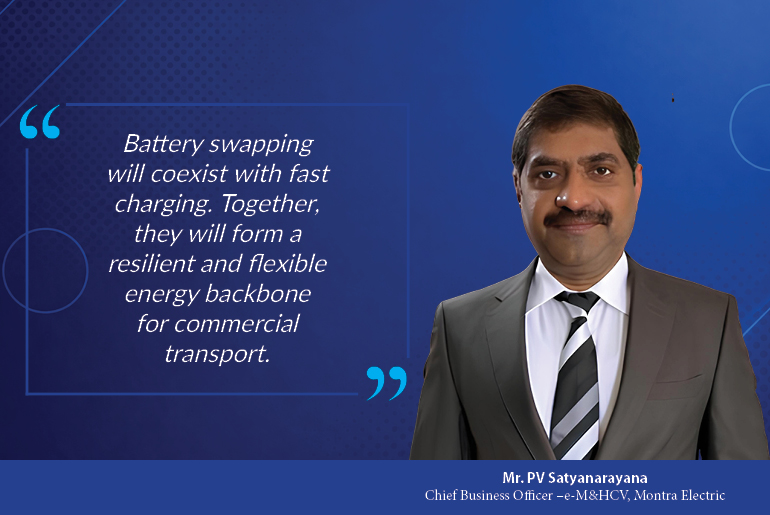
Battery swapping will coexist with fast charging. Together, they will form a resilient and flexible energy backbone for commercial transport.
A Strategic Necessity for India’s EV Transition
India’s freight sector cannot afford to wait for perfect infrastructure to emerge organically.
To electrify M&HCVs at speed, scale, and affordability, energy delivery systems must align with commercial realities.
Battery swapping offers higher uptime, lower capital barriers, predictable operating economics, and networked energy access. It transforms electric trucks from experimental assets into dependable, revenue-generating workhorses.
For India’s heavy electric mobility transition, battery swapping is a strategic necessity.
 Electrify your feed!