As India accelerates investments in Battery Energy Storage Systems (BESS), the focus is gradually shifting beyond batteries to the power electronics that enable safe, efficient and reliable grid integration. PCS, Energy Management Systems (EMS) and advanced control technologies are becoming indispensable for ensuring the performance, flexibility and stability of modern energy storage projects. With more than a decade of experience serving India’s battery manufacturing ecosystem, Ador is now expanding its footprint into BESS by developing indigenous power conversion solutions tailored for Indian operating conditions.
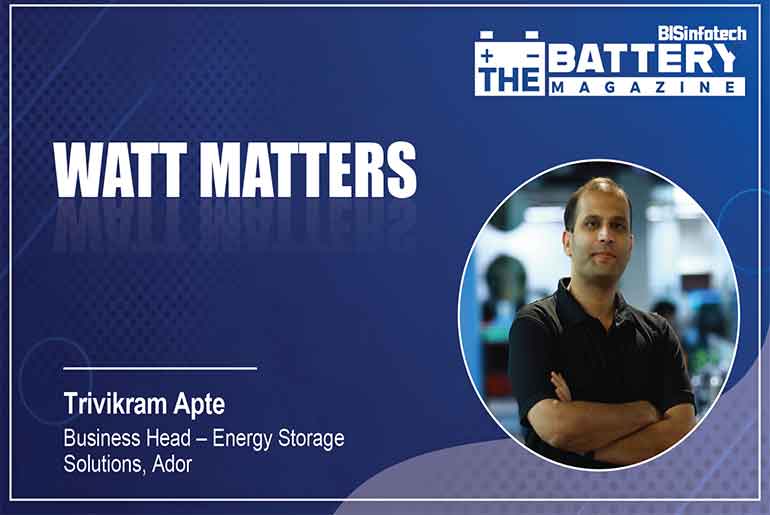
At India Energy Storage Week (IESW) 2026, Shweta Kumari, Sub-Editor, The Battery Magazine, spoke with Trivikram Apte, Business Head – Energy Storage Solutions, Ador, about the company’s latest PCS solutions, emerging trends in the energy storage sector, and its roadmap for developing next-generation software-driven energy management technologies.
Ador has been serving India’s battery industry for several years. Could you introduce the company and tell us about the solutions you are showcasing at India Energy Storage Week?
We are delighted to be participating at India Energy Storage Week once again. In fact, Ador has been partnering with the India Energy Storage Alliance (IESA) for the past three years, and it is always encouraging to interact with battery manufacturers, system integrators, developers and other stakeholders from across the energy storage ecosystem.
Ador Group is a 118-year-old Indian industrial group, and Ador focuses exclusively on advanced power electronics and battery technologies. For over 13 years, we have been supporting India’s battery manufacturing industry by supplying battery test systems, battery manufacturing equipment and advanced engineering solutions.
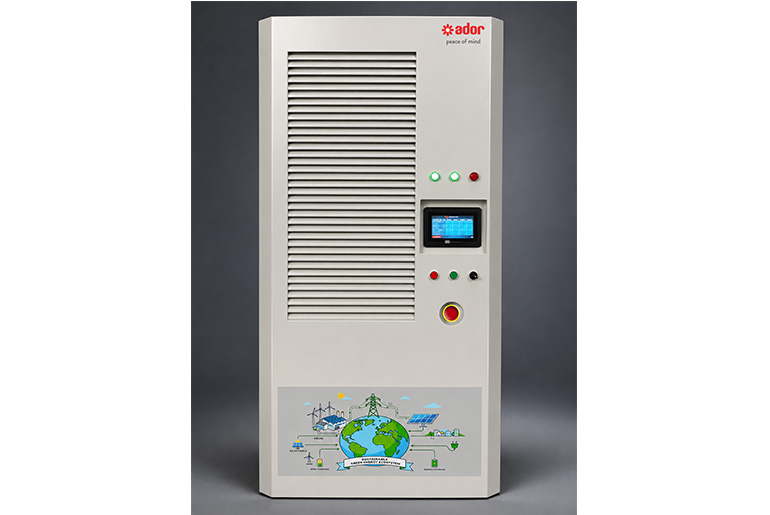
This year, we are showcasing our Power Conversion System (PCS) designed specifically for Battery Energy Storage Systems. The solution on display is a 500 kW string-based PCS, developed to support BESS developers, Independent Power Producers (IPPs) and system integrators. While we are currently demonstrating a string-based architecture, we are also actively working with industry partners on centralized PCS solutions based on project-specific requirements.
What differentiates Ador’s Power Conversion Systems in an increasingly competitive market?
One of our biggest strengths is that we are an Indian engineering company that understands the realities of deploying energy storage solutions in India.
Every project comes with unique technical and operational requirements. Therefore, flexibility, customization and responsive after-sales support become just as important as the hardware itself.
Having worked closely with battery manufacturers and industrial customers for over a decade, we understand the challenges they face—from environmental conditions to grid requirements and project execution timelines. These insights have helped us develop products that are specifically engineered for Indian operating conditions while providing customers with long-term technical support throughout the project lifecycle.
For us, delivering value extends beyond supplying equipment; it means partnering with customers throughout their energy storage journey.
Battery Energy Storage Systems are witnessing unprecedented growth in India. What major trends are you currently observing in the market?
The industry today is witnessing a clear shift toward large-scale integration of renewable energy with the power grid.
Energy storage is becoming a critical enabler for grid stability, renewable integration and power reliability. As renewable energy capacity continues to increase, Battery Energy Storage Systems will play an increasingly important role in balancing supply and demand.
We are already seeing tremendous momentum in the BESS segment, and in many ways, its growth trajectory is even stronger than certain segments of the electric mobility market.
The next two to three years will be particularly significant. The decisions made today—whether in terms of technology, policy or deployment—will define how India’s energy storage industry evolves over the coming decade.
Beyond hardware, digital intelligence is becoming increasingly important for energy storage. How is Ador preparing for this transition?
The future of Battery Energy Storage Systems extends far beyond hardware. While power electronics remain our core strength, our engineering teams in India are actively developing advanced Energy Management System (EMS) solutions that will complement our Power Conversion Systems.
Our objective is to create an integrated ecosystem where hardware and software work together to maximise system performance, operational efficiency and lifecycle optimisation. This is only the first generation of our product portfolio. Going forward, customers can expect a much broader range of solutions that combine intelligent software with robust power electronics to deliver greater value across different BESS applications.
Looking ahead, what is Ador’s long-term vision for India’s energy storage industry?
India’s energy transition presents an extraordinary opportunity for indigenous technology development.
Our vision is to continue strengthening India’s capabilities in power electronics, Battery Energy Storage Systems and intelligent energy management by developing solutions that are designed, engineered and supported within the country.
We remain committed to continuous innovation, expanding our software capabilities alongside hardware development, and working closely with industry stakeholders to build reliable, scalable and future-ready energy storage infrastructure.
As the Indian energy storage ecosystem matures, we look forward to contributing with technologies that help improve grid resilience, renewable integration and overall energy efficiency.
Power Conversion Systems are often described as the ‘heart’ of a Battery Energy Storage System. What technical parameters should developers and EPC companies prioritise while selecting a PCS for utility-scale and commercial BESS projects?
The PCS is genuinely the heart of any BESS installation, and getting the selection right has a direct bearing on project performance over its entire lifecycle.
Safety has to be the first and non-negotiable parameter. Beyond that, efficiency is critical, since even small differences compound significantly over the life of a utility-scale project. Voltage compatibility is another important consideration; with battery architectures moving toward higher voltage platforms, developers should look for PCS solutions that support up to 1500V DC, ensuring the system remains future-ready rather than becoming a constraint later.
Grid-forming capability is increasingly important as well, particularly as renewable penetration increases and grid stability becomes a shared responsibility across storage assets. And finally, modularity matters a great deal from a practical standpoint. It gives developers and EPCs the flexibility to scale capacity in line with project phasing, without having to redesign the system architecture at every stage.
Taken together, these parameters determine not just how a PCS performs on day one, but how well it adapts as the project and the grid around it evolve.
India is moving rapidly towards indigenous manufacturing under initiatives such as ‘Make in India.’ How is Ador increasing localisation across its power electronics portfolio, and what challenges still remain?
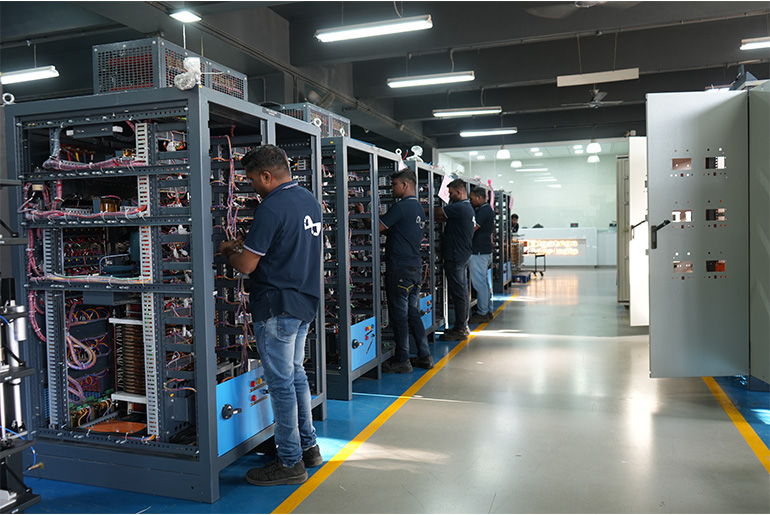
Localisation is a priority for us, and we are approaching it step by step rather than making claims that outpace reality on the ground.
That said, some genuine challenges remain for the entire industry, not just for us. The availability and reliance on critical components, much like semiconductors, remains a real constraint. Similarly, sourcing magnetics materials domestically at the quality and scale required is still a work in progress.
Building deep technical competence is equally important, and this goes beyond hardware. Developing grid-forming software and capabilities such as black start implementation requires specialised expertise that the Indian ecosystem is still building. There are also broader supply chain gaps that need to be addressed collectively, through stronger vendor development and closer collaboration between manufacturers, component suppliers and policymakers.
We see these as industry-wide challenges rather than company-specific ones, and we are investing accordingly, both in our own engineering capability and in strengthening our local supplier base.
With India’s BESS market expected to grow significantly over the next decade, how do you see the role of integrated solutions combining PCS, EMS and advanced software evolving in future energy storage projects?
I see this as the natural next phase for the industry. As BESS deployments scale up and grids become more complex, standalone hardware performance will no longer be sufficient on its own.
The real value will come from autonomous grid integration driven by AI-based controls, where systems can sense grid conditions in real time and respond intelligently, without waiting for manual intervention. This means PCS, EMS and software layers working together as a single intelligent system rather than as separate components bolted onto one another.
This is exactly the direction we are building toward. As we mentioned earlier, our current generation of products is only the starting point. Going forward, integrated, software-driven energy management will be central to how BESS projects are designed and operated across India.
 Electrify your feed! Click here to join our Whatsapp group and to get the latest updates, expert insights, and innovations driving India’s energy storage revolution.