Researchers at the Indian Institute of Technology Guwahati (IIT Guwahati) have developed an advanced perovskite semiconductor technology that has the potential to enhance the efficiency and long-term stability of solar cells while also enabling next-generation memory applications. The breakthrough addresses several technical challenges that have so far hindered the large-scale commercial adoption of perovskite-based devices.
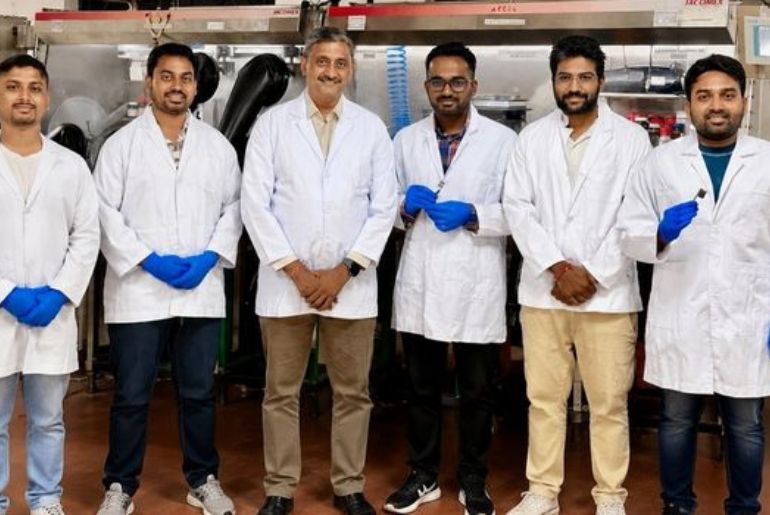
The research team, led by Prof. Parameswar K Iyer from the Department of Chemistry and the Centre for Nanotechnology, developed a molecular interface-engineering approach using two specially designed donor-acceptor organic molecules.
These ultrathin layers, measuring just 10-15 nanometres, are inserted between the charge-transport layer and the perovskite layer to reduce defects and improve charge transport.
According to the researchers, the approach enables a smoother flow of electrical charges generated by sunlight, reducing energy losses due to surface defects and interfacial instability.
Solar Cell Efficiency Reaches 25.73%
Using the new interface engineering technique, the team achieved a solar cell efficiency of 25.73%, allowing the device to convert nearly one-quarter of incoming sunlight into electricity.
The researchers also reported improved durability, with the solar cells retaining around 90% of their initial performance under ambient storage conditions and approximately 75% under continuous heat and light stress.
The team has since progressed further and reported efficiencies exceeding 26%. Work on improving performance continues under real-world operating conditions and to scale up production.
The researchers also demonstrated that the same perovskite material can be used in memristor devices, a type of non-volatile memory technology being explored for artificial intelligence and neuromorphic computing applications. The devices showed stable low-power switching, multistate memory capability and reliable endurance.
The study further found that the technology could support applications such as neuromorphic computing, secure computing systems and true random number generation for cryptographic applications.
The IIT Guwahati team is currently working with industry partners to develop large-area and flexible versions of the technology for commercial deployment.
Potential for Space and Flexible Electronics
The researchers believe the technology could unlock a wide range of applications beyond conventional renewable energy systems. Its lightweight, flexible, and highly stable design makes it a promising candidate for use in satellites, space missions, and other demanding operating environments. In addition, the innovation could support the development of flexible electronic devices that integrate both energy generation and data storage capabilities within a single platform.
 Electrify your feed! Click here to join our Whatsapp group and to get the latest updates, expert insights, and innovations driving India’s energy storage revolution.