
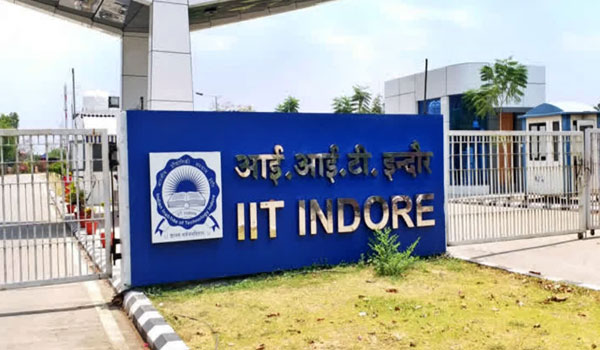
The Indian Institute of Technology (IIT) Indore has created a color-changing supercapacitor that not only stores energy but also visually indicates its charging status through color variations, representing a notable advancement in energy storage and smart material technology.
The innovation is the work of the Materials and device (MAD) lab of the physics department headed by professor Rajesh Kumar. The gadget shows red when fully charged, green half charged, and blue when discharged and therefore allows users to quickly know its level of charge without having to use separate monitoring circuits.
Dual functionality: storing energy and heat control
In contrast to traditional types of supercapacitors, this type of electrochromic supercapacitor does not allow infrared heat to pass through during the charging process, which helps to maintain the temperature and energy movement. The technology makes use of a well-developed vanadium oxide complex, which varies in its optical characteristics during charging and discharging.
The prototype was found to have an optical modulation of up to 70 percent in red and 50 percent in blue, which is good performance and flexible. It is a bendable or twisting, though solid-state, device that does not compromise its efficiency. The research team was able to test a prototype of 25 cm² and demonstrated scalability to an industrial and commercial use.
Potential for vehicles, buildings, and electronics
According to Prof. Rajesh Kumar, “Our technology combines energy storage, heat control, and visual feedback in one compact device, offering a smarter, more efficient way to manage energy. It has the potential to transform consumer electronics, electric vehicles, and smart building systems.”
The innovation can find a huge application in automobiles, whereby energy storage and temperature regulation are essential, and smart buildings, where it can sieve heat and cut costs on cooling and at the same time remain transparent. The market of automotive supercapacitors, which is currently estimated at USD 1.3 billion in 2023, is expected to grow to USD 7.5 billion in 2032, which means that there is a good business outlook for such technologies.
Feminist scientists on the move
One of the outstanding characteristics of this project is a high level of female representation among researchers, and more than half of the core team was represented by women. It consists of Bhumika Sahu, Dr. Tanushree Ghosh, Nikita, Dr. Suchita Kandpal, Dr. Love Bansal, a Translational Research Fellow (TRF), and Deb Kumar Rath.
The TRF scheme in IIT Indore assists young researchers in coming up with laboratory innovations to be used in the real world.
Leadership and vision
IIT Indore Director Professor Suhas Joshi praised the achievement, stating, “This breakthrough is a proud moment for IIT Indore. It reflects our commitment to technologies that not only serve India’s energy needs but also advance global sustainability. The TRF scheme has been instrumental in nurturing such impactful innovations.”
As the team progresses toward commercialization, the innovation is set to make energy storage more efficient, sustainable, and user-friendly, contributing to the global shift toward renewable and green energy solutions.
 Electrify your feed! Click here to join our Whatsapp group and to get the latest updates, expert insights, and innovations driving India’s energy storage revolution.