India’s energy landscape is undergoing a tectonic shift. With renewable energy targets soaring and electricity demand climbing to record highs, Battery Energy Storage Systems (BESS) have emerged as the critical link between generation and reliability. The transformation is no longer theoretical — it’s unfolding in real time.
Policy reforms, private investments, and technological innovation are aligning to unlock India’s next big clean energy frontier. From utility-scale storage for grid balancing to distributed systems enabling resilient power for industries, the momentum is unmistakable. 2025 has already seen record tendering activity, with new business models — from storage-as-a-service to hybrid renewables — redefining how energy is stored, managed, and monetized.
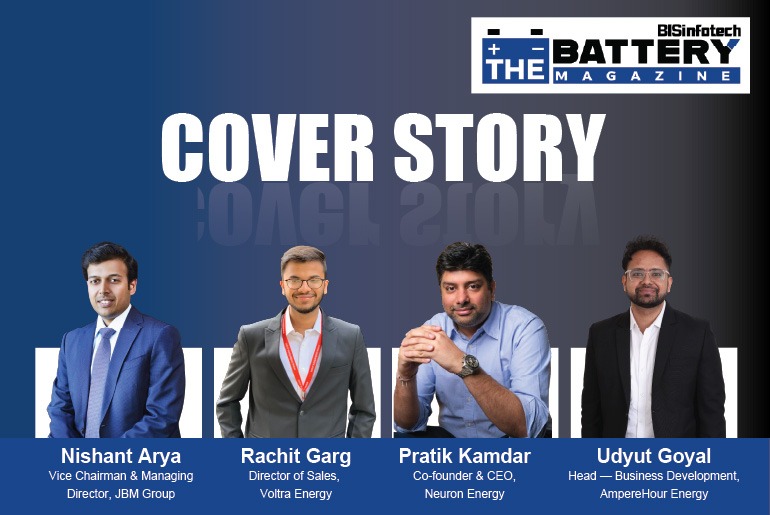
As India moves toward its 2030 goals, The Battery Magazine brings together voices from across the ecosystem to decode the opportunity and the road ahead. In this edition, Nishant Arya, Vice Chairman & Managing Director, JBM Group, Rachit Garg, Director of Sales, Voltra Energy and Pratik Kamdar, Co-founder & CEO, Neuron Energy, share their insights on India’s readiness, technology readiness, and the manufacturing revolution driving the future of energy storage.
India’s Readiness for Large-Scale Energy Storage
Nishant Arya, Vice Chairman & Managing Director, JBM Group, said, “ India’s readiness for large-scale battery storage adoption has advanced rapidly, thanks to decisive regulatory reforms, substantial public and private investment and clear alignment with the country’s renewable energy ambitions. Recent policy changes now recognise energy storage as an essential infrastructure, allowing both utilities and end-users greater flexibility in ownership and participation. States like Gujarat, Maharashtra and Rajasthan have surged ahead, driving project pipelines with supportive regulations and annual storage obligations through to 2030.
We have witnessed a strong momentum in tendering with multiple energy storage projects allocated in the first half of 2025 alone, marking a substantial pipeline of projects across hybrid renewables, grid balancing and distributed applications. While physical deployment is still catching up with this rapid market evolution, record-low tariffs and new business models, such as ‘storage-as-a-service,’ are making storage commercially viable and accelerating real adoption. As we move forward, challenges around permitting, local manufacturing and timely execution remain, but the sector’s trajectory is clear and positive. India is now positioned as one of the world’s most dynamic markets for battery storage, poised for the next wave of scale-up and innovation.”
Pratik Kamdar, Co-founder & CEO, Neuron Energy, said, “Absolutely, this is true. India is on an ambitious path to achieve 40 GW of solar capacity by 2030, and the push to move away from fossil fuels is accelerating this transition. The national grid alone cannot yet meet the country’s growing energy needs, so we need reliable, sustainable alternatives. Battery Energy Storage Systems are emerging as a cornerstone of this effort. They help balance load, manage peak demand, and stabilise frequency and voltage. Importantly, they also provide dependable backup during outages, making them essential for a resilient and flexible energy ecosystem.
Rachit Garg, Director of Sales, Voltra Energy, said, “ With ambitious targets (500 GW non fossil energy by 2030), solar and wind growth is very rapid, which increases the need for storage to manage intermittency, peak demand, and grid stability. Globally, battery costs are falling, which helps make many storage economics more viable. The Indian government’s ability to allocate more GWh under existing budgets reflects declining costs. India has pushed forward Viability Gap Funding (VGF) schemes to support BESS deployment. It seems a perfect opportunity for RE Developers, Integrators and OEMs to contribute towards the growth of India in the RE Sector. We has a OEM with a GWH cell to pack facility that is playing our role in localising the components and hence reducing the downtime and supply chain risk. We are working with policy makers to help shape favorable regulatory frameworks to meet India’s fast growing demands as well as making it more sustainable and India dependent for the coming years.
Udyut Goyal, Head — Business Development, Amperehour Energy, said, “India stands at an inflection point in its energy journey. With deep renewable build-out, growing peak power demand, and a pressing need for grid flexibility, the commercial case for large-scale storage is now stronger than ever. Policy momentum through renewables tenders, energy-storage mandates, and manufacturing incentives is improving the ecosystem by improving supply chains, enabling financing, and driving operational learning across utilities and developers.
At AmpereHour, our focus is to bridge the gap between technology maturity and market readiness. We’re enabling real-world deployment through turnkey BESS engineering and fast-deploy modular systems that minimize lead-time risks. Beyond engineering, we’re also helping clients unlock new revenue opportunities across capacity, ancillary services, peak-shaving, and AR- arbitrage making storage not just a technical asset, but a financially viable one. Our goal is simple: to ensure battery storage transitions from pilot projects to large-scale procurement as a core part of India’s clean energy future.”
Strategic Role in India’s Energy Transition
Nishant Arya, Vice Chairman & Managing Director, JBM Group, said, “We recently launched JBM ECOBOLT, our energy storage business with India’s largest high-voltage lithium-ion battery manufacturing facility in the Delhi-NCR region, with an annual installed capacity of 6GWh serving a wide spectrum from passenger vehicles to large-scale grid storage. We have secured firm orders totalling 3 GWh for grid-scale and electric mobility applications, reflecting strong market confidence in our ability to deliver advanced, sustainable battery solutions.
Our focus is on providing integrated energy storage systems that enable grid stability, renewable integration and electrification of mobility. By combining expertise across these domains, we aim to support India’s clean energy goals through reliable and scalable storage solutions.
Looking ahead, we remain committed to working closely with policymakers, utilities and industry stakeholders to accelerate deployment, enhance manufacturing capabilities and foster innovation in energy storage technologies. Our objective is to contribute meaningfully to India’s sustainable energy transition and energy security.”
Pratik Kamdar, Co-founder & CEO, Neuron Energy, said, “India is making great progress in this space. The government’s National Energy Storage Mission, along with production-linked incentives for Advanced Chemistry Cell batteries, is setting a strong foundation. The growing number of BESS tenders from SECI and various states highlights increasing demand. While large-scale adoption will take time, policy frameworks, investments, and pilot projects show that India is moving in the right direction.
At Neuron, we are taking decisive steps to shape this transition. Over the next year, we plan to invest ₹20 million in a dedicated factory to provide containerised BESS solutions. Our goal is to deliver scalable, efficient systems that meet both current and future market needs.”
Rachit Garg, Director of Sales, Voltra Energy, said, “3000 KVA BESS The system is designed with high voltage lithium batteries to provide reliable power and integrate with uninterrupted power systems. Six UPS each of 500 KVA is planned with three battery racks in parallel totaling up to 18 battery racks. Long life and deep cycling cells are used matching high safety and reliability. Modular design is adopted with DC Combiners and breakers to isolate stack wise batteries in case of any maintenance. The system is connected in between the panel and load as an easy installation at site. The smart EMS controller studies the load on a real time basis and provides the UPS upper cut-off voltage, lower cut-off voltage, charging current etc for smooth Lithium battery operations. CAN communication offers smooth communication with BMS to manage Cell balancing , Overcharge/overdischarge protection , Temperature monitoring, Short-circuit protection etc. At Voltra we work with various power generation source which work seamlessly with multiple assets: solar, wind, gensets, EV charging, or grid services. Native integration with SCADA/DERMS platforms, allowing utilities to control storage as part of grid operations. Multi-protocol communication (Modbus, IEC 61850, OPC-UA) for plug-in interoperability. Built-in grid compliance features: frequency/watt control, ride-through, black-start capability.”
Key Differentiators in BESS Design
Nishant Arya, Vice Chairman & Managing Director, JBM Group, said, “JBM ECOBOLT’s BESS design stands out for its modularity, allowing scalable solutions that can be customised for applications ranging from microgrids to utility-scale projects. Our systems incorporate advanced thermal management and stringent safety protocols to withstand the diverse climate conditions in India, ensuring reliability and extended battery life. Our expertise in intelligent battery management systems enables real-time optimisation of energy flow, enhancing efficiency, lifespan and seamless integration with renewable energy assets. Additionally, drawing on our extensive experience in electric mobility including an EV charging infrastructure serving over 50 electric bus depots pan India, we are aptly placed to deliver tailored BESS solutions that support both grid and transportation electrification needs.
With the introduction of next-generation energy storage technologies tailored for round-the-clock renewable energy projects, captive net metering and hybrid systems, JBM ECOBOLT focuses on delivering high-quality power availability while optimising the total cost of ownership for customers. Our technology-agnostic approach ensures flexibility in incorporating emerging chemistries and software advancements, positioning us to industrialise these solutions at scale with speed and reliability.”
Pratik Kamdar, Co-founder & CEO, Neuron Energy, said, “Currently, Lithium Ferro Phosphate is the widely adopted cell chemistry due to its proven safety, long cycle life, and reliability. At the same time, emerging technologies such as sodium-ion are on our radar, and we are closely evaluating them for future adoption. At Neuron, we are building a dedicated design centre to respond rapidly to market requirements and deliver solutions that meet diverse applications.
Our BESS systems feature a modular, plug-and-play architecture that allows for rapid deployment, easy maintenance, and seamless scalability. This design ensures they can serve both large utility-scale projects and smaller distributed or commercial installations. At the heart of our solution, intelligent energy management systems optimise performance, extend asset life, and enhance ROI, while maintaining full grid-interactive capability. Safety and sustainability are embedded in every aspect of the design, ensuring that our solutions are reliable, future-ready, and economically efficient for operators.”
Rachit Garg, Director of Sales, Voltra Energy, said, “Yes— technology is the backbone of competitive, scalable, and bankable energy storage solutions. When evaluating or positioning a company’s differentiators in BESS (Battery Energy Storage Systems), the most critical technological pillars include battery chemistry, system design/modularity, software intelligence, and integration flexibility.
● Li-ion (LFP) is dominant due to safety, cost, and lifecycle balance — ideal for grid and renewable integration. ● NMC offers higher energy density — better for space-constrained or mobile applications.
● Flow batteries, Na-ion, or solid-state may be explored for long-duration or high-safety use cases. Use of proprietary LFP and the surrounding ecosystem has reached to point that other chemistry finds it very difficult to compete, especially because of enhanced cycle life & temperature stability. Massive adoption and deep R&D on LFP batteries, BMS according to their needs have developed the supply chain much ahead for LFP in comparison to other chemistry. EMS is the brain of the BESS — it determines how batteries are charged, discharged, and optimized.
Differentiator Examples:
● AI/ML-based forecasting of load, generation, and pricing to maximize arbitrage and peak shaving.
● Multi-objective optimization (e.g., maximize revenue + extend battery life + support grid stability).
● Real-time grid interfacing for FFR, frequency regulation, black start, and VPP (virtual power plant) participation.
● Open APIs and cloud-based EMS platforms for remote monitoring, diagnostics, and asset management.”
Udyut Goyal, Head — Business Development, Amperehour Energy, said, “At AmpereHour, our design philosophy is rooted in flexibility, scalability, and intelligence ensuring each project delivers reliable performance and long-term value.
We’ve developed a cell-agnostic architecture that supports multiple lithium chemistries and form factors, giving us procurement flexibility while minimizing single-supplier dependency and price volatility.
Our modular, transportable design built on containerized and skidded building blocks enables staged capacity additions and simplifies deployment, particularly in space-constrained Indian sites.
The heart of our system is our proprietary Energy Management System (EMS), featuring hierarchical controls that integrate plant-level operations, market participation logic (including IEX and other exchanges), and asset health analytics. This ensures optimal dispatch for both revenue maximization and battery longevity.
We also place strong emphasis on safety and balance-of-plant engineering, with redundant HVAC, multi-level isolation, and automated fault containment to reduce operational risk and ease regulatory approvals.
Together, these innovations lower total cost of ownership, enhance system reliability, and accelerate project commissioning—making AmpereHour’s BESS solutions both technologically advanced and commercially competitive.”
Leveraging EMS, Analytics and AI for Lifecycle Performance
Nishant Arya, Vice Chairman & Managing Director, JBM Group, said, “ We integrate advanced Energy Management Systems (EMS), AI-driven analytics and digital twins to significantly enhance battery lifecycle performance and enable predictive maintenance. Our proprietary Battery Management System (BMS) collects and analyses over 1.2 million data points per battery daily, allowing real-time monitoring of battery health, thermal conditions and performance indicators. Leveraging AI-enabled digital twins and adaptive algorithms, our platform predicts battery degradation and potential faults early, enabling pre-emptive maintenance actions that reduce downtime and extend asset life.
This approach optimises energy usage, ensures operational reliability and lowers the total cost of ownership for our customers. Additionally, JBM’s intelligent e-mobility platform, JBM E-Verse, combines AI-powered fleet diagnostics, telematics and battery health management to deliver predictive maintenance and operational efficiency across electric buses and energy storage systems. The cloud-based monitoring and service scheduling capabilities provide high uptime and data-backed lifecycle support, positioning JBM’s solutions as highly reliable and future-ready.”
Pratik Kamdar, Co-founder & CEO, Neuron Energy, said, “At our company, we view Energy Management Systems as the core of any modern BESS. They help us optimise operations, whether through peak shaving, frequency regulation or time-of-use shifting, ensuring our assets deliver maximum value while remaining fully compliant with grid requirements. Advanced telemetry and SCADA systems allow us to capture detailed operational data, which we analyse to identify trends, model degradation, and detect any irregularities early.
We also use AI and machine learning to support predictive maintenance, improve energy forecasting and fine-tune system performance. Alongside this, we focus on safety, cybersecurity, diagnostics, lifecycle management and asset performance optimisation to ensure our solutions remain reliable, efficient and cost-effective over the long term.”
Rachit Garg, Director of Sales, Voltra Energy, said, “Our EMS platform is designed in-house (or with top-tier partners) to be modular, scalable, and cloud-enabled. It functions as the central controller that dynamically optimizes:
1. Real-time charge/discharge decisions based on market signals (e.g. ToD pricing, grid load, solar generation)
2. Multi-objective dispatching, balancing revenue, battery health, and grid services
3. Integration with DERs, including solar, wind, diesel gensets, Turbine Generators or EV charging infrastructure
We are developing AI-based analytics to pre-empt failures, reduce downtime, and extend system life for Battery Health Forecasting where we can do Continuous monitoring of SoH (State of Health) and SoC (State of Charge) trends using ML models trained on historical and live data. Predicting degradation curves, enabling proactive cell/module replacement or cycling strategy adjustment. AI-based fault classification helps field teams triage issues, minimizing unnecessary intervention.
Udyut Goyal, Head — Business Development, Amperehour Energy, said, “AmpereHour recently commissioned a landmark grid‐scale Battery Energy Storage System (BESS) for BSES Rajdhani Power Ltd (BRPL) at the Kilokari substation in South Delhi — a project that underscores India’s transition towards smarter, cleaner, and more resilient urban energy systems.
Scale & Regulatory Milestone:
At 20 MW / 40 MWh, this is one of India’s first utility-scale standalone BESS projects to receive regulatory approval under Section 63 of the Electricity Act, 2003, marking a key precedent for future grid-scale storage deployments.Deployment & Execution:
Delivered under a Battery Energy Storage Capacity Agreement (BESPA) with BRPL, the project was executed on a turnkey basis. Despite urban logistical challenges, AmpereHour completed installation and commissioning in just 11 months — ahead of schedule — with full operations beginning in April 2025.Operational Benefits & Use-Cases:
- Delivers four hours of backup power daily — two during afternoon peaks and two during evening/night demand — reducing dependency on fossil-based peaking sources.
- Strengthens supply for critical urban infrastructure including hospitals (Moolchand, Safdarjung), educational institutions, and dense residential zones such as Defence Colony and Lajpat Nagar.
- Enables peak load shaving, optimizes energy arbitrage, and helps defer costly grid upgrades, improving network stability and reducing power purchase costs.
Technology, EMS & Digitalization:
The system is powered by AmpereHour’s proprietary ELINA Energy Management Software (EMS) — a unified digital layer that:
- Optimizes dispatch based on real-time grid dynamics and market signals (IEX and others).
- Manages grid contingencies such as voltage dips and frequency fluctuations.
Uses predictive analytics and intelligent controls to maximize asset life, safety, and return on investment.”
Policy and Infrastructure Reforms for BESS Acceleration
Nishant Arya, Vice Chairman & Managing Director, JBM Group, said, “India’s ambitious clean energy goals require targeted policy and infrastructure reforms to scale Battery Energy Storage Systems (BESS) efficiently.
Key policy enablers include the expansion of Viability Gap Funding (VGF) schemes for utility-scale BESS projects, which significantly de-risk investments and catalyse large-scale deployments. Reforms that tighten qualification criteria in renewable-plus-storage tenders can help weed out non-serious bidders, ensuring quality execution and project completion.
India’s broader renewable energy mission further amplifies the strategic importance of these reforms with an ambitious 2030 goal of reaching 350–500 GW. This exponential growth makes flexible grid capacity indispensable, and BESS will be central to ensuring round-the-clock renewable power.
Infrastructure reforms must therefore focus on expediting grid evacuation development, especially in renewable-rich regions, to minimise project delays linked to Power Purchase Agreement (PPA) signing and grid connectivity. Encouraging co-location of storage with renewable parks can reduce transmission bottlenecks and enhance system reliability. Also, draft amendments under the Electricity Rules are expected to offer clarity on storage systems’ regulatory status, supporting market participation and contractual flexibility.”
Pratik Kamdar, Co-founder & CEO, Neuron Energy, said, “To accelerate BESS adoption in India, a multi-pronged approach is essential. This includes establishing a clear and stable regulatory framework, providing viability gap funding to improve project economics, and modernising the grid to handle flexible storage integration. Supporting circular economy initiatives and battery recycling mechanisms will ensure sustainability, while targeted capacity building and R&D support can drive innovation and operational efficiency. Together, these measures can create an ecosystem that not only encourages deployment but also ensures long-term reliability and scalability of BESS across India.
Rachit Garg, Director of Sales, Voltra Energy, said, “India is indeed making bold moves with clean energy targets, and policies like the PLI scheme for advanced chemistry cells (ACC) and hybrid renewable tenders are essential levers. But to truly scale BESS adoption — especially across both grid-scale and distributed/C&I segments — India needs to go further with targeted policy reforms, market design updates, and infrastructure enablers.
● Enable BESS to participate in ancillary service markets and capacity markets with guaranteed payments. ● Encourage more and more long-term contracting models (like storage PPAs) to build investor confidence.
● Allow time-of-day pricing and storage arbitrage to create monetization pathways for stored energy.
● Promoting distributed C&I storage maybe with dedicated subsidies or tax incentives for rooftop solar + BESS or standalone storage in C&I segment. Mandate storage readiness in new industrial buildings or green factories (e.g., as part of ESG/compliance). Include distributed BESS under the revamped FAME, PM-KUSUM, or green building codes.
● Rationalize Taxation — GST & Duties on Storage can also Boost Domestic Manufacturing and local supply chain.
● With the growing BESS needs highly qualified lab systems to be developed very fast to issue IEC and UL for High voltage systems.”
Udyut Goyal, Head — Business Development, Amperehour Energy, said, “To unlock large-scale adoption of energy storage in India, we believe policy clarity and market structure consistency are as critical as technology maturity. While national initiatives like the Production Linked Incentive (PLI) scheme, Viability Gap Funding (VGF) tenders, and energy storage obligations have built strong momentum, the next wave of progress will depend on how effectively these are translated into actionable, state-level frameworks.
Currently, several state policies lack operational clarity — particularly on how BESS can participate in commercial and industrial (C&I) applications, open access projects, and behind-the-meter deployments. For example, Rajasthan’s framework demonstrates strong intent but still needs clearer definitions on how C&I consumers can integrate or monetize storage, which would greatly accelerate adoption if streamlined. Similar clarity on technical interconnection standards, billing mechanisms for hybrid assets, and discharge tariffs would help reduce investor uncertainty and ease execution challenges.
To catalyze adoption, we recommend four key reforms:
- Clear market access for storage assets: Enable direct participation in energy and ancillary services markets with simplified settlement mechanisms, especially for hybrid projects.
- Faster grid interconnection and standardized codes: Establish predictable, uniform procedures and technical standards for integrating storage with renewable and distribution networks.
- Financial de-risking measures: Introduce viability gap funding for early large-scale projects and transitional incentives for hybrid developers to underwrite initial revenue streams.
- Balanced manufacturing and import policy: Maintain PLI-driven domestic manufacturing growth while providing short-term import relief on critical balance-of-system components to avoid supply bottlenecks.
Together, these reforms can reduce execution risks, boost investor confidence, and accelerate India’s transition toward a resilient, storage-led clean energy future.”
Looking to 2030: The Growth Opportunity Ahead
Nishant Arya, Vice Chairman & Managing Director, JBM Group, said, “ The most significant growth opportunity for JBM looking towards 2030 lies at the intersection of large-scale electrification and battery energy storage systems (BESS), creating a powerful multiplier effect for clean mobility and renewable integration. As India moves towards its ambitious 2030 renewable energy goals of reaching 350–500 GW of capacity, the country’s energy landscape will increasingly depend on scalable storage solutions to stabilise the grid, enable round-the-clock renewable power and support rapid electrification of transportation and industry.
This structural shift opens a major growth runway for JBM ECOBOLT. Our advanced BESS platform is designed to deliver high-efficiency, modular and scalable energy storage solutions. With industry projections indicating storage demand in the range of several hundred GWh by 2030, BESS is not just an enabler but a core pillar of India’s decarbonisation strategy.
JBM is uniquely positioned to capitalise on this opportunity through a vertically integrated model that combines BESS, electric mobility, charging infrastructure and digital energy management. ECOBOLT complements the company’s e-bus leadership by ensuring reliable grid balancing, peak load management and renewable integration for both public and commercial fleets. Its modular architecture allows seamless deployment across utility, mobility, and distributed energy segments, making it suitable for both domestic and international markets.
By 2030, with ECOBOLT at the core of its energy strategy, JBM aims to play a pivotal role in accelerating India’s clean energy transition and bridging the gap between renewable generation, storage, and zero-emission transportation on a global scale.”
Pratik Kamdar, Co-founder & CEO, Neuron Energy, said, “Looking ahead to 2030, BESS opportunities span two primary application spaces: Front-of-the-Meter and Behind-the-Meter. It is crucial to develop modular, scalable solutions that can serve both utility-scale projects and C&I or residential applications. Growth is being driven by rising grid tariffs, corporate ESG commitments, and RE100 targets, which are encouraging the adoption of solar-plus-storage systems, while distributed and residential storage demand continues to rise.
At Neuron, we are preparing to lead by establishing a state-of-the-art GW-scale manufacturing facility, exploring strategic partnerships, securing funding, adopting advanced technologies, and building a dedicated design centre to cater to evolving market needs. Our approach balances proactive expansion with careful monitoring of market dynamics, ensuring we are well-positioned to capture opportunities across both segments.”
Rachit Garg, Director of Sales, Voltra Energy, said, “Looking ahead to 2030, the biggest growth opportunity for Battery Energy Storage Systems (BESS) in India (and globally) will be shaped by policy maturity, cost reduction, grid needs, and consumer economics. Each segment — grid-scale, C&I, and distributed storage — has distinct drivers. Dynamic and scalable opportunities lies in different section for example grid-Scale which has also came out very strong in last one year is a very High growth, policy-led, volume play seeing India’s target of 500 GW non-fossil power capacity by 2030 demands massive firming capacity. Peak load, RE intermittency, and grid flexibility needs will require lot of storage by 2030. BESS will be used for frequency regulation, renewable smoothing, time-shifted dispatch, and capacity support. But we are also strong supporters of the C&I distributed BESS market as that saves a lot of T&D cost and gives a predictable RTC energy to the consumer. Strong synergy with rooftop solar and diesel replacement. Corporate ESG goals and net-zero targets will drive behind-the-meter decarbonization. Could be the fastest-growing market in revenue terms, especially if paired with solar or storage-as-a-service models. At Voltra we are actively offering solar + storage bundles, peak shaving systems, and energy management platforms for industrial parks, data centers, logistics hubs, campuses and industrial units. We are giving 10-year performance contracts with guaranteed uptime and lifecycle management to the C&I client, also with Tier-1 client Battery Energy Storage System as a service is also being offered by Voltra to establish the use case and customer confidence in the technology. To lead the next wave, we’re investing deeply on R&D in India for LFP storage technologies — including optimisation of battery, thermal runways, BMS for different critical use cases. Also as software is going to be crucial in the future we are also working on Intelligent EMS and digital twins tailored for behind-the-meter storage.”
Udyut Goyal, Head — Business Development, Amperehour Energy, said, “
By 2030, grid-scale storage will likely dominate India’s installed capacity, driven by renewable firming, grid balancing, and peak demand management. At the same time, commercial and industrial (C&I) and distributed hybrid systems will emerge as high-growth segments, offering flexible, revenue-rich applications that combine resilience with strong financial returns.
Amperehour is gearing up for this shift by expanding modular manufacturing to shorten lead times, enhancing its EMS and digital platforms for multi-market participation, and developing standardized O&M solutions for distributed and C&I customers. We’re also building strategic partnerships with developers and financiers to accelerate capacity additions as new tenders and PPAs emerge. Together, these initiatives position Amperehour to play a pivotal role across India’s evolving energy ecosystem — from large utility-scale projects to intelligent, distributed energy networks.
At Amperehour, our strength lies in being a 100-member specialist team dedicated entirely to battery energy storage — the largest such focused team in India today. Our mission is clear: to help clients design, deploy, and operate reliable BESS solutions tailored to their specific needs, with complete technology neutrality and without bias toward any single OEM.
Our systems are hardware-agnostic, offering developers the flexibility to select the right cell chemistry and supplier mix while ensuring seamless performance through our in-house engineered integration layer. Every project is designed end-to-end within Amperehour — from electrical and thermal layouts to safety systems and control architecture — allowing us to deliver both flexibility and accountability.
Safety remains our highest priority, embedded into every level of our engineering process. All systems incorporate certified components, multi-tier fire detection and suppression systems, and robust operational safeguards. For us, safety isn’t just a compliance box — it’s part of our culture.
What truly distinguishes Amperehour is our ownership mindset. We operate with the agility of a startup and the discipline of an OEM, taking complete responsibility from concept to commissioning and beyond. This blend of technical depth, adaptability, and customer-first execution has helped us earn the trust of developers, discoms, and industrial clients alike. In essence, Amperehour’s differentiator isn’t just our technology — it’s how we combine engineering excellence with unwavering commitment to performance and partnership.
 Electrify your feed! Click here to join our Whatsapp group and to get the latest updates, expert insights, and innovations driving India’s energy storage revolution.