

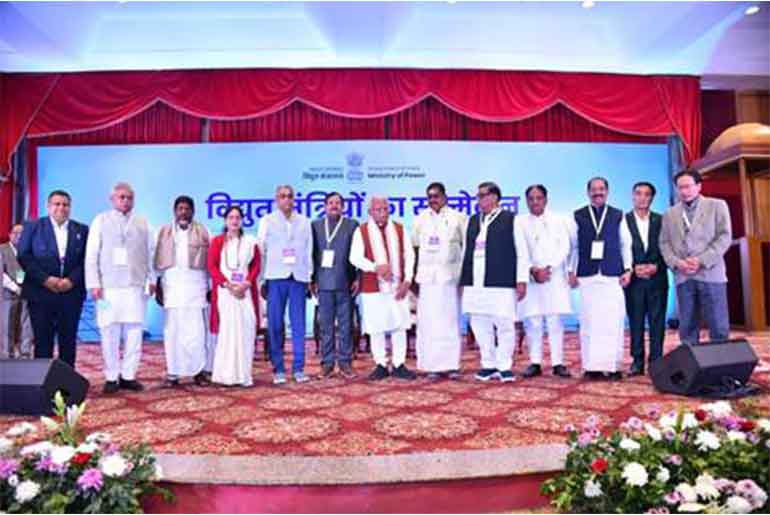
India’s power sector presents an investment opportunity of approximately ₹200 lakh crore over the next two decades, Union Minister for Power and Housing & Urban Affairs Manohar Lal said at the two-day Power Ministers’ Conference that began in New Delhi on November 27, 2026.
The conference, being held on November 27–28, brings together Power Ministers, senior government officials and electricity regulators from 28 States and eight Union Territories. The event is aimed at discussing key policy priorities, implementation challenges and strategies to strengthen India’s power sector.
Addressing the gathering, Manohar Lal called for stronger coordination between the Central and State governments, private sector players and other stakeholders to unlock the sector’s investment potential. He highlighted India’s progress in expanding power generation capacity, integrating renewable energy and strengthening the national electricity grid.
The Minister stressed that the next phase of power sector development requires an integrated planning approach covering generation, energy storage, transmission and distribution. He also urged States to accelerate smart meter implementation, highlighting the benefits for electricity consumers and distribution companies.
Focus on BESS Deployment and Power Infrastructure
A major focus of the conference is accelerating energy storage deployment as part of Resource Adequacy (RA) plans. Discussions will also cover inter-state and intra-state transmission challenges, financial sustainability of distribution companies (DISCOMs), and strengthening electricity infrastructure.
Other key agenda items include the implementation of the Revamped Distribution Sector Scheme (RDSS), with particular emphasis on smart metering, feeder separation and household electrification, along with issues related to nuclear power sites.
The Minister also highlighted the financial improvement of DISCOMs, noting that the sector recorded a positive profit after tax (PAT) collectively during FY 2024–25. He called for continued policy, operational and regulatory reforms to maintain this improvement and strengthen the financial position of distribution companies.
India Adds Around 60 GW of Power Capacity in 12 Months
Minister of State for Power Shripad Yesso Naik urged participating States and Union Territories to share their experiences, implementation challenges and regulatory concerns. He emphasised the need to move from policy formulation towards effective execution and measurable outcomes through coordinated efforts.
Pankaj Agarwal, Secretary, Ministry of Power, highlighted India’s progress towards energy independence under the vision of Viksit Bharat @ 2047. He stated that the country’s installed power generation capacity has reached approximately 563 GW, with more than 55% coming from non-fossil fuel sources.
India added around 60 GW of power generation capacity over the past 12 months, of which approximately 87% came from non-fossil fuel sources, Agarwal noted.
Joint Session with Electricity Regulators on November 28
A key highlight of the conference on November 28 will be a joint session involving the Forum of Regulators and State Electricity Regulatory Commissions (SERCs). The session will bring together State Power Ministers, SERC Chairpersons, State Secretaries for Power and Energy, and Ministry officials to discuss important regulatory and operational issues affecting the electricity sector.
The conference is expected to strengthen Centre–State coordination and encourage collaboration among public and private sector stakeholders to support India’s growing electricity demand, renewable energy integration and long-term energy security.
 Electrify your feed! Click here to join our Whatsapp group and to get the latest updates, expert insights, and innovations driving India’s energy storage revolution.