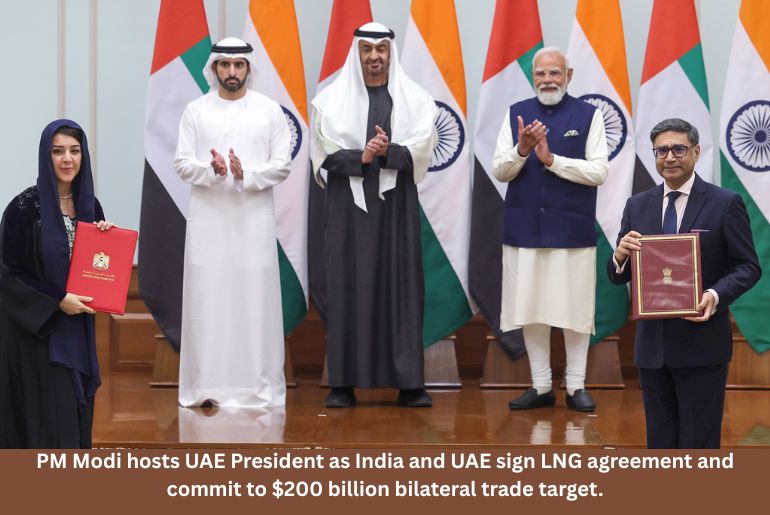
Prime Minister Narendra Modi hosted UAE President Sheikh Mohamed bin Zayed Al Nahyan in New Delhi on Monday, where the two nations agreed to deepen strategic cooperation, boost energy ties and set an ambitious goal of doubling bilateral trade to USD 200 billion by 2032.
The leaders held high-level talks spanning energy security, defence, space, and economic collaboration, underscoring the expanding Comprehensive Economic Partnership Agreement (CEPA) relationship between India and the United Arab Emirates. The visit came amid strong economic momentum and rising strategic ties between the two nations.
Long-Term LNG Supply Agreement
A key outcome of the visit was the signing of a long-term Liquefied Natural Gas (LNG) supply agreement. Under the 10-year pact, Hindustan Petroleum Corporation Limited (HPCL) will receive 0.5 million metric tonnes per annum of LNG from ADNOC Gas, commencing in 2028, reinforcing India’s energy security. The UAE now stands as India’s second-largest LNG supplier.
Strategic and Sectoral Cooperation
Beyond trade and energy, both sides signed letters of intent to elevate cooperation on defence and space infrastructure projects, reflecting growing strategic alignment. Areas of future collaboration include advanced nuclear technologies, enhanced defence partnerships, and joint space initiatives.
Foreign Secretary Vikram Misri described the visit as “short but extremely substantive,” highlighting the breadth of agreements spanning energy, technology, and infrastructure. India and the UAE also discussed cooperation in artificial intelligence, data centre development, and other high-technology sectors.
The discussions build on the rapidly expanding economic engagement since CEPA’s implementation, with bilateral trade crossing USD 100 billion in 2024-25, prompting leaders to set a target to double that figure by the end of the decade.
Economic and Strategic Significance
The agreements reinforce the UAE’s role as a key economic and energy partner for India. Enhanced cooperation in trade, energy, defence, and technology is expected to create new opportunities for businesses, deepen diplomatic ties, and contribute to regional stability.
Together, both nations reaffirmed their commitment to expanding economic linkage, driving mutual growth, and supporting sustainable development goals in a fast-changing geopolitical landscape.
 Electrify your feed! Click here to join our Whatsapp group and to get the latest updates, expert insights, and innovations driving India’s energy storage revolution.