Scientists from India have developed a metal-free organic porous material that could help reduce the cost of next-generation energy storage technologies, particularly zinc-air (Zn-air) batteries.
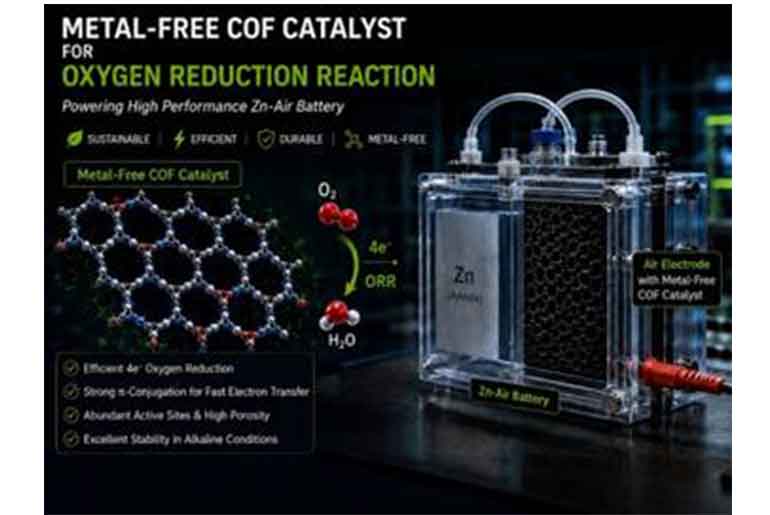
The research team from the S. N. Bose National Centre for Basic Sciences (SNBNCBS), Kolkata, the Institute of Nano Science and Technology (INST), Mohali, and SRM University, Amaravati, developed a material known as TTT-DHTD. The catalyst is designed to improve the oxygen reduction reaction (ORR), a key electrochemical process that influences the performance of Zn-air batteries.
Zinc-air batteries are being explored as an alternative to conventional lithium-ion batteries because they use abundant and relatively inexpensive zinc while obtaining oxygen directly from the surrounding air. According to the research findings, the technology offers potential advantages including higher theoretical energy density, lower material costs, improved safety and greater sustainability. However, challenges related to rechargeability, cycle life and oxygen reaction kinetics continue to limit wider adoption.
A major challenge in oxygen electrochemistry is the use of platinum-based catalysts, particularly in applications such as fuel cells. Platinum delivers high catalytic performance but is expensive and scarce, creating challenges for large-scale deployment. The development of efficient platinum-free catalysts could therefore help improve the cost and scalability of Zn-air batteries.
The TTT-DHTD material, developed using organic molecular linkers, consists of abundant elements including carbon, sulfur, nitrogen and hydrogen. Researchers said its highly porous, honeycomb-like structure provides active sites that facilitate the conversion of oxygen during the electrochemical process.
Laboratory testing showed that the material achieved approximately 96% of the performance of commercial platinum catalysts while demonstrating strong stability. The catalyst maintained its performance after 120 hours of continuous operation, according to the research findings.
The researchers also used advanced computational simulations to investigate the material’s performance. The simulations indicated that its molecular structure creates favourable sites for oxygen molecules to attach and undergo reactions, supporting efficient oxygen electrochemistry.
The study was led by Dr. Pradip Pachfule of SNBNCBS, Prof. Ramendra Sundar Dey of INST, and Prof. Ranjit Thapa of SRM University, Amaravati. The findings have been published in the journal Science Advances.
The development could support further efforts to reduce the reliance on precious metals in energy-storage and clean-energy technologies. By using earth-abundant materials in place of platinum, the research points toward potentially more affordable and scalable zinc-air batteries, with possible applications in clean transportation, portable power and renewable energy storage.
 Electrify your feed! Click here to join our Whatsapp group and to get the latest updates, expert insights, and innovations driving India’s energy storage revolution.