The battery industry has followed the same ambition for decades: to pack in more energy, make it safer, and reduce its cost. Lithium-ion batteries have brought the world nearer to this goal in powering everything from smartphones and laptops to electric vehicles and large-scale Battery Energy Storage Systems (BESS). But as renewable energy grows, and the grid needs storage for days, not hours, even lithium-ion batteries are hitting their limits.This is where zinc-air batteries enter the conversation.
Zinc-air batteries are different than conventional batteries that carry all the ingredients needed to produce electricity by drawing oxygen directly from the air around them. It sounds almost unbelievable, but this unique design has put the technology in the running as one of the most promising candidates for Long-Duration Energy Storage (LDES) – an emerging sector that is tipped to be a crucial enabler of renewable energy, grid resilience and reduced reliance on critical minerals.
This increasing interest is no longer just a research lab phenomenon. Governments, startups and industrial leaders are investing in zinc-air technology to solve a problem that the leading battery chemistries of today were never designed to solve: how to store clean electricity economically for 8, 24 or even 100 hours. In India, collaborations between Hindustan Zinc and IIT Madras, alongside startups such as Sthyr Energy, are beginning to build an indigenous zinc-based battery ecosystem, while internationally, companies like Zinc8 Energy Solutions, e-Zinc, and NantEnergy are pushing the technology closer to commercial deployment.
So the question is: Will zinc-air batteries be the missing link in the global energy transition, or will they remain a promising technology that has yet to break through? But to answer that, we need to understand why the world is looking beyond lithium-ion in the race to build the future of energy storage.
Why Zinc-Air Batteries Are Gaining Global Attention
For years the global battery industry was built on one chemistry – lithium-ion. Its quick adoption has changed consumer electronics, electric vehicles and most recently Battery Energy Storage Systems (BESS). But as countries ramp up their renewable energy deployment, a new challenge has arisen. Solar panels stop producing electricity once the sun has gone down, wind power is dependent on the weather and electricity grids need storage that can reliably deliver power for much longer than the standard two to four hours of conventional lithium-ion batteries.
This growing demand for Long-Duration Energy Storage (LDES) has shifted the industry’s attention toward alternative battery chemistries, and zinc-air batteries have emerged as one of the most promising candidates. Unlike traditional batteries that store both active materials internally, zinc-air batteries use metallic zinc as a fuel and draw oxygen from the air to generate electricity. This unique architecture reduces the amount of material needed inside the battery offering the potential for higher energy density, improved safety and lower material costs than many existing technologies.
Zinc-air batteries are interesting not because they are competing with lithium-ion batteries, but because they are meant to solve a totally different problem. Zinc-air batteries are being developed for applications where electricity needs to be stored economically for eight hours, twenty-four hours or even several days, while lithium-ion still dominates applications requiring high power output and fast charging. This makes them increasingly relevant for renewable energy integration, utility-scale storage, microgrids, critical infrastructure, and remote power systems.
The opportunity is attracting serious global attention. The U.S. Department of Energy (DOE) has identified zinc batteries as one of the key technologies capable of supporting affordable long-duration energy storage, while companies such as Zinc8 Energy Solutions, e-Zinc, NantEnergy, and Phinergy are actively advancing commercial projects across North America and Europe. Meanwhile, India is also developing its own zinc-based battery ecosystem through industrial partnerships, research institutions and deep-tech startups, with an emphasis on indigenous long-duration storage solutions.
The message is becoming more and more clear. The future of energy storage might not be defined by one battery chemistry. Instead, different technologies will serve different applications, and zinc-air batteries are positioning themselves to be one of the strongest contenders for next-generation long-duration energy storage.
How Do Zinc-Air Batteries Work?
At first glance, zinc-air batteries look similar to conventional batteries. They contain an anode, a cathode, and an electrolyte that enables electrochemical reactions. The difference lies in one remarkable design choice: instead of storing every reactant inside the battery, zinc-air batteries use oxygen from the surrounding atmosphere to produce electricity.
Inside the battery, metallic zinc acts as the anode, while an air-breathing cathode allows oxygen to enter from the environment. During discharge, zinc reacts with oxygen through an electrochemical process, generating electricity while forming zinc oxide as a by-product. Because oxygen is freely available from the air, the battery requires less active material inside the cell, giving the chemistry one of the highest theoretical energy densities among commercially relevant battery technologies.
This advantage becomes even more striking when viewed numerically. Zinc-air batteries have a theoretical energy density exceeding 1,000 Wh/kg, considerably higher than conventional lithium-ion batteries, although practical commercial systems achieve lower values due to engineering constraints. That gap between what can theoretically be done and what happens in reality is exactly what a lot of research is about today. Scientists are trying to make batteries more efficient, more durable, and more recharge-able without compromising safety or cost.
There are some practical advantages to this simple idea. Zinc is abundant, inexpensive and readily available worldwide. . Unlike many lithium-ion batteries, zinc-air systems do not depend on critical minerals such as lithium, cobalt or nickel, alleviating concerns around raw material availability and geopolitical supply chains. Most zinc-air batteries also use aqueous electrolytes, which are inherently non-flammable and help prevent thermal runaway, a key safety issue for large-scale energy storage.
However, zinc-air technology is not limited to a single design. Today, researchers are developing two distinct approaches. The first is the electrically rechargeable zinc-air battery, where electricity is used to recharge the battery much like a lithium-ion cell. The second, and perhaps more innovative approach, is the mechanically rechargeable zinc-air battery, where spent zinc is replaced with freshly regenerated zinc instead of recharging the battery directly. This concept, pioneered through research at IIT Madras and now being commercialized by Sthyr Energy, separates energy generation from zinc regeneration, making it particularly attractive for long-duration and even seasonal energy storage.
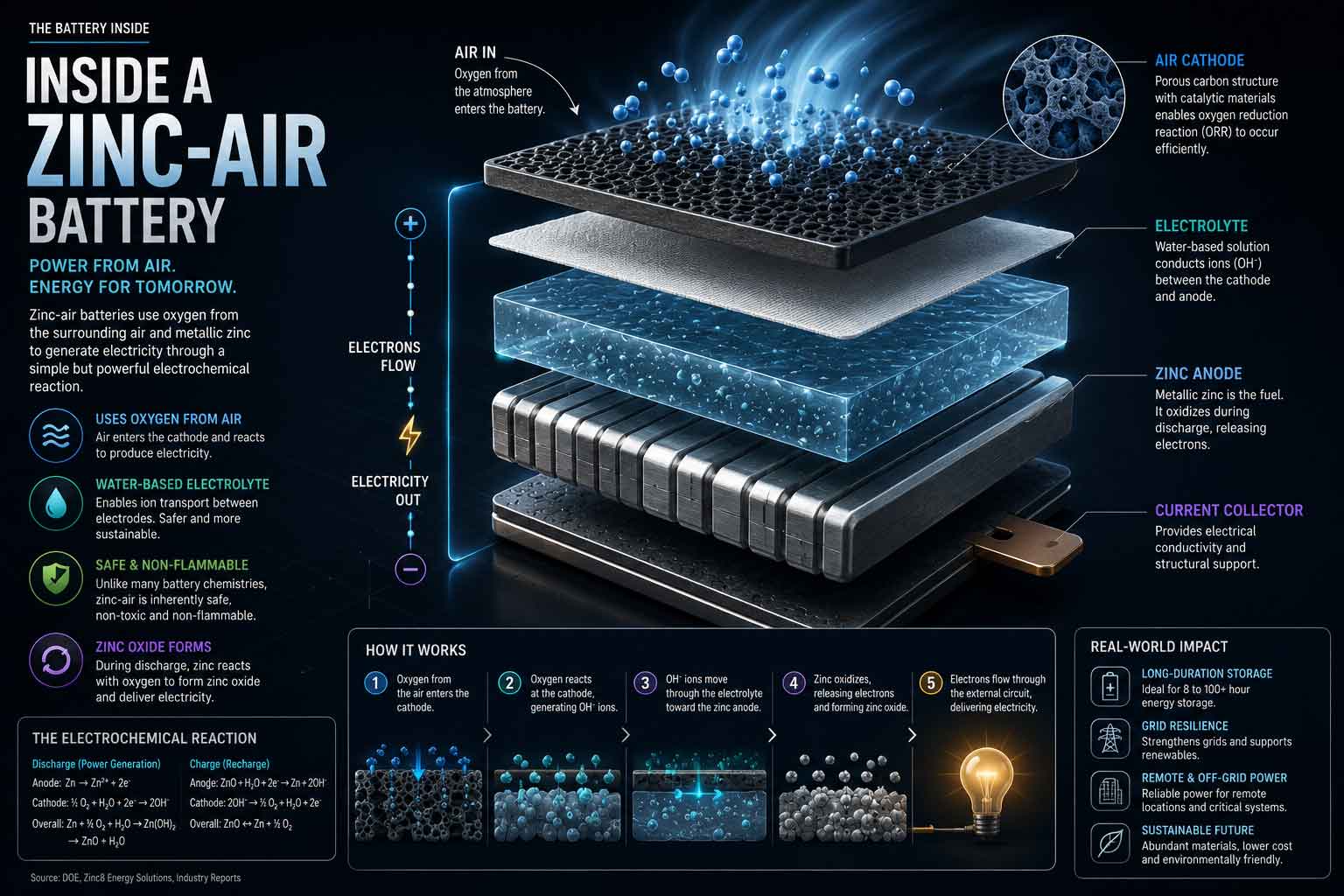 This technology is among the most challenging battery chemistries to commercialise, despite its elegant design. Engineers are still trying to improve the rechargeability, the cycle life, the prevention of zinc dendrite formation, the durability of the air electrode and the electrolyte degradation by carbon dioxide from the atmosphere. These are the reasons why, after decades of research, rechargeable zinc-air batteries are only just starting to make the leap from the laboratory to commercial deployment.
Ironically, these engineering hurdles are also what make the recent progress so significant. Companies and research institutions are no longer trying to prove that zinc-air batteries can work—they are focused on making them reliable, durable, and commercially viable for the next generation of Battery Energy Storage Systems (BESS).
Why Haven’t Zinc-Air Batteries Been Commercialized at Scale?
If zinc-air batteries promise high energy density, improved safety, abundant raw materials, and lower dependence on critical minerals, a logical question follows: why haven’t they become mainstream?
The answer lies not in the chemistry’s potential, but in the engineering challenges of making it reliable over thousands of charging and discharging cycles.
Unlike primary zinc-air batteries—which have powered hearing aids, medical devices, and specialized electronics for decades—rechargeable zinc-air batteries are significantly more complex. During repeated charging, tiny needle-like structures known as zinc dendrites can form on the anode. Over time, these dendrites reduce battery efficiency, shorten cycle life, and in severe cases, create internal short circuits. Preventing dendrite formation remains one of the industry’s biggest technical priorities.
Another challenge lies in the air cathode, arguably the most sophisticated component of the battery. As zinc-air batteries continuously consume the oxygen from the atmosphere, the air electrode should effectively catalyse both the oxygen reduction and oxygen evolution reactions in each charge-discharge cycle. Worldwide, researchers are still working on designing durable catalysts that can perform at high levels for thousands of cycles without significant degradation.
Rechargeability introduces another challenge known as hydrogen evolution. During charging, unwanted side reactions can generate hydrogen gas, reducing energy efficiency while gradually consuming active materials inside the battery. Together with dendrite formation and air electrode degradation, hydrogen evolution remains one of the key engineering barriers researchers must overcome before rechargeable zinc-air batteries can achieve widespread commercial adoption.
The battery’s greatest advantage—using air as a reactant—also introduces an unexpected complication. Atmospheric air contains not only oxygen but also carbon dioxide. As time goes on, carbon dioxide reacts with the alkaline electrolyte and forms carbonate deposits, which lower the ionic conductivity and slowly degrade the battery performance. One challenge that researchers continue to face is managing this process without sacrificing efficiency.
These challenges explain why most commercial activity today is focused on improving durability rather than proving the technology itself. Across the world, companies and research institutions are experimenting with advanced bifunctional catalysts, three-electrode battery architectures, 3D porous zinc anodes, and next-generation electrolyte formulations to extend cycle life and improve rechargeability. Recent laboratory demonstrations have already shown substantial improvements, giving researchers confidence that many of these long-standing limitations can be overcome.
The progress of the industry reflects this change. There’s no question that zinc-air batteries work. The goal is to make them economically manufacturable, commercially robust, and able to support large-scale Battery Energy Storage Systems (BESS) for decades, not years.
In many respects, zinc-air batteries are where lithium-ion was several decades ago. Scientifically validated, commercially promising, but still in the engineering refinement phase prior to mass adoption.That is precisely why governments, startups, universities, and industrial companies continue investing heavily in their development. The race is no longer about discovering the chemistry; it is about perfecting it.
Who Is Leading the Global Race for Zinc-Air Batteries?
While zinc-air batteries have been researched for decades, the race to commercialize them is only beginning. Unlike the lithium-ion industry—dominated by manufacturing giants such as CATL, BYD, and LG Energy Solution—the zinc-air ecosystem remains relatively open. A handful of startups, industrial companies, and research institutions are now competing to transform laboratory breakthroughs into commercially viable Long-Duration Energy Storage (LDES) solutions.
In North America, companies such as Zinc8 Energy Solutions and e-Zinc are developing zinc-air systems capable of delivering electricity for 8 to 24 hours or longer, targeting renewable energy integration, utility-scale Battery Energy Storage Systems (BESS), and microgrids.
Another early commercial player, NantEnergy, has already deployed rechargeable zinc-air batteries for telecom infrastructure, remote communities and backup power applications, demonstrating that the technology is gradually moving out of research laboratories. Meanwhile, Israel-based Phinergy is developing metal-air battery technologies for mobility and speciality energy applications as part of the broader evolution of air-breathing battery systems.
There are more companies competing out there.” Sweden-based Enerpoly is developing rechargeable zinc-ion batteries for stationary energy storage, and ZAF Energy Systems has been developing advanced zinc-based batteries for aerospace, defence and specialised industrial applications. While these companies are pursuing different zinc chemistries, their advances are part of a larger industry trend: a growing confidence that zinc-based energy storage will become a major pillar of future battery technologies.
Growing commercial interest is also demonstrated by government support. Zinc batteries have been identified by the U.S. Department of Energy (DOE) as one of the most promising technologies for low-cost long-duration energy storage, and DOE continues to fund research to improve battery longevity, manufacturing and cost competitiveness. The DOE doesn’t consider zinc batteries a replacement for lithium-ion but an addition to the storage tool kit that can complement existing technology and fill a niche for longer duration storage where conventional batteries become less economical.
For India, zinc-air batteries represent more than another battery chemistry—they represent an opportunity to participate in a global market that is still taking shape. While countries such as China established leadership in lithium-ion manufacturing over the past two decades, the emerging long-duration energy storage market has yet to produce a dominant player. With one of the world’s largest zinc industries, growing investments in clean energy, and a strong academic research base, India has an opportunity to build capabilities in a technology where global competition remains relatively open.
One of the country’s most significant initiatives is the collaboration between Hindustan Zinc and IIT Madras, which is developing a 1 kWh electrically rechargeable zinc-air battery prototype using indigenous technology. Beyond this partnership, IIT Madras has established itself as one of India’s leading research centres for zinc-air batteries, with work spanning electrically rechargeable systems, mechanically rechargeable battery architectures, advanced air electrodes, and battery designs aimed at both electric mobility and long-duration stationary storage. Rather than focusing solely on laboratory research, the institute is actively pursuing technologies that can transition toward commercial deployment.
That transition is already beginning. Sthyr Energy, an IIT Madras spinout founded by Gunjan Kapadia, Akhil Kongara, and Muhammed Hamdan, is developing mechanically rechargeable zinc-air batteries designed for long-duration and seasonal energy storage.Instead of repeatedly charging the battery electrically, the company’s approach stores energy in metallic zinc that can be regenerated separately and reused, allowing energy generation and fuel regeneration to take place independently. The approach, along with a water-based electrolyte and modular system architecture, intends to cut storage costs while boosting scalability for renewable energy and grid-scale uses. It also raised $1 million in seed funding and is among the most closely watched deep-tech startups in the energy storage space in India.
India’s zinc battery ecosystem extends beyond startups. Offgrid Energy Labs is commercializing zinc-bromide batteries for renewable energy, industrial facilities, and data centres, demonstrating the broader commercial interest in zinc-based energy storage. Meanwhile, research organizations including CSIR-Central Electrochemical Research Institute (CSIR-CECRI) and the Jawaharlal Nehru Centre for Advanced Scientific Research (JNCASR) continue advancing zinc electrochemistry, catalyst development, and next-generation battery materials. Together, these efforts suggest that India is not simply following global battery trends—it is steadily building the scientific, industrial, and entrepreneurial foundation required to compete in one of the fastest-evolving segments of the global energy storage industry.
Why the World Needs Zinc-Air Batteries More Than Ever
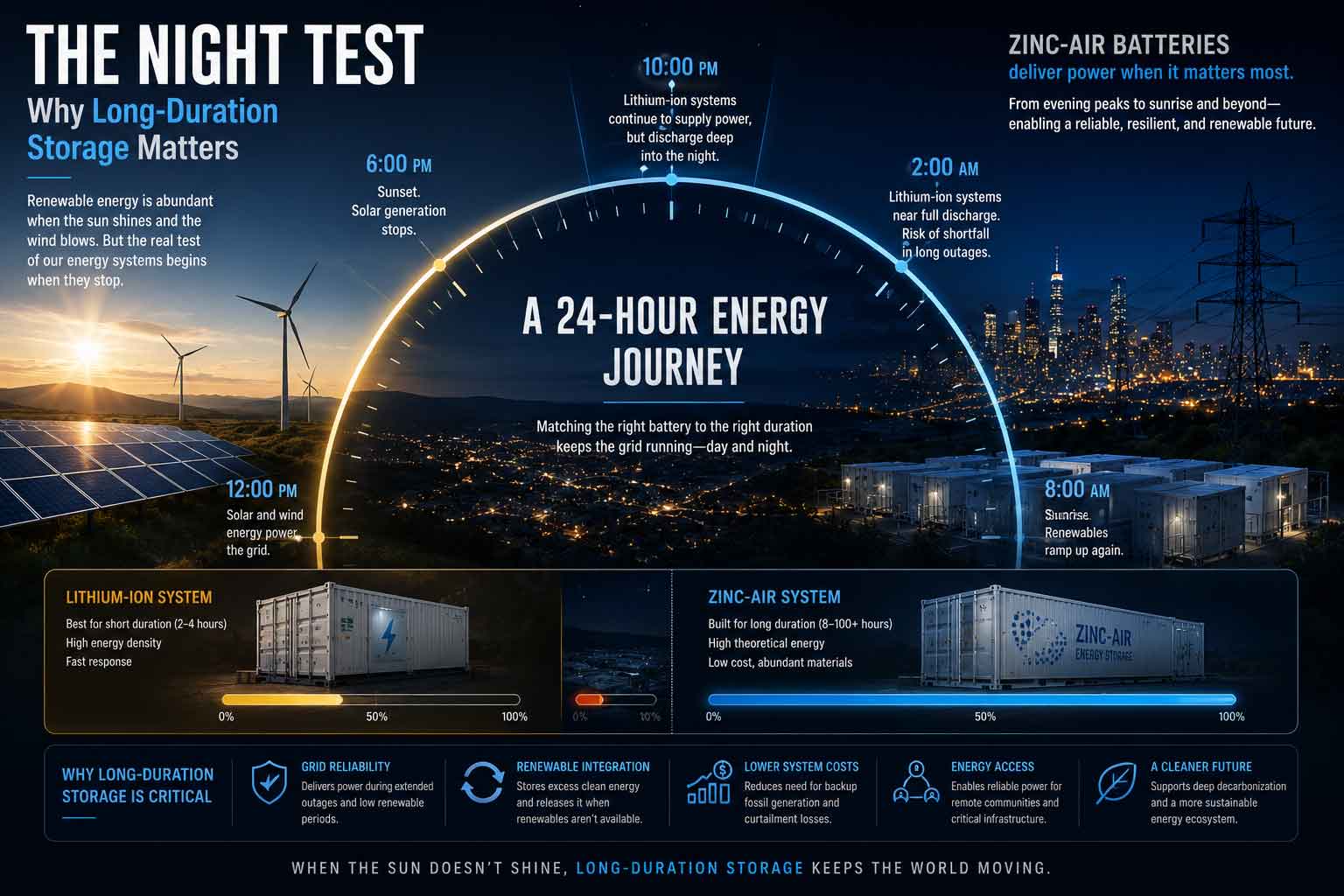
The future of zinc-air batteries is not being shaped by electric vehicles or consumer electronics. It is being shaped by a much bigger challenge—how to store renewable electricity when the sun isn’t shining and the wind isn’t blowing.
Over the past decade, countries around the world have rapidly expanded solar and wind power. While renewable energy is becoming cheaper and more abundant, its intermittent nature continues to place enormous pressure on electricity grids. Producing clean electricity is only half the challenge; storing it reliably for hours or even days has become the next frontier of the global energy transition.
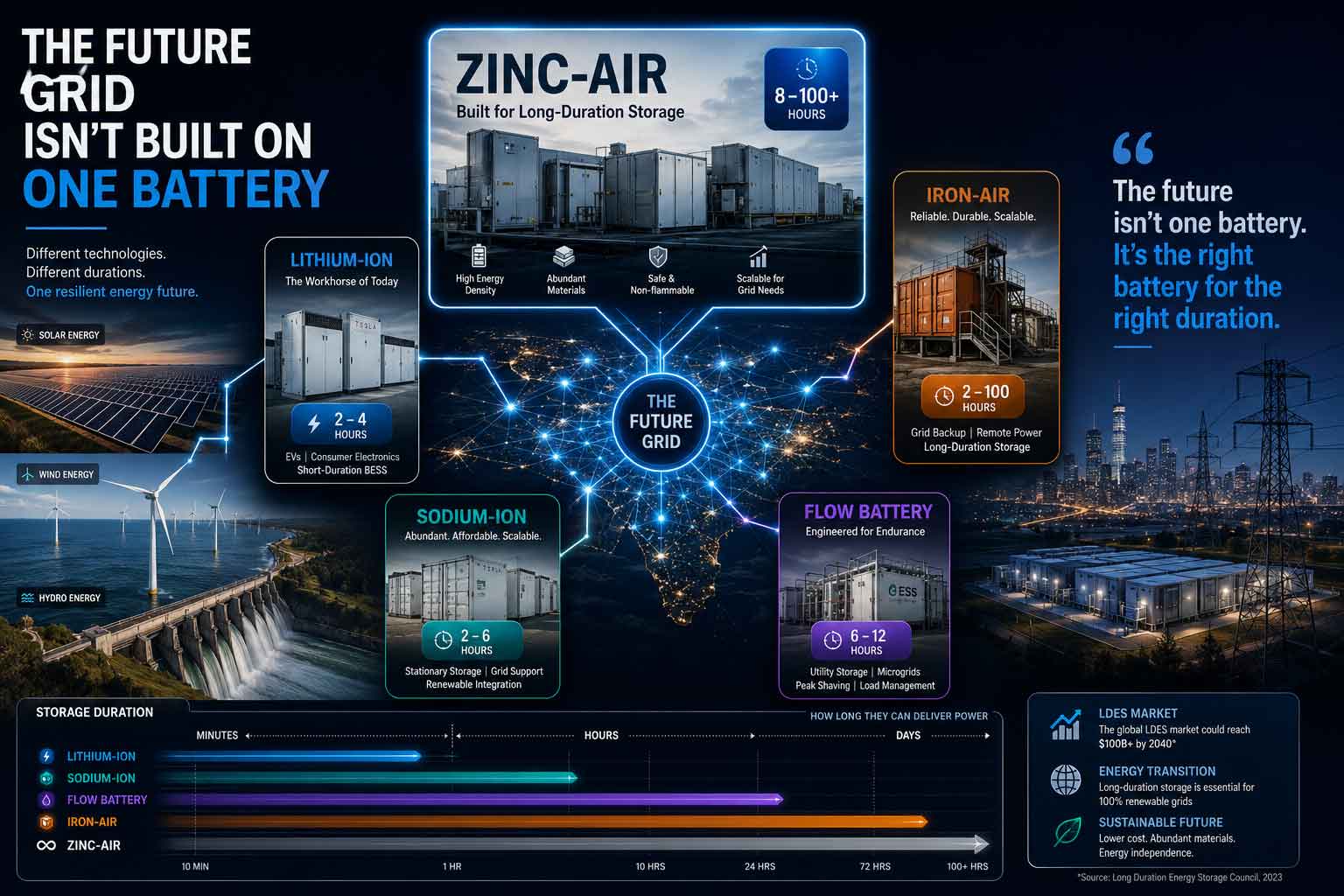
This is exactly why LDES (Long-Duration Energy Storage) is getting unprecedented attention. Traditional Battery Energy Storage Systems (BESS) discharge electricity for two to four hours, while long-duration storage is meant to provide power for eight, twenty-four or even multiple days. These systems are expected to be essential for integrating renewable energy, enhancing grid resilience, supporting industrial decarbonisation, and bolstering energy security.
Innovation across the energy storage sector is accelerating just as rapidly. According to the International Energy Agency (IEA), energy storage technologies accounted for around 40% of global energy patenting activity in 2023, highlighting the growing race to develop batteries capable of supporting increasingly renewable electricity systems. Zinc-air batteries are emerging as one of several technologies competing to meet this demand, alongside sodium-ion, iron-air, and flow batteries.
The scale of this opportunity is enormous. According to the Long Duration Energy Storage Council, global long-duration energy storage capacity could expand to between 1.5 and 2.5 terawatts (TW), equivalent to 85–140 terawatt-hours (TWh) of storage by 2040 if countries pursue net-zero energy systems. That represents one of the largest infrastructure opportunities in the global energy transition.
Recognizing this need, governments are accelerating investment in alternative battery technologies. The U.S. Department of Energy (DOE) says zinc batteries are one of the most promising pathways for affordable long-duration storage, supporting research to improve durability, reduce manufacturing costs and decrease the levelized cost of storage. Instead of searching for a single battery chemistry that can do it all, policymakers are increasingly thinking of an energy ecosystem in which different technologies are deployed for different uses according to their strengths.
This change means a fundamentally different way of looking at zinc-air batteries. Their best bet is not to replace lithium-ion batteries, but to augment them. The lithium-ion battery will probably continue to be the preferred choice for applications that require high power output, fast charging, and compact battery packs, like electric vehicles and portable electronics. Zinc-air batteries, however, are being developed for applications where fast charging is trumped by safety, low cost, abundant raw materials and long shelf life.
For countries such as India, this transition creates an opportunity that extends beyond technology. It opens the possibility of building a domestic battery ecosystem around a resource the country already produces at scale. Instead of competing head-on in the mature lithium-ion manufacturing race, India could establish itself in one of the fastest-evolving segments of the global energy storage industry.
In many ways, the future of zinc-air batteries will not be decided by whether they outperform lithium-ion. It will be decided by whether the world needs a battery designed for a different purpose. As electricity systems become increasingly renewable, that answer appears to be moving steadily toward yes.
| Technology | Best Storage Duration | Key Strength | Typical Applications |
| Lithium-ion | 2–4 hours | High power, mature ecosystem | EVs, short-duration BESS |
| Zinc-Air | 8–100+ hours | Low-cost LDES, safety | Renewable integration, grid storage |
| Iron-Air | 10–100+ hours | Ultra-long duration | Grid-scale storage |
| Sodium-Ion | 2–6 hours | Abundant materials | Stationary storage, mobility |
| Flow Batteries | 6–12+ hours | Long cycle life | Utility-scale storage |
The Road Ahead for Zinc-Air Batteries
Every major battery breakthrough has followed a familiar pattern. First comes scientific curiosity. Then years of experimentation. Then skepticism. Finally, commercialization reshapes the market.
Zinc-air batteries are somewhere between the third and fourth stages of that journey.
The science is no longer in question. Researchers have demonstrated the chemistry’s potential, startups are moving beyond laboratory prototypes, industrial companies are investing in commercialization, and governments are funding technologies that can deliver affordable Long-Duration Energy Storage (LDES). The remaining challenge is not proving that zinc-air batteries work—it’s proving that they can be manufactured economically, operate reliably for thousands of cycles, and compete in real-world energy markets.
That transition is already underway. Across North America, Europe, and Asia, companies are building pilot projects to validate long-duration storage for renewable energy, utilities, telecom infrastructure, and industrial applications. In India, collaborations between Hindustan Zinc, IIT Madras, and emerging startups such as Sthyr Energy signal that the country is beginning to participate in this next chapter of battery innovation rather than simply observing it.
The broader energy storage industry is also evolving. Rather than searching for a single technology capable of meeting every requirement, utilities and policymakers increasingly recognize that future electricity systems will rely on a portfolio of battery chemistries. Lithium-ion is expected to remain the preferred choice for electric vehicles and short-duration storage, while technologies such as zinc-air, flow batteries, sodium-ion, and iron-air are being developed to address applications where longer storage duration, lower material costs, or enhanced safety provide a competitive advantage.
For zinc-air batteries, that shift in thinking may prove to be the biggest breakthrough of all.
The question is no longer whether zinc-air batteries can replace lithium-ion. That was never the right question.
The real question is whether the global energy transition can succeed with only one dominant battery chemistry.
As renewable energy becomes the backbone of modern power systems, the answer is increasingly pointing toward no. Building resilient, affordable, and low-carbon electricity grids will require multiple technologies working together, each optimized for a different role.
In that future, zinc-air batteries may not become the most common batteries in the world—but they could become some of the most important.
 Electrify your feed! Click here to join our Whatsapp group and to get the latest updates, expert insights, and innovations driving India’s energy storage revolution.