


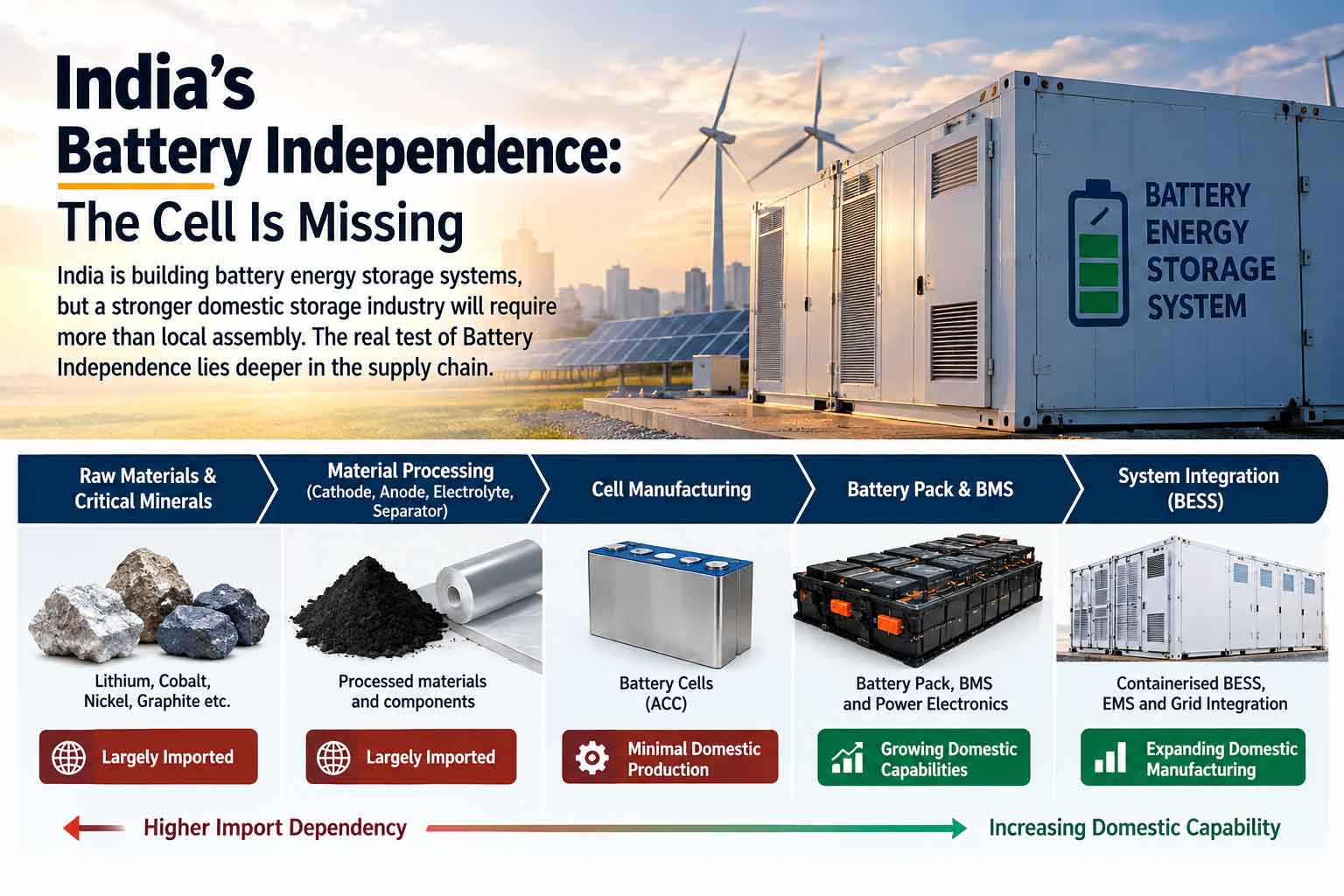
We often hear that India is scaling its Energy Storage Ecosystem, its manufacturing. It is finally making Made in India Batteries but the deeper questions still is, how much of the part is actually Indian. A stronger domestic storage industry will require more than local assembly. From competitive cell manufacturing and material processing to technology, quality and economics, the real test of Battery Independence lies deeper in the supply chain.
The Assembly Paradox: Made in India, but Where Is the Cell?
India’s battery energy storage system (BESS) industry is entering an important phase. Renewable energy capacity is expanding, electricity demand is changing, and the need to balance intermittent solar and wind generation is bringing energy storage into sharper focus. Battery storage is increasingly being considered for grid stability, peak-demand management, renewable energy integration and round-the-clock power supply.
Alongside this demand, an industrial ecosystem is taking shape. Indian companies are manufacturing battery packs, developing containerised storage systems, integrating power conversion equipment, building battery management systems and deploying energy management software. These capabilities create domestic engineering expertise, employment and opportunities for local suppliers.
Yet one essential component remains a major weakness: the battery cell.
A battery energy storage system may be assembled in India, tested by an Indian engineering team and integrated with locally developed controls, but its most important energy-storing component may still arrive from an overseas supplier. The finished product can therefore be Indian-made without the entire battery supply chain being Indian.
The distinction is central to the question of Battery Independence.
The Ministry of Heavy Industries acknowledged in March 2026 that domestic demand for advanced chemistry cells continued to be met largely through imports. Under the government’s Production Linked Incentive (PLI) scheme for Advanced Chemistry Cell (ACC) battery storage, 40 GWh of manufacturing capacity had been awarded to four beneficiaries against a target of 50 GWh. However, the ministry reported only 1 GWh of installed capacity among those beneficiaries at that time. The figure referred to installed capacity under the scheme, not the entire Indian battery industry or actual commercial production.
This gap illustrates the challenge India faces. The country is developing the ability to integrate and deploy storage systems, but building a competitive cell-manufacturing base requires a different level of capital investment, process expertise, production stability and supply-chain depth.
The missing link is not simply a factory. It is the ability to manufacture cells consistently, at commercial scale and at a cost that makes sense for Indian projects.
The Import Bill: Understanding the Scale of Dependence
India’s dependence on imported lithium-ion batteries is visible in trade data, although the figures require careful interpretation.
A September 2026 analysis drawing on research by Koan Advisory Group and the Institute of Chinese Studies, reported that China accounted for approximately 83.6% of India’s lithium-ion battery imports in financial year 2025–26, with imports from China valued at around US$3.9 billion.
The figure indicates India’s exposure to Chinese battery supply chains. It should not, however, be interpreted as the share of BESS cells alone. Broad lithium-ion battery trade classifications can include products used in electric vehicles, consumer electronics, industrial equipment and stationary storage. They do not necessarily distinguish individual cells from complete battery products or identify their final applications.
That limitation matters. A credible assessment of Battery Independence must distinguish the total lithium-ion import bill from imports specifically used in grid-scale BESS projects.
Even with this qualification, the strategic concern remains. If domestic storage deployment grows faster than Indian cell manufacturing, the country could expand its energy storage infrastructure while remaining heavily exposed to overseas supply for a critical component.
The risk is not limited to the price of a cell. It includes lead times, exchange-rate movements, freight costs, export controls, supplier concentration and the availability of technology and materials. Disruptions in any of these areas can affect project costs and delivery schedules.
At the same time, imports have helped Indian companies participate in a rapidly developing market without waiting for a complete domestic supply chain to emerge. Imported cells are not evidence of industrial failure by themselves; they are part of the supply structure that currently makes many projects possible.
The question is how India can reduce excessive dependence without undermining the commercial viability of its storage sector.
Why Chinese Cells Remain Competitive
Any serious discussion of Battery Independence must recognise why Chinese manufacturers have become central to the global battery industry.
China’s position has been built through sustained investment, manufacturing scale, supplier concentration, process expertise and an extensive ecosystem covering materials, equipment and finished cells. Its manufacturers have developed production capabilities and supply networks that are difficult for new entrants to reproduce quickly.
For Indian BESS integrators, choosing an imported cell is often a commercial decision. A supplier must offer not just a low price but also consistent specifications, reliable delivery, predictable performance, technical support and confidence that warranty commitments will be honoured.
Cell manufacturing is a demanding process. Chemistry formulation, electrode coating, drying, calendaring, cell assembly, formation, ageing and quality control must work together. Variations in materials or process conditions can affect performance, usable capacity, degradation and safety.
A new factory does not immediately achieve the yields, production stability and cost efficiency of an established facility. It must build experience, qualify products with customers, improve yields and operate at sufficient utilisation to spread fixed costs across a large output.
Wood Mackenzie’s 2026 research on India’s battery-storage supply chain estimated that Indian-made cells could initially cost 25–40% more than imported alternatives. It attributed the potential gap to factors including limited scale, higher financing costs and an underdeveloped supplier ecosystem. The estimate is a modelled industry assessment, not a universal premium applicable to every Indian factory or chemistry.
Actual comparisons depend on chemistry, cell format, specifications, order volume, financing, freight, duties, warranty and delivery terms. The landed price of an imported cell is also not directly comparable with a factory’s domestic manufacturing cost unless the same cost components are included.
For a BESS developer working within a competitive tariff, even a modest cost difference can matter. Higher cell costs can raise project capital expenditure and put pressure on the tariff required to make a project financially viable.
The objective of Battery Independence should therefore not be to dismiss imported technology or demand an immediate replacement of established suppliers. It should be to build domestic manufacturing that can compete on cost, performance, quality and reliability.
Chinese companies have helped establish the scale and technical standards against which new manufacturers are measured. India can learn from that experience, collaborate where useful and develop its own production capabilities without turning industrial policy into a contest of nationalities.
Announced Capacity Is Not the Same as Manufacturing Strength
India’s cell-manufacturing pipeline is expanding, but capacity announcements must be separated from actual production.
The PLI scheme for ACC battery storage was approved with an outlay of ₹18,100 crore to support 50 GWh of manufacturing capacity. Of this, 40 GWh was awarded to four beneficiaries: ACC Energy Storage, Ola Cell Technologies and two Reliance entities.
In a February 2026 update, the Ministry of Heavy Industries reported that, as of 31 December 2025, the beneficiaries had reported cumulative investment of ₹3,237 crore and employment of 1,118 people. It also stated that at least ten manufacturers outside the scheme had announced a combined capacity of approximately 178 GWh over the following five years. These were announced capacities, not a statement that the facilities were already operating. Source: Ministry of Heavy Industries.
Ola Cell Technologies had established a plant with 1 GWh of installed capacity and begun pilot production in March 2024, while working towards stabilising operations for full-scale commercial production. This distinction is important: installed capacity does not necessarily mean a plant is producing the same volume of saleable cells.
More recent company developments point to progress elsewhere in the ecosystem. Exide Energy Solutions has reported commissioning the first phase of its cell facility in Bengaluru, with a planned expansion across two phases. Amara Raja Advanced Cell Technologies commissioned a 60 MWh Customer Qualification Plant in Telangana in July 2026. The company said commercial-scale production was targeted to begin within the following year, with 2 GWh of manufacturing planned for 2027.
These are meaningful milestones, but they represent different stages of development. A qualification plant, a commissioned production line and a commercially operating gigafactory are not interchangeable categories.
A complete assessment of Battery Independence must examine whether a facility has installed its equipment, achieved stable production, qualified cells with customers and started supplying commercial orders. Actual output, production yields and utilisation are more revealing than a headline capacity figure alone.
The government’s own reporting has highlighted the difficulties facing the sector: technology availability, skilled manpower gaps, imported machinery and the non-availability of upstream components. These are structural issues that cannot be resolved through factory announcements alone.
The next stage of India’s battery journey will depend on converting investment plans into reliable production, improving manufacturing yields and building a supplier ecosystem capable of supporting long-term demand.
The Cell Is Only One Part of the Supply Chain
Even if India increases domestic cell production, it will not automatically achieve independence from imported battery inputs.
A lithium-ion cell depends on a chain of materials and processing capabilities. Depending on its chemistry, these can include cathode active materials, anode materials, separators, electrolytes, current collectors and specialised production equipment. The battery value chain also relies on access to minerals, chemical processing, quality testing and recycling.
China has a particularly strong position in several parts of this ecosystem. Research from the Institute for Energy Economics and Financial Analysis highlights China’s substantial role in processing lithium, cobalt and other battery materials, as well as its dominance in lithium iron phosphate (LFP) cathode active-material production.
This matters because importing a finished cell and importing the materials needed to manufacture a cell are different forms of dependence. A domestic cell factory that relies on imported cathodes, anodes, separators, electrolytes and production equipment can add valuable manufacturing capability in India, but it does not yet represent a fully domestic supply chain.
The distinction should not diminish the importance of local cell manufacturing. Building cells domestically can strengthen process knowledge, quality control, engineering capability and supplier development even before every input is sourced locally. Localisation is better understood as a progression than as a single achievement.
India’s mineral ambitions are also at an early stage. The Geological Survey of India announced a lithium resource of approximately 5.9 million tonnes in the Reasi district of Jammu and Kashmir in 2023. A geological resource estimate is not the same as an economically recoverable reserve, an operating mine or battery-grade lithium available to manufacturers. Exploration, feasibility studies, environmental clearances, infrastructure, extraction and refining all stand between geological potential and commercial supply.
The National Critical Mineral Mission, approved in January 2025, provides a framework for strengthening exploration, processing, overseas sourcing and recycling. It has a planned outlay of ₹16,300 crore, including ₹2,600 crore in budgetary support through 2030–31. India has also pursued overseas mineral partnerships through Khanij Bidesh India Limited.
These measures can help diversify supply, but access to mineral resources is only one part of the challenge. Battery-grade processing requires technical expertise, reliable feedstock, consistent product quality and customers willing to qualify and purchase the output.
The same applies to recycling. A domestic recycling industry can recover valuable materials from manufacturing scrap and end-of-life batteries, reducing the need for virgin imports over time. However, the amount of material available depends on batteries reaching end of life, collection systems, recycling yields and the commercial recovery of usable output. Announced recycling capacity or pledged throughput should not be confused with actual recovered material.
For Battery Independence, the strategic task is to connect mining, refining, materials, cells, packs and recycling into a supply chain that can grow together.
The Policy Push: Turning Incentives into Industrial Output
India has already recognised the importance of domestic battery manufacturing through financial incentives, critical-mineral initiatives and storage procurement policies. The next challenge is to make these measures reinforce one another.
The ACC PLI scheme is intended to encourage large-scale manufacturing and reduce reliance on imported cells. Its impact will depend on whether supported facilities reach commercial production, achieve competitive yields and develop a sufficiently local supplier base. Incentives can help offset the cost of establishing a new industry, but they cannot replace process expertise, technology access, reliable demand or disciplined execution.
Domestic value-addition requirements also need to be understood precisely. Under the ACC programme, beneficiaries must meet prescribed minimum domestic value-addition thresholds at specified stages of implementation. The scheme requires at least 25% domestic value addition initially, rising to 60% within five years, alongside prescribed investment obligations. These are scheme-specific conditions, not a blanket requirement that every BESS project use only Indian-made cells.
A further step came in July 2026, when the Ministry of Heavy Industries invited bids for 10 GWh of ACC manufacturing capacity dedicated to grid-scale stationary storage under the PLI framework. This is significant because stationary storage has different demand characteristics from electric vehicles. Grid projects often place particular emphasis on cost per usable kilowatt-hour, operating life, degradation, safety, warranty and long-term serviceability.
The initiative should be understood as a procurement process intended to establish additional capacity, not as 10 GWh of manufacturing already operating. The ministry published amendments to the bid schedule in October 2026, underscoring the importance of tracking tender milestones separately from awarded or commissioned capacity.
There is also a design question for policy. Local-content requirements can help create demand for Indian suppliers, but a requirement that is too rigid before domestic production is ready could raise project costs or delay deployment. Conversely, incentives that support assembly without building a clear path towards cell and material localisation may reinforce the very imbalance that Battery Independence is intended to address.
The strongest policy framework would link support to measurable progress: commissioned equipment, qualified products, actual output, yields, utilisation, domestic value addition and sustained customer orders. It should also offer a predictable pipeline of storage tenders so manufacturers can make long-term investment decisions with greater confidence.
Quality, Safety and Bankability Must Grow with Capacity
Cost is important, but it cannot be the only measure of a successful domestic battery industry.
A BESS is a long-life infrastructure asset. Its performance depends on the quality of its cells, thermal management, battery management system, power conversion equipment, energy management software, fire protection and system integration. A low upfront price can become expensive if the system degrades faster than expected, requires repeated maintenance or fails to deliver the contracted capacity.
Indian cell manufacturers must therefore demonstrate more than the ability to produce a cell. They must establish consistent quality across batches, predictable degradation characteristics, credible warranty support and dependable supply. Integrators and project owners need transparent testing and qualification processes that compare products on equivalent specifications rather than country of origin.
Standards and testing infrastructure will be central to this process. India’s adoption of industrial lithium-battery safety standards aligned with IEC 62619, alongside the Ministry of Power and Central Electricity Authority’s 2026 regulatory work on BESS safety and construction, provides a foundation for safer deployment. The applicable requirements depend on the product and project; no single certification should be assumed to cover every component of a complete BESS.
Bankability also depends on confidence in the supplier. Developers, lenders and insurers need assurance that manufacturers will remain able to provide technical support, replacement cells and warranty service over the life of a project. A new supplier can build this confidence through independent testing, field-performance data, transparent documentation and partnerships with established integrators.
These requirements should apply consistently to domestic and imported products. Battery Independence will be meaningful only if Indian-made cells meet the standards required by demanding commercial projects.
What India Should Measure Next
India does not need to manufacture every battery component domestically overnight to reduce strategic vulnerability. It needs a realistic sequence of milestones that connects industrial development with the economics of storage deployment.
- First, manufacturing data must become more transparent. Public reporting should distinguish announced, under-construction, commissioned, qualified and commercially operating capacity. Actual production, utilisation, yield and saleable output should be reported wherever commercially possible. These measures would provide a clearer picture of progress than headline gigawatt-hour announcements alone.
- Second, policy should support the transition from pilot production to stable commercial manufacturing. Access to technology, skilled personnel, process engineering, testing facilities and reliable upstream components must be treated as part of the industrial strategy. Factories need support not only to begin production but also to improve yields and reach competitive utilisation.
- Third, domestic materials production should develop alongside cell manufacturing. India should prioritise supply-chain gaps where there is a credible route to competitive scale, including battery-grade chemical processing, anode and cathode materials, electrolyte components and recycling. Partnerships with established global suppliers can accelerate learning while domestic capability grows.
- Fourth, demand visibility must improve. Storage procurement should be predictable enough to encourage investment, while project design and tariff evaluation should account for performance, degradation, safety and lifecycle cost rather than focusing exclusively on the lowest initial price. Long-term offtake arrangements could help cell manufacturers justify investment and give integrators greater confidence in future supply.
- Finally, India should pursue diversified sourcing alongside domestic production. Imports will remain part of the battery ecosystem for the foreseeable future. Building relationships with multiple suppliers and countries can reduce concentration risk, while domestic production provides a stronger base for resilience, technical learning and value creation.
Battery Independence Is a Capability, Not a Slogan
India’s energy storage ambition is larger than the question of where a battery is assembled. The country is building an industry capable of integrating storage systems, developing electronics and controls, and serving a growing market. That is a meaningful foundation. But the gap between downstream manufacturing and cell production shows why the next stage will be more difficult.
Battery Independence will require factories that operate reliably, cells that compete on cost and performance, materials that meet demanding specifications, and a supplier ecosystem capable of supporting long-term projects. It will require policy incentives that reward execution rather than announcements, and a market that values quality and lifecycle performance alongside upfront price.
China’s manufacturing strength has been built over years through scale, investment, technical expertise and supply-chain depth. India’s route will be different, shaped by its own demand, industrial capabilities and policy choices. The objective should not be to sever global connections or replace imports at any cost. It should be to ensure that Indian companies have more choices, more domestic capability and greater resilience when global supply conditions change.
The cell is missing not because India has made no progress, but because the country’s battery manufacturing ambitions have moved faster downstream than upstream. Closing that gap is the next industrial test.
Ultimately, Battery Independence will not be measured by how many batteries carry an Indian assembly label. It will be measured by how much of the value chain India can manufacture competitively, how reliably it can supply its own storage projects, and whether domestic capability can grow without compromising affordability, safety or performance.
 Electrify your feed! Click here to join our Whatsapp group and to get the latest updates, expert insights, and innovations driving India’s energy storage revolution.