Exide Industries Limited is accelerating its expansion into India’s fast-growing electric vehicle (EV) and energy storage markets, with plans to invest approximately ₹1,400 crore in financial year 2026-27 (FY27) to scale up lithium-ion cell manufacturing at its Bengaluru facility.
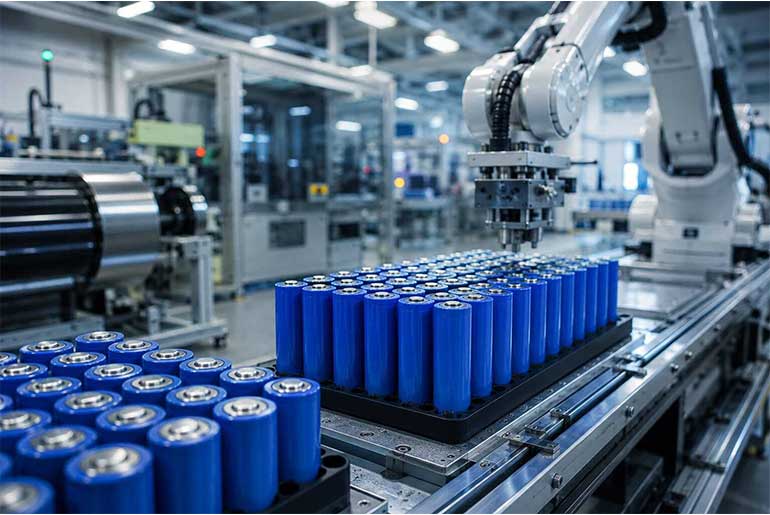
The investment will be made through the company’s wholly owned subsidiary, Exide Energy Solutions Limited (EESL), which is developing an integrated advanced cell manufacturing ecosystem to cater to the growing demand for batteries in electric mobility and energy storage applications.
According to the company, EESL has already started dispatching sample lithium-ion cells to customers as part of its product validation and commercialisation process. Exide expects the lithium-ion cell business to start generating commercial revenue from the third quarter of FY27, marking a significant milestone in its transition towards advanced battery technologies.
The planned investment is part of Exide’s broader strategy to establish a strong presence in India’s domestic lithium-ion battery manufacturing sector. With EV adoption increasing across passenger vehicles, two-wheelers, three-wheelers and commercial vehicles, demand for locally manufactured battery cells is expected to rise significantly in the coming years.
India currently remains dependent on imports for a substantial portion of its advanced battery cells and critical battery materials. By developing domestic manufacturing capabilities, Exide aims to reduce exposure to global supply chain disruptions and import dependency while supporting the government’s broader objective of building a self-reliant battery manufacturing ecosystem.
The company has outlined an ambitious expansion roadmap for its lithium-ion manufacturing operations. Following the initial capacity development, Exide plans to add another 6 GWh of capacity in the second phase. This expansion is expected to take the company’s total planned lithium-ion cell manufacturing capacity to 12 GWh.
The planned capacity addition could strengthen Exide’s position in the rapidly evolving Indian battery market, particularly as automakers and energy storage companies increasingly seek reliable domestic suppliers. The company’s integrated approach is also expected to support greater control over the battery value chain and improve its ability to serve customers across multiple applications.
Exide’s advanced battery ambitions come alongside continued growth in its established lead-acid battery business. The company remains focused on strengthening its position in the conventional battery segment, which continues to serve automotive, industrial, telecom and backup power applications. Exide is targeting annual revenues of more than ₹20,000 crore from its overall business in the coming years.
The company is also expected to benefit from India’s expanding clean mobility ecosystem and government initiatives aimed at encouraging domestic manufacturing of electric vehicle components and advanced batteries. Policies supporting EV adoption, battery manufacturing and energy storage are creating new opportunities for companies investing in local production capabilities.
With EV sales gaining momentum and the demand for stationary energy storage expected to increase alongside renewable energy deployment, Exide is positioning itself to participate in two of the country’s fastest-growing battery markets.
The planned ₹1,400 crore investment in FY27, coupled with the proposed 12 GWh lithium-ion cell manufacturing capacity, represents a major step in Exide’s transformation from a traditional lead-acid battery manufacturer into a diversified energy storage company. As EESL progresses towards commercial production and customer validation, the company is looking to establish itself as a key domestic player in India’s advanced battery and clean mobility ecosystem.
 Electrify your feed! Click here to join our Whatsapp group and to get the latest updates, expert insights, and innovations driving India’s energy storage revolution.