Execution at scale, not breakthrough chemistry, is defining the lithium-ion battery industry in 2026. From raw material volatility to China’s policy shift and from Europe’s ramp-up challenge to India’s industrial opportunity, the winners will be those who can turn materials into reliable, bankable cells at commercial scale.
In 2026, the battery race has been less about announcing capacity and more about proving that capacity can run consistently, safely, and profitably.
SCALE IS THE NEW STRESS TEST
The global lithium-ion battery industry has moved beyond the first wave of market creation. Demand continues to expand across the electric vehicles, stationary storage, and industrial applications, but the pressure point has shifted. The most important question is no longer whether batteries have a market. It is whether producers can stabilize yield, process windows, scrap rates, quality systems, and workforce routines once plants move from pilot learning to commercial production.
That makes 2026 a year of execution. Battery materials are not being judged only by energy density, cost curves, or laboratory performance; they are being judged by how reliably they can be converted into high-quality cells at gigawatt-hour scale. This is where many Western projects have struggled: the transition from a validated pilot line to a large, fully staffed facility is not linear. It demands process discipline, operator learning, supply chain resilience, and patient capital.
EUROPE NEEDS A MIDDLE STEP BETWEEN PILOTS AND MEGA PLANTS
Europe’s policy direction recognizes the weakness in the ramp-up phase, but the sequencing of support remains critical. The EU’s proposed Battery Booster Facility is right to focus on the fragile move from planned capacity to running capacity. However, a high entry threshold can reinforce a “bigger first” mindset at exactly the stage where producers need controlled learning.
Small-scale proof lines (1-2 GWh) are a critical bridge to full-scale production. They help cell manufacturers validate materials, train operators, reduce scrap, tighten process controls, and improve yields before expanding capacity. Without this step, public funding may support capacity announcements rather than building sustainable manufacturing capability.
POLICY SUPPORT IS STARTING TO TILT TOWARD THE NEXT CYCLE
China’s policy signals point to a more selective phase of support. From September 2026 onward, lithium-ion cells and packs are expected to again carry a consumption tax, beginning at 2% and rising to 4% in 2027, while qualifying sodium-ion, solid-state, and fuel-cell products remain exempt through 2028. The immediate cost impact may be manageable, but the direction is clear: mature lithium-ion is being treated differently from technologies that could shape the next investment cycle.
For global suppliers, this creates two parallel realities. Lithium-ion remains the dominant commercial platform, especially where cost, safety, and supply reliability matter. At the same time, policy incentives are encouraging companies to build options in sodium-ion, solid-state, and other emerging systems. The strategic challenge is to fund the future without weakening the factories that must deliver today.
VOLATILITY IS SEPARATING STRONG PLAYERS FROM WEAK ONES
Material markets are again testing the value chain. Lithium carbonate prices rebounded sharply in early 2026 even as battery pack prices kept falling, squeezing cathode and cell producers that must keep plants running. Overcapacity makes this harder. Manufacturers that pass through higher costs risk losing volume, while stronger players with balance sheet depth, raw material access, and customer leverage can hold the line longer.
This is accelerating integration. Refining, cathode production, cell manufacturing, and long-term customer contracts are becoming more tightly linked. Companies with secured feedstock, disciplined offtake agreements, and control over quality-critical process steps are better positioned than producers that depend on spot markets and fragmented supply. In practical terms, supply chain control is becoming as important as chemistry selection.
LFP LEADS BECAUSE THE ECOSYSTEM IS MATURE
Technology selection is becoming more pragmatic. LFP (lithium iron phosphate ) remains the workhorse chemistry because it combines cost competitiveness, safety, and a deep manufacturing base. Korean and Western players are adding LFP capability, particularly for energy storage, but they remain exposed to the cathode active material gap. Non-Chinese LFP capacity is still limited, while Chinese suppliers benefit from years of process learning, equipment familiarity, and scale.
The market is not simply choosing the best chemistry on paper. It is choosing the chemistry with the most mature, bankable, and cost-effective supply chain. For stationary storage, where safety, cycle life, and cost often outweigh maximum energy density, this gives LFP a strong runway.
SODIUM-ION IS PROGRESSING, BUT DEPENDENCY REMAINS
Sodium-ion is moving from promise to early industrialization, but it does not automatically solve supply chain dependency. China has built the most complete sodium-ion ecosystem, spanning cathode materials, hard-carbon anodes, electrolyte, separator, equipment, and standards. LG Energy Solution’s decision to place sodium-ion pilot work in Nanjing highlights the gap in infrastructure and knowhow outside China.
This technology has credible use cases in stationary storage, lower-cost mobility, and cold-weather applications. Yet, commercial deployment outside China will depend on more than chemistry. It will require localized material qualifications, equipment learning, customer validation, and standards alignment. In that sense, sodium-ion faces the same industrial lesson as lithium-ion: scale is earned through manufacturing maturity.
NEXT-GEN CHEMISTRIES MUST CLEAR THE FACTORY GATE
Lithium manganese-rich (LMR) and solid-state batteries remain important to watch, but their timelines reinforce the same message. LMR offers attractive economics on paper, including the potential for higher energy density than LFP at comparable cost. However, it must still prove cycle life, voltage stability, and manufacturability in mass production. Solid-state batteries remain even further from routine volume deployment.
For customers, investors, and policymakers, the practical test is not whether a chemistry works in a favorable demonstration. It is whether the material system can be manufactured repeatedly, safely, and economically under commercial operating conditions. In 2026, manufacturability outweighs theoretical performance gains.
INDIA AND EUROPE SHOW WHY ECOSYSTEMS MATTER
The global industry remains uneven because few regions have end-to-end ecosystems. India illustrates the gap between announced capacity and actual cell output. Europe highlights the difference between policy ambition and production competitiveness. Energy storage is creating a second demand outlet for capacity originally planned for EVs, but it rewards the same capabilities: low-cost materials, proven LFP chains, quality control, and disciplined ramp-up.
For India, the opportunity lies not only in cell announcements but also in building the surrounding system, covering materials qualification, pack integration, testing, recycling, safety standards, equipment capability, and skilled manufacturing teams. Without these layers, capacity targets face risks of remaining disconnected from bankable output.
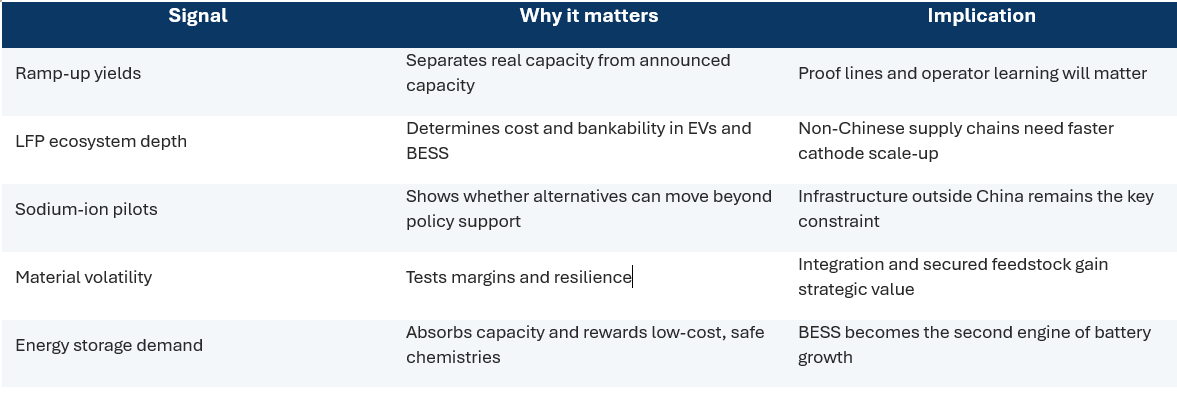
WHAT TO WATCH IN 2026
 BOTTOM LINE
The lithium-ion battery materials landscape in 2026 is defined by execution, integration, and supply chain control. Leadership will belong to companies and regions that can convert materials into reliable cells at scale, not simply those announcing the next chemistry breakthrough. The industry’s next advantage will be built less in the laboratory headline and more on the factory floor.
 Electrify your feed! Click here to join our Whatsapp group and to get the latest updates, expert insights, and innovations driving India’s energy storage revolution.