As Battery Energy Storage Systems (BESS) become an integral part of India’s clean energy transition, the spotlight is increasingly shifting beyond battery cells to the engineering, manufacturing and system integration that make these solutions reliable, scalable and deployment-ready. Belding India Ltd., an Original Equipment Manufacturer (OEM) for the BESS industry, is contributing to this transformation by developing indigenous engineering solutions, manufacturing key system components in-house and strengthening India’s domestic energy storage manufacturing ecosystem. With a growing focus on localisation and integrated BESS solutions, the company aims to support the country’s rapidly expanding renewable energy ambitions.
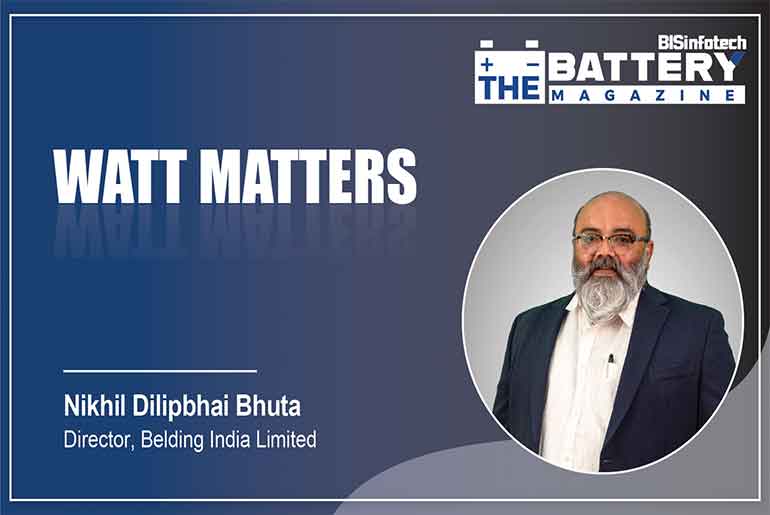
At India Energy Storage Week (IESW) 2026, Shweta Kumari, Sub-Editor, The Battery Magazine, spoke with Nikhil Dilipbhai Bhuta, Director at Belding India Limited, about the company’s approach to indigenous manufacturing, containerised Battery Energy Storage Systems, engineering-led innovation, safety standards and the future of energy storage in India. He also shares why building a robust domestic manufacturing base and adopting responsible industry practices will be crucial to shaping the next phase of India’s BESS journey.
Belding India Ltd. has emerged as an important player in India’s Battery Energy Storage System ecosystem.
Could you introduce the company and tell us what you are showcasing at India Energy Storage Week?
Belding India Ltd. is primarily an Original Equipment Manufacturer (OEM) for the Battery Energy Storage System (BESS) industry. Our focus is not only on delivering complete BESS solutions but also on manufacturing many of the critical components that integrate an entire energy storage system.
Most of these components are manufactured in-house at our manufacturing facility spread across nearly nine acres in Khed City, Pune.
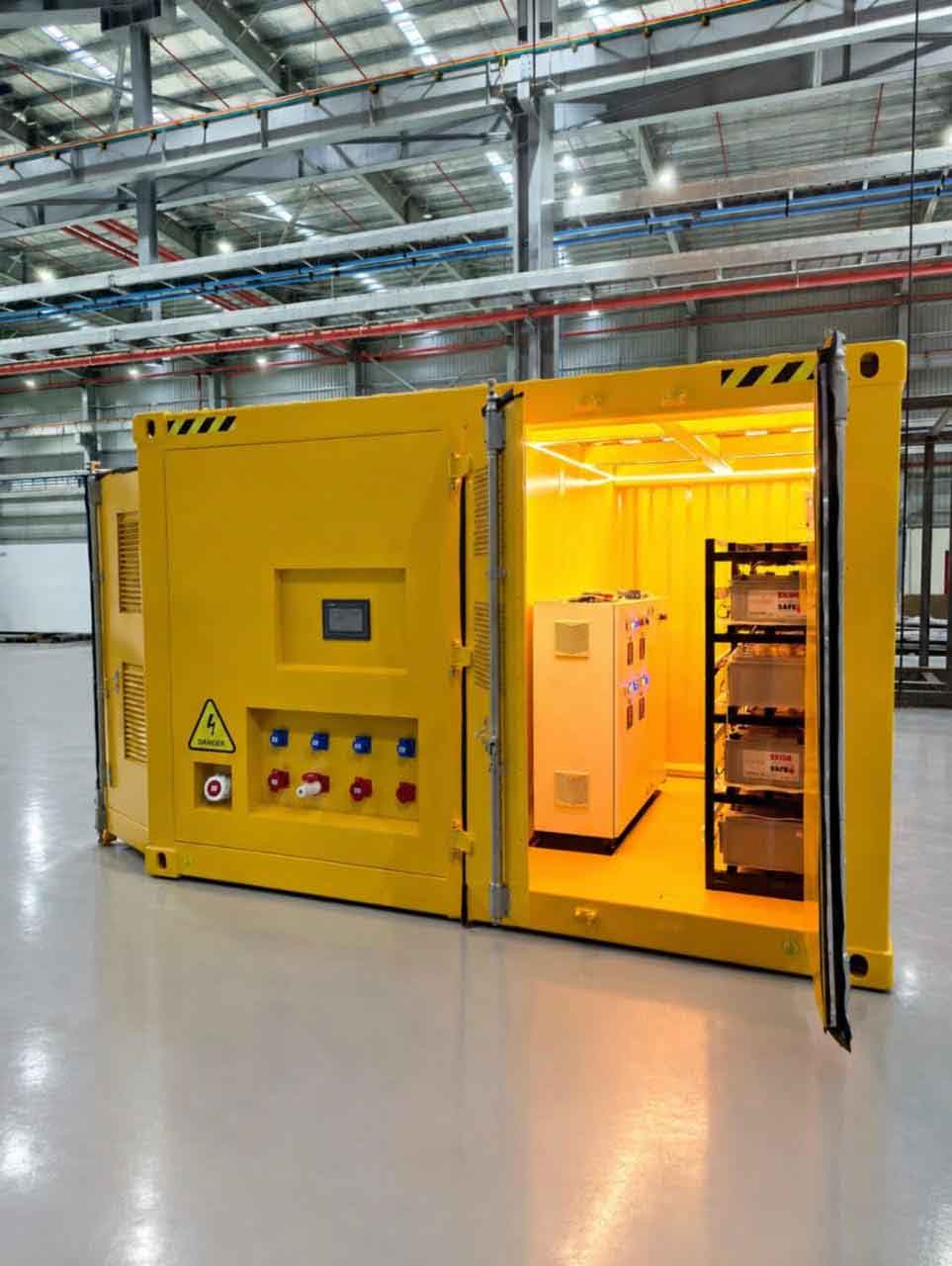
At India Energy Storage Week, we are showcasing two key products. The first is our containerised Battery Energy Storage System, designed for large-scale energy storage applications. The second is a hybrid power backup solution that combines a diesel generator (DG set) with a Battery Energy Storage System within a single containerised unit.
Our objective is to position Belding India as a trusted OEM partner for the growing energy storage industry.
How do Belding India’s Battery Energy Storage Systems differentiate themselves in terms of design, manufacturing and reliability?
The biggest differentiator is our emphasis on indigenous manufacturing.
Except for the battery cells—which are currently imported because suitable domestic alternatives are still evolving—the majority of the components used in our Battery Energy Storage Systems are designed, manufactured or assembled in India.
Our manufacturing facility in Pune not only assembles complete BESS solutions but also fabricates many of the structural and engineering components in-house. This integrated approach gives us greater control over quality, reliability and system integration.
What would you describe as Belding India’s biggest strength in the Battery Energy Storage System market?
Our biggest strength lies in our role as an OEM.
Rather than competing with EPC companies, project developers, independent power producers (IPPs) or DISCOMs, we support them by providing engineered Battery Energy Storage System solutions and components.
Being an OEM with strong indigenous manufacturing capabilities allows us to serve a wide range of customers while contributing to the localisation of India’s energy storage ecosystem.
Beyond battery chemistry, how important is engineering in building a safe and reliable Battery Energy Storage System?
Engineering plays a critical role in ensuring that a Battery Energy Storage System operates safely and reliably.
While batteries are the core component, they need to be integrated with effective cooling systems, fire protection measures, structural engineering and enclosure design. All these elements must work together seamlessly.
Developing modular, containerised Battery Energy Storage Systems requires careful engineering and fabrication, and that is where robust system integration becomes extremely important.
As Battery Energy Storage Systems scale rapidly across India, what policy and regulatory measures would you like to see for improving safety?
India certainly needs a more comprehensive regulatory framework for Battery Energy Storage Systems.
We require well-defined standard operating procedures (SOPs), certification requirements, safety standards and disposal guidelines specifically developed for BESS applications.
Many international markets, including Europe, the United States and parts of Southeast Asia, have already established dedicated safety frameworks. India should study these global best practices and develop comprehensive national guidelines that cover installation, operation, certification and long-term safety.
Such regulations will help the industry grow in a structured and responsible manner.
India is rapidly increasing its renewable energy capacity. Where do you see Battery Energy Storage Systems fitting into this journey over the next five years?
India has made tremendous progress in expanding renewable energy generation.
However, renewable energy generation and electricity demand often do not occur simultaneously. That mismatch creates a gap between generation and consumption.
Battery Energy Storage Systems bridge this gap by storing surplus renewable energy and supplying it when demand increases. This enables much more efficient utilisation of renewable energy while reducing unnecessary power generation.
As renewable energy capacity continues to grow, Battery Energy Storage Systems will become an essential part of India’s energy infrastructure.
How is Belding India preparing for this growing demand, and what innovations can we expect from the company in the coming years?
We have already established a 3 GWh Battery Energy Storage System manufacturing facility in Pune, with plans to expand the capacity to more than 10 GWh.
Alongside expanding manufacturing, we are continuously evaluating emerging battery chemistries that could complement future energy storage requirements.
We are also exploring collaborations with international technology partners while supporting research initiatives with academic institutions to promote safer and more advanced battery technologies in India.
Lithium-ion batteries currently dominate the energy storage market. Are you exploring alternative battery chemistries?
Lithium-ion remains the most mature and commercially proven battery technology available today. At present, there is no alternative that matches its scale and level of global acceptance.
That said, we are closely monitoring developments in next-generation battery technologies. We are supporting research initiatives with IITs and collaborating with researchers from Europe to evaluate battery chemistries that could offer enhanced safety and long-term performance.
Rather than committing to any one technology today, our approach is to evaluate emerging chemistries carefully and adopt the most suitable solutions as they become commercially viable.
Finally, what message would you like to share with companies entering India’s Battery Energy Storage System industry?
Battery Energy Storage Systems represent one of the most promising opportunities in India’s clean energy transition, but they also demand responsibility.
As the industry grows, companies should focus on building reliable, high-quality solutions rather than looking for short-term gains. Strong engineering, adherence to safety standards and responsible manufacturing practices will be essential for creating a sustainable industry.
If we approach this sector with both innovation and responsibility, we can build not only successful businesses but also a stronger and more energy-secure India.
India is steadily moving towards greater localisation in Battery Energy Storage Systems. Which components of the BESS value chain do you believe India can realistically manufacture domestically over the next five years, and where do you still see dependence on imports?
Battery cells are the biggest piece of BESS — both in terms of cost and technology — and right now, India is largely dependent on imports for these. That said, things are moving. Government, Private initiatives for advanced chemistry cells are starting to build domestic capacity, and we expect meaningful, though partial, progress on this front over the next five years.
India is already well positioned on the other components of the system. Components like PCS, EMS, Thermal Management Systems, Fire Detection & Suppression Systems & Protection are all areas where Indian manufacturers have shown solid design and manufacturing capability. We expect most of these to reach high levels of localisation within this timeframe — and in several cases, export-grade quality.
At Belding India, we are contributing to this localisation journey by building capabilities as an indigenous BESS OEM. We have capabilities across battery pack and module assembly, thermal management, fire safety, power systems, EMS and the overall system integration. The launch of our indigenously developed Hybrid BESS is a reflection of this approach — combining locally developed technology and manufacturing capabilities to address power requirements while reducing dependence on conventional power sources.
On the cell side, progress will have happen, but it’ll be gradual, constrained by limited domestic raw material availability and a still-developing skilled manpower base for advanced cell manufacturing. At the same time, India is also exploring alternatives to lithium-ion, such as sodium-ion and other emerging technologies — which could ease our long-term dependence on imported critical minerals and provide more sustainable path to localisation.
So overall, the next five years should see India become largely self-sufficient on the other components of the system, while battery cells remain the main import dependency — one that’s gradually shrinking rather than disappearing.
As Battery Energy Storage Systems become larger and more complex, how do you see the role of Indian OEMs evolving in building globally competitive, export-ready energy storage solutions?
India is emerging into important phase in the growth of infrastructure and renewable energy storage. The Government of India has projected of around 236 GWh of BESS by 2031-32, and this domestic demand itself is significant enough to keep Indian OEMs occupied for some time. India has already demonstrated strong manufacturing capabilities in manufacturing several components of the BESS ecosystem, though cells continue to be imported. Given the scale of domestic requirement, we expect to progressively expand from meeting the growing needs of the Indian market to serving international customers.
That said, India has long been recognised as a preferred hub for skilled manpower, cost-competitive manufacturing, and ability to provide consistent quality — much like its established position as a Global Capability Centre (GCC). These same strengths — engineering talent, cost efficiency, and manufacturing discipline — are directly transferable to the BESS space.
As a result, as Indian OEMs focus on scaling up to meet domestic demand, global markets will naturally look to India as a competitive sourcing destination. Over time, this will effectively pull Indian OEMs into the export market. With India emerging as an important manufacturing and export hub for energy storage solutions, we see Indian OEMs evolving from domestic solution providers into global technology and delivery partners for BESS.
 Electrify your feed! Click here to join our Whatsapp group and to get the latest updates, expert insights, and innovations driving India’s energy storage revolution.